Artwork
The Fortress of Königstein
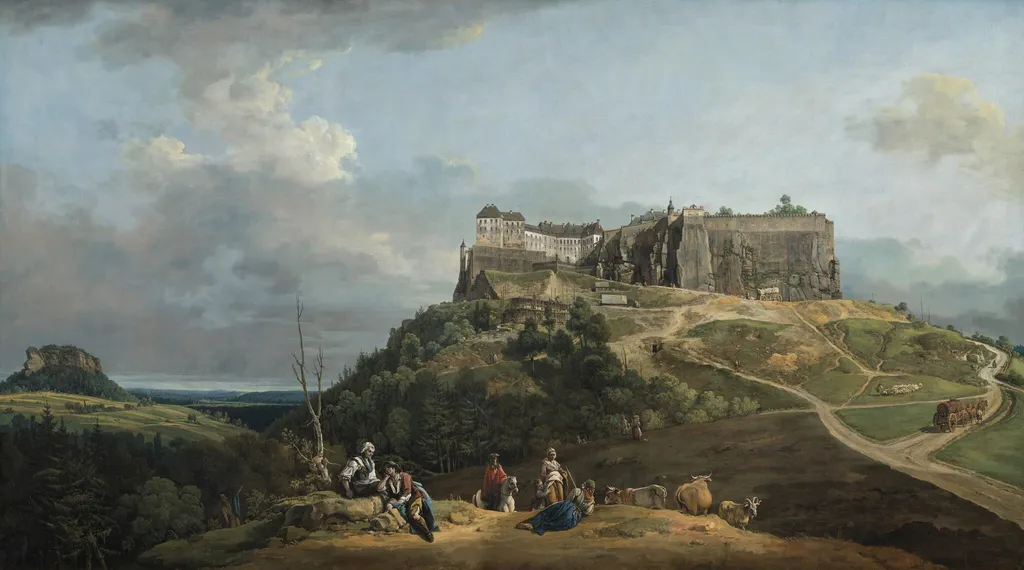
The Fortress of Königstein is an oil painting by the Rococo painting artist Bernardo Bellotto. It dates from 1757 and is held in the collection of the National Gallery of Art.
About this work
Subject & Meaning
The work was commissioned by Augustus III of Saxony as part of a series intended to celebrate Saxon sovereignty and the architectural grandeur of his domains.
The painting depicts the Saxon fortress of Königstein, a monumental stronghold set against a broad landscape of the Elbe valley. Bellotto emphasizes the fortress’s sheer walls and bastions, conveying its strategic importance and impregnability. The orderly arrangement of buildings within the walls and the disciplined lines of the fortifications underscore military power and administrative control.
The work was commissioned by Augustus III of Saxony as part of a series intended to celebrate Saxon sovereignty and the architectural grandeur of his domains. Although interrupted by the Seven Years' War, the series reflects the political ambitions of the Elector-King, using topographical representation to assert territorial authority.
Technique & Style
Executed in 1756, this work is an oil painting on canvas. The composition measures 133 cm in height and 235.7 cm in width. It belongs to a series of five views of the fortress commissioned by Augustus III, all produced on canvases sharing identical dimensions and format.
These paintings were intended for the Stallgebäude, a wing of the royal palace dedicated to the king's collection, though the series was never delivered due to the outbreak of the Seven Years' War. The specific handling of the oil medium and the large-scale support reflect Bellotto's approach to creating monumental topographical records for royal patrons during this period.
History & Provenance
The Fortress of Königstein was commissioned by Augustus III, king of Poland and elector of Saxony, between 1756 and 1758 as part of a series of five views of the fortress intended for the royal palace's painting collection [1]. The work remained in the possession of the sitter's descendants, passing to Henry Temple, 2nd Viscount Palmerston, and later to his son Henry John Temple, 3rd Viscount Palmerston [1]. It was sold at Foster's in London on 5 November 1850 [2], then to Henry, 4th Earl Beauchamp, and subsequently inherited by Else, Countess Beauchamp [3].
The painting was sold at Sotheby's in London on 11 December 1991 [4] and acquired by the National Gallery of Art in Washington, D.C., in 1993 [5].
The Fortress of Königstein is held by the National Gallery of Art in Washington, D.C. It entered the collection through a sale at Sotheby's London on 11 December 1991 (no. 18) and was sold to the National Gallery of Art on 3 June 1993. The work is catalogued in the National Gallery of Art's collection with accession data reflecting its transfer from the estate of Else, countess Beauchamp, following the 1991 auction. The painting measures 133 cm in height and 235.7 cm in width, consistent with the dimensions recorded in the National Gallery of Art's catalog.
The work was previously owned by Henry Temple, 3rd Viscount Palmerston, and later by Henry, 4th Earl Beauchamp, before passing to his granddaughter Else, countess Beauchamp, whose inheritance facilitated its 1991 auction and subsequent acquisition by the National Gallery of Art.
Overview
Bernardo Bellotto’s oil on canvas, dated 1757, depicts the Fortress of Königstein perched atop a rugged hill. The composition balances the imposing stone structure with a surrounding landscape of fields, trees, and a winding road, while figures and livestock occupy the foreground, creating a lively yet orderly scene.
Artist & collection

Artist
Bernardo Bellotto, was an Italian urban landscape painter or vedutista, and printmaker in etching famous for his vedute of European cities – Dresden, Vienna, Turin, and Warsaw.

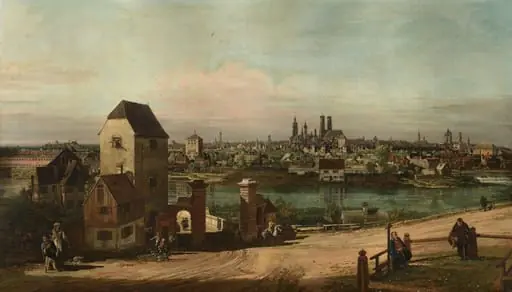
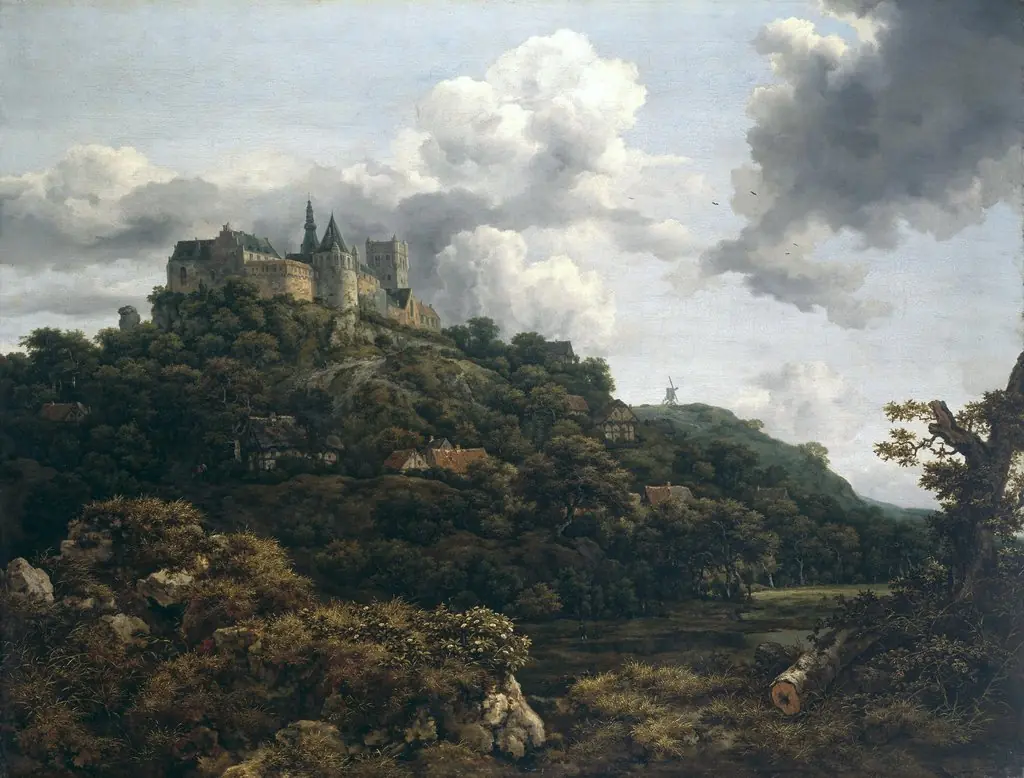
- Castle Bentheim
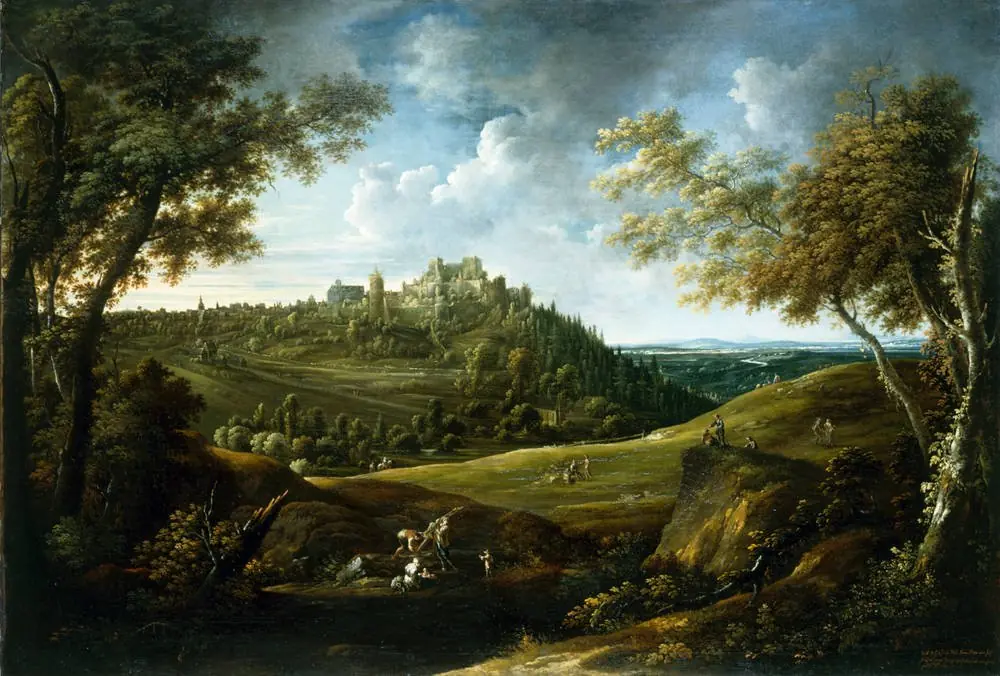 Burg und Stadt Frauenstein
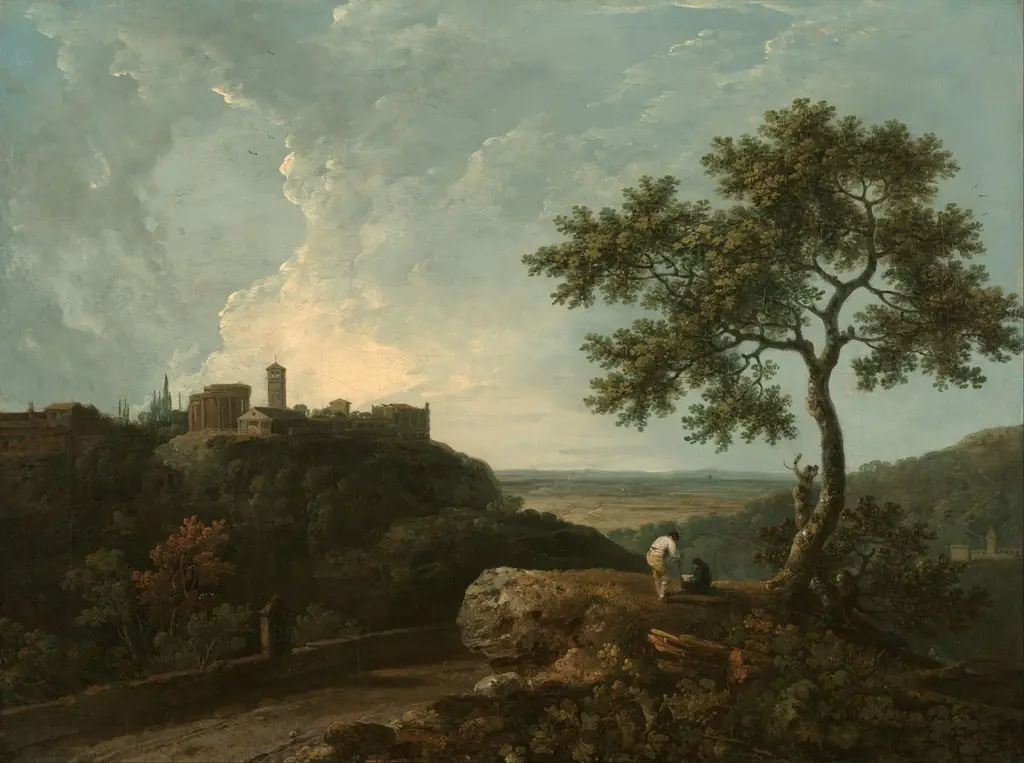 Tivoli: The Temple of the Sybil and the Campagna
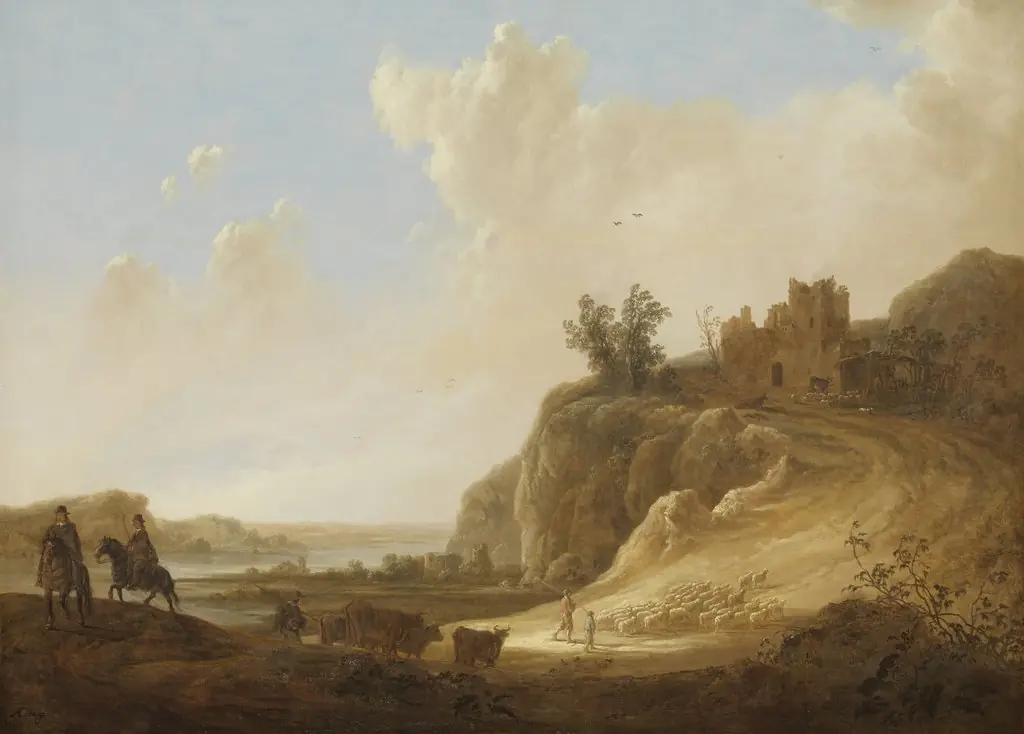 Mountainous landscape with the ruins of a castle
 Landscape with Shepherds
 Italian Landscape
 Italian Landscape
 Die Ruine Theben an der March
 Italina landscape with round tower
 Roman Landscape
 Italina landscape with round tower
 River landscape