Artwork
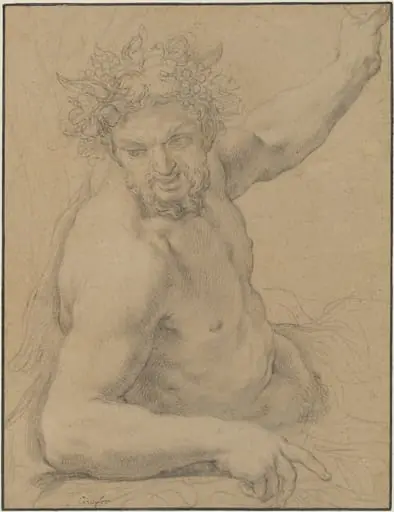
The River God Tiber (Study for a fresco, Miracle of the Snow, or the Foundation of Santa Maria Maggiore, Rome in the Canigiani chapel of S. Felicita, Florence)
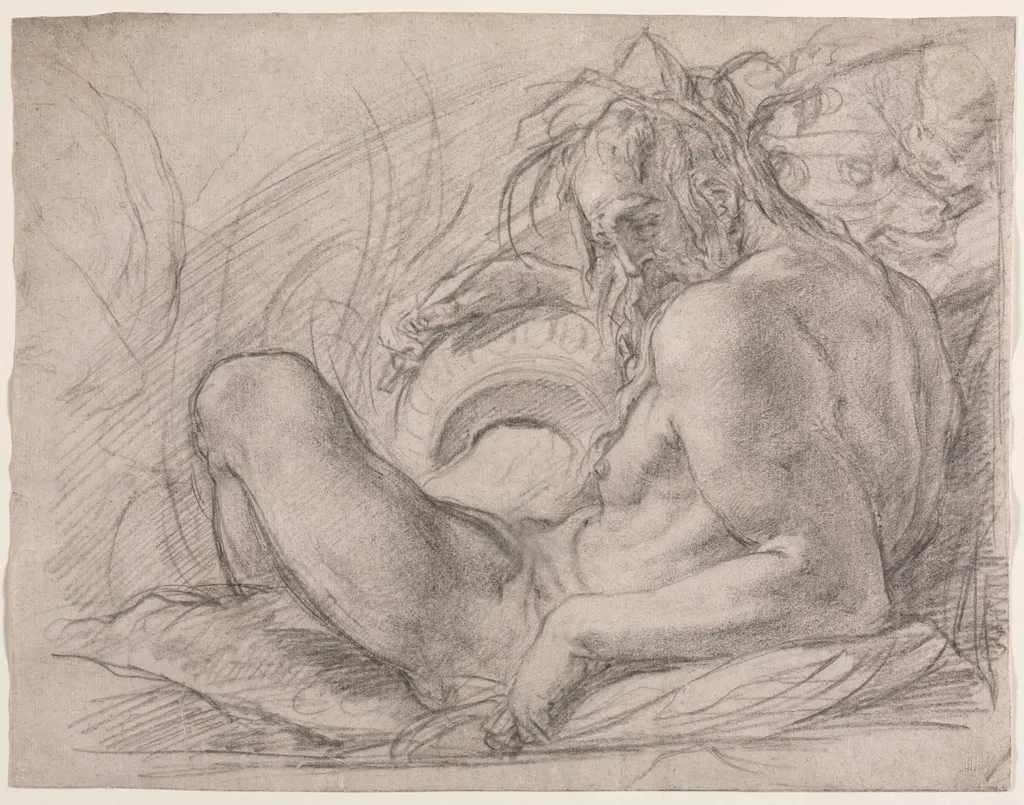
The River God Tiber (Study for a fresco, Miracle of the Snow, or the Foundation of Santa Maria Maggiore, Rome in the Canigiani chapel of S. Felicita, Florence) is a drawing by the Renaissance artist Bernardino Poccetti. It dates from 1589 and is held in the collection of the Cleveland Museum of Art.
- Accession no.
- 2012.36
- Credit line
- Severance and Greta Millikin Purchase Fund
About this work
Overview
This drawing is a preparatory study by Bernardino Poccetti for a fresco intended for the Canigiani chapel of Santa Felicita in Florence. The composition centers on a reclining, bearded figure representing the Tiber River, a common allegorical device in Renaissance art. The sketch anticipates a larger mural that would depict the legendary foundation of Santa Maria Maggiore in Rome.
Subject & Meaning
The river god embodies the Tiber, a symbol of Rome’s mythic origins. Behind the figure, Poccetti lightly rendered the head of the she-wolf that, according to legend, rescued the infant twins Romulus and Remus. A faint facial profile, possibly that of one of the twins, is also suggested, linking the river’s presence to the city’s founding narrative.
Technique & Style
Executed in fine pen and wash, the study displays Poccetti’s characteristic fluid line work and subtle tonal modulation. The reclining god is rendered with a gentle expression and relaxed posture, while the ancillary elements, the wolf’s head and infant’s face, are sketched with minimal strokes, indicating their provisional role in the final composition.
History & Provenance
Created as a preparatory drawing for the fresco known as the Miracle of the Snow or the Foundation of Santa Maria Maggiore, the work remained in the artist’s workshop before being associated with the Canigiani chapel. Its survival provides insight into the planning stages of large-scale religious commissions in late‑16th‑century Florence.
Context
During the Italian Renaissance, river deities were frequently personified as bearded men leaning on or holding large urns that symbolized the flow of water. Poccetti’s study follows this iconographic tradition while integrating local Roman myth, reflecting the period’s interest in merging classical motifs with Christian narratives.
Own this work as a print
Artist & collection
Artist
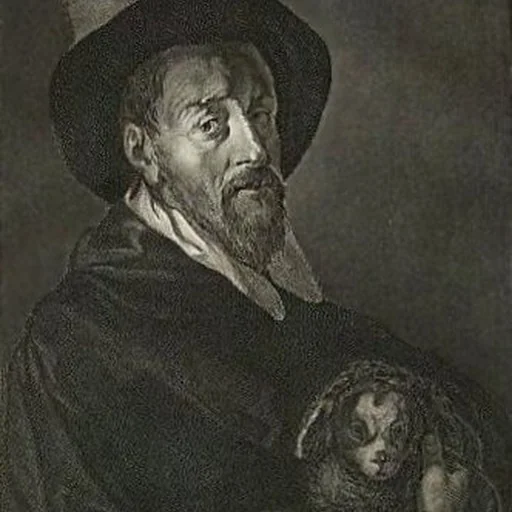
Bernardino Poccetti (26 August 1548 – 10 October 1612), also known as Barbatelli, was an Italian Mannerist painter and printmaker of etchings.