Artwork
Embryo
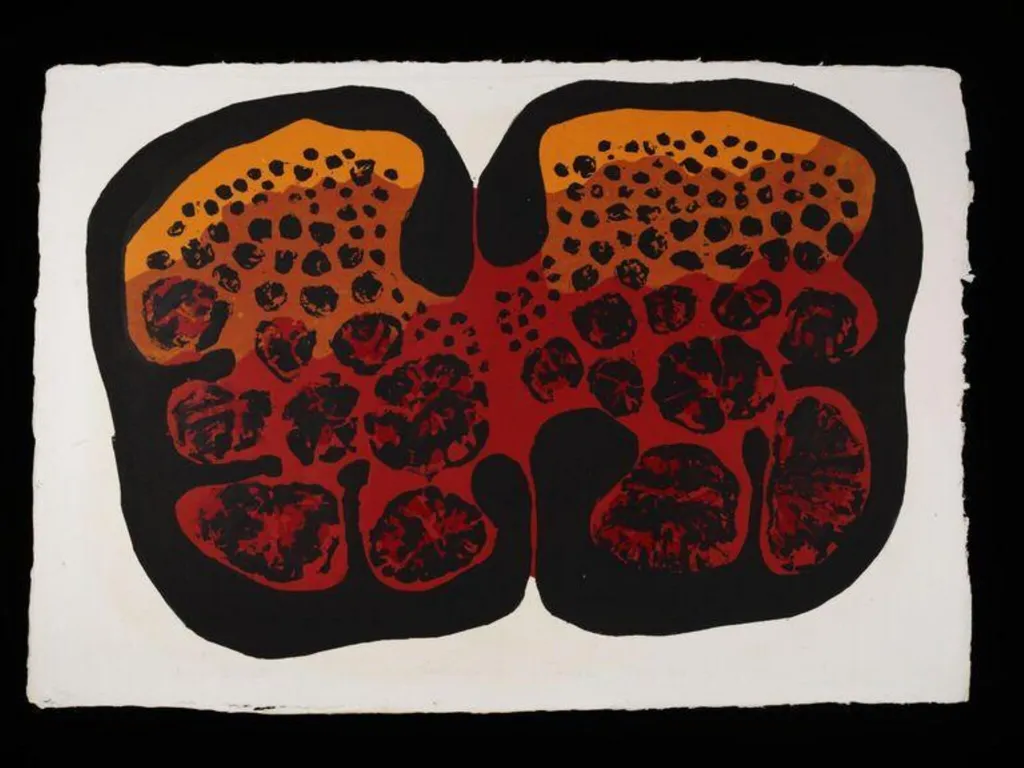
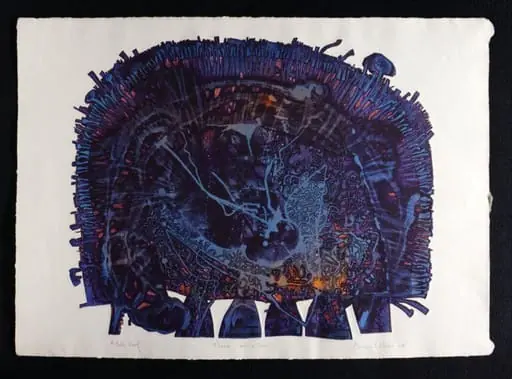
Embryo is a print by Tadeusz Franz Beutlich. It dates from 1967 and is held in the collection of the Victoria and Albert Museum.
About this work
The print "Embryo" was created by Tadeusz Franz Beutlich in 1967. It is an abstract work.
Tadeusz Franz Beutlich was a versatile artist who worked with textiles and prints. He experimented with unique printing methods, using inked surfaces like lino and plywood to make impressions.
You can learn more about his printing techniques and other works at the Victoria and Albert Museum.
Overview
'Embryo,' created in 1967, is one of several works published by Editions Alecto and reflects his interest in organic abstraction.
Tadeusz Franz Beutlich, born in Poland in 1922 and based in the UK from 1947, was a multidisciplinary artist known for textile weaving and experimental printmaking. His relief prints, primarily produced in the 1960s and 1970s, were made without a printing press, relying instead on hand-pressed inked surfaces such as lino and plywood. 'Embryo,' created in 1967, is one of several works published by Editions Alecto and reflects his interest in organic abstraction.
Subject & Meaning
'Embryo' presents an abstract, biomorphic form that suggests early biological development without literal representation. The composition evokes natural growth patterns through layered textures and irregular contours, inviting interpretation as a metaphor for emergence or potential. Beutlich avoided figurative language, instead using tactile surfaces to convey vitality and organic transformation through form and materiality.
Technique & Style
Beutlich developed a distinctive printmaking method by inking unconventional surfaces, plywood and linoleum, and pressing them by hand onto paper. This approach yielded rich, uneven textures and unpredictable edges, distinguishing his work from mechanized prints. The resulting images are characterized by dense, tactile surfaces and a muted palette, emphasizing material presence over graphic clarity, aligning with his broader interest in the physicality of art-making.
History & Provenance
Created in 1967, 'Embryo' was published by Editions Alecto, a London-based press known for collaborating with avant-garde artists. The print is among a small group of Beutlich’s works acquired by the publisher, alongside 'Purple Coral' and 'Meteors.' The Beutlich family later donated these prints to a public collection, ensuring their preservation and accessibility within institutional contexts such as the Victoria and Albert Museum.
Context
Beutlich’s printmaking emerged alongside broader postwar British interest in material experimentation and non-traditional techniques. His work resonated with contemporaries exploring abstraction and process, while his textile background informed his tactile approach to print. Unlike many of his peers, he avoided commercial printing methods, favoring direct, hands-on methods that emphasized the artist’s physical engagement with the medium.
Legacy
Beutlich’s prints remain notable for their departure from conventional printmaking norms and their integration of textile sensibilities into paper-based work. Though less widely known than his tapestries, his relief prints contributed to a broader redefinition of print as a medium for material exploration. His techniques continue to inform artists interested in hand-made processes and the expressive potential of surface texture.
Artist & collection
Artist
Tadeusz Franz Beutlich spent years folding and pleating paper in his studio, convinced the simplest creases could trap more light than any brushstroke.