Artwork
Evening
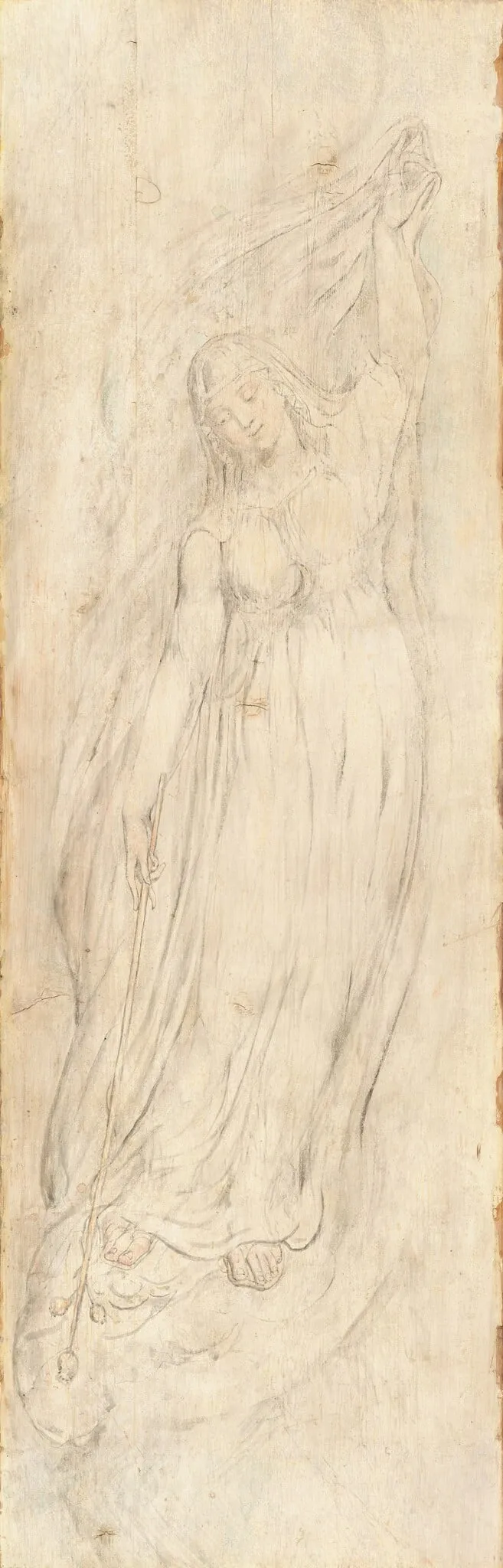
Evening is a watercolor painting by the British Romanticist artist William Blake. It dates from 1822 and is held in the collection of the National Gallery of Art.
About this work
Subject & Meaning
The scene's soft, fading light and solitary tree carry symbolic weight, representing the transition from day to night and the contemplative mood of evening.
The painting depicts a tranquil twilight landscape inspired by Christopher Wordsworth's poem "The Task," reflecting Blake's fascination with the spiritual resonance of nature. The scene's soft, fading light and solitary tree carry symbolic weight, representing the transition from day to night and the contemplative mood of evening.
Blake's watercolor and chalk technique on wood creates a delicate, atmospheric effect that emphasizes the ethereal quality of the depicted hour. This work is part of the National Gallery of Art's collection in Washington, D.C., having entered the museum through a gift in 1990 after its acquisition by Thomas Agnew & Sons, Ltd. in 1979.
Technique & Style
Evening is a watercolor and chalk painting executed on a wood support, measuring 91.8 cm in height and 29.7 cm in width. The work belongs to the landscape genre and features the slender vertical format characteristic of several of Blake's 1820 illustrations. The combination of watercolor with chalk on an unconventional wooden panel rather than paper or canvas reflects Blake's experimental approach to materials during this period.
The delicate medium and narrow proportions suggest an intimate, refined handling suited to the pastoral subject matter drawn from William Cowper's poem The Task.
History & Provenance
William Blake created the watercolor and chalk work Evening in 1820. The piece was commissioned by John Johnson, who is identified in records as a Reverend. Following Johnson's ownership, the work descended through his family line, passing to Canon Cowper Johnson, then to Bertram R. Vaughan Johnson.
Upon Bertram's death, it went to his widow and subsequently to the Reverend B. Talbot Vaughan Johnson before entering the Vaughan Johnson Trust.
The trust consigned the painting to a Sotheby's auction in London on July 18, 1979, where it was sold as lot 59. The dealers Thomas Agnew & Sons, Ltd. purchased the work on behalf of Mr. and Mrs. Gordon Hanes of Winston-Salem, North Carolina. The Hanes couple retained the piece until 1990, at which point they donated it to the National Gallery of Art in Washington, D.C.
The painting is held by the National Gallery of Art in Washington, D.C.
It was acquired by the National Gallery of Art in 1990, following its purchase by Thomas Agnew & Sons, Ltd., London, for Mr. and Mrs. Gordon Hanes of Winston-Salem, North Carolina, at Sotheby's on 18 July 1979 (sale no. 59).
The work was previously owned by Rev. John Johnson, Canon Cowper Johnson, Bertram R. Vaughan Johnson, his widow, Rev. B. Talbot Vaughan Johnson, and the Vaughan Johnson Trust.
Context
Blake's Evening (1820), a watercolor and chalk work on wood depicting a twilight landscape, entered the National Gallery of Art collection through a 1990 gift from the estate of Gordon Hanes, having previously been acquired by Thomas Agnew & Sons from the 1979 Sotheby's sale of the Vaughan Johnson Trust collection, which originated with Rev. John Johnson who commissioned the piece as part of The Task series.
Scholarly attention to Evening has centered on its role within Blake's thematic exploration of temporal liminality and its visual response to the philosophical underpinnings of The Task, a work by his patron John Johnson, establishing its significance within the artist's mature landscape vision and early 19th-century British Romanticism.
Legacy
The Evening watercolor, painted by William Blake in 1820, has been recognized as an influential example of his later landscape work, particularly for its atmospheric treatment of light and its thematic resonance with literary sources such as The Task. Its presence in the National Gallery of Art's collection since 1990 has enabled extensive scholarly study and public display, contributing to a sustained appreciation of Blake's innovative use of watercolor techniques in the nineteenth century.
The work's provenance, documented through several generations of the Johnson family and its acquisition by Thomas Agnew & Sons before purchase by the Hanes family, illustrates a clear chain of ownership that underscores its cultural significance. Its inclusion in major exhibitions and subsequent research has reinforced its reputation as a key piece for understanding Blake's artistic legacy beyond his more widely known illuminated prints.
Overview
Created around 1822, Evening is a small-scale work executed in watercolor and chalk on a wooden panel. The composition presents a solitary female figure in a loose white garment, her head bowed as she lifts a translucent piece of cloth above her. The background is rendered in deep, muted tones, giving the scene a subdued, contemplative atmosphere typical of early nineteenth‑century Romantic art.
Artist & collection
Artist
William Blake (28 November 1757 – 12 August 1827) was an English poet, painter and printmaker.

- Study for Penelope
 Mercury and a goddess
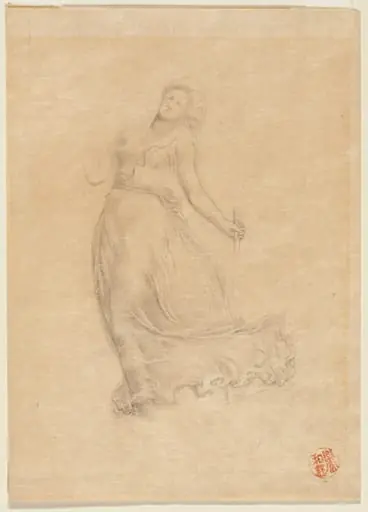 Allegorical Female Figure
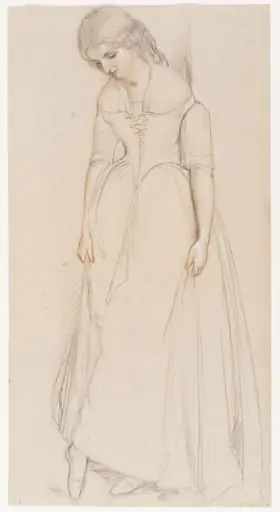 Study for the woman near the doorway in <i>Cinderella About to Try on the Glass Slipper</i> (1842)
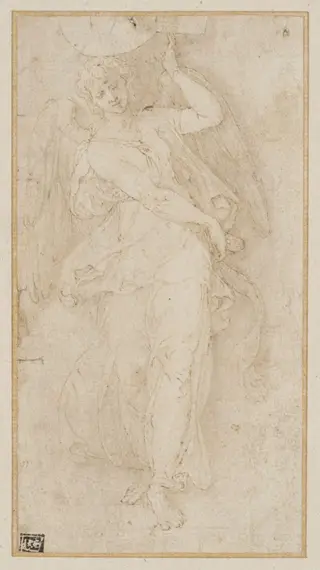 A nymph dancing
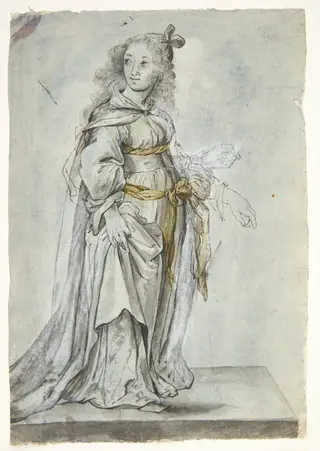 Allegorisk kvindefigur. Hele højre side af kroppens kontur er rettet. Kvindens venstre arm udsat for pentiménto
![Woman in Toga [verso], by Hubert Robert](https://artifactworldgallery.com/img/hubert-robert--woman-in-toga-verso--1c4b04982206f60e-w320.webp) Woman in Toga [verso]
Woman in Toga [verso] Saint John the Baptist
 The Cap
![Statue of Abundance [recto], by Hubert Robert](https://artifactworldgallery.com/img/hubert-robert--statue-of-abundance-recto--af10c767ab97b269-w320.webp) Statue of Abundance [recto]
Statue of Abundance [recto] The Cap
 Bishop Saint in Supplication