Artwork
Job and His Daughters
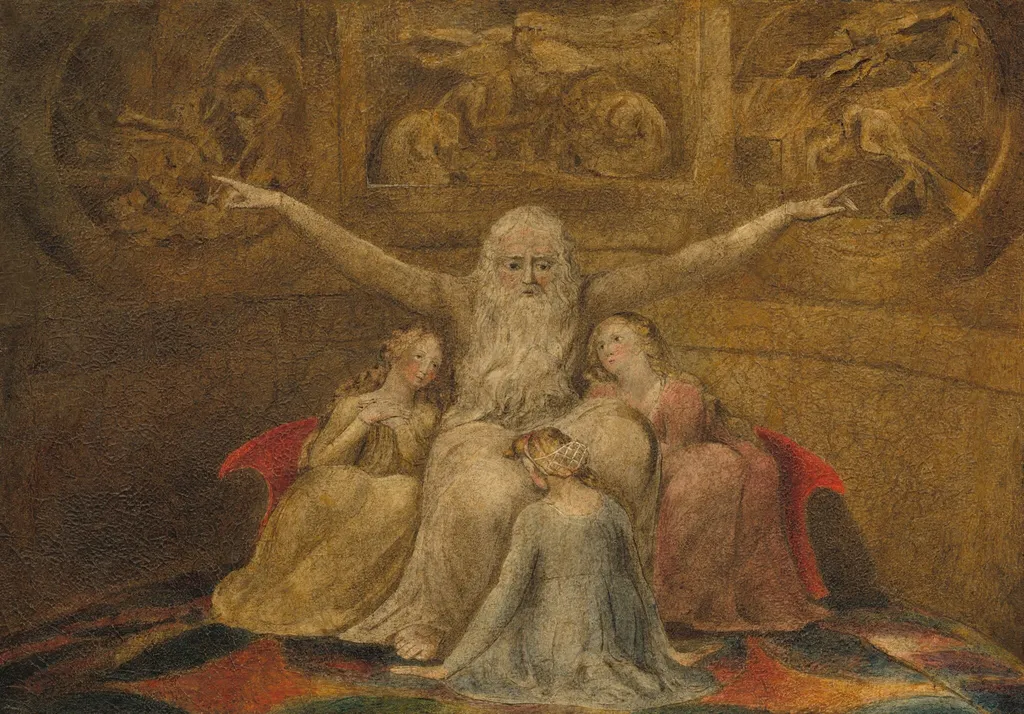
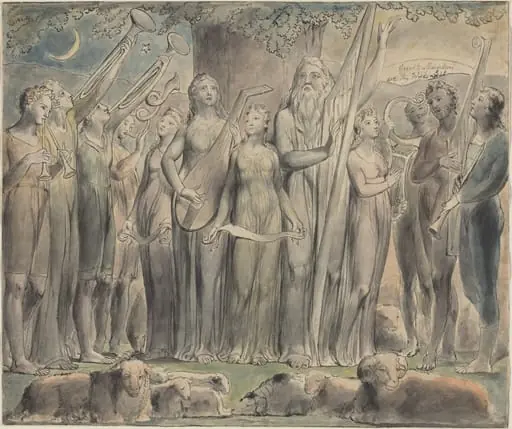
Job and His Daughters is a tempera painting by the Romanticist artist William Blake. It dates from 1800 and is held in the collection of the National Gallery of Art.
About this work
Subject & Meaning
Blake renders Job seated centrally in a state of quiet contemplation or blessing, while his daughters attend him with gestures of care and reverence.
The painting depicts the biblical patriarch Job surrounded by his three daughters, Jemimah, Keziah, and Keren-happuch, after his restoration to health and prosperity, a scene drawn from the Book of Job (42:13-15). Blake renders Job seated centrally in a state of quiet contemplation or blessing, while his daughters attend him with gestures of care and reverence. Their youthful presence and tender postures underscore themes of familial renewal and divine recompense following suffering.
The luminous treatment of the figures and the restrained palette emphasize a mood of serene restoration aligned with Blake's interpretation of Job's reconciliation with God's providence.
Technique & Style
Job and His Daughters is executed in pen and tempera on canvas, a combination that reflects William Blake's experimental approach to his biblical subjects. Its relatively small scale, measuring 27.3 by 38.4 centimetres, is characteristic of the intimate format Blake favoured for the tempera paintings he produced for his patron Thomas Butts. The tempera medium, applied with pen work, allowed Blake to achieve the precise linear definition and luminous colour typical of his graphic sensibility, distinguishing the work from conventional oil painting of the period and aligning it with the broader series of biblical illustrations he created for Butts.
History & Provenance
William Blake painted Job and His Daughters in 1800 as part of a series of biblical illustrations commissioned by Thomas Butts. The work passed to Thomas Butts, Jr. in 1853, then to J.C. Strange, to William Bell Scott by 1876, and subsequently to Bernard Quaritch, Charles Eliot Norton, Gabriel Wells, George C. Smith, Jr., and Rosenbach & Co. before being acquired for Lessing J. Rosenwald in 1938 at a Parke-Bernet sale in New York. Rosenwald gave the painting to the National Gallery of Art in Washington, D.C., in 1943, where it has remained since.
Legacy
The painting contributed to Romantic visual interpretations of biblical narrative and to later British religious art through Blake's emotional intensity and symbolic language. It remained in private collections before entering the National Gallery of Art in 1943.
Overview
Created in 1800, Job and His Daughters is a modestly sized work executed in pen and tempera on canvas. The composition presents an elderly, bearded figure seated on a couch, arms outstretched, flanked by two women and a younger girl positioned before him. Warm, muted tones dominate the scene, lending it an intimate, domestic atmosphere.
Context
Job and His Daughters belongs to the religious genre that Blake frequently explored, alongside his poetry and illuminated books. The piece reflects the broader Romantic preoccupation with individual experience, inner feeling, and the use of biblical themes to probe universal human conditions. Its symbolic density aligns with Blake’s simultaneous pursuits in literature and visual art.
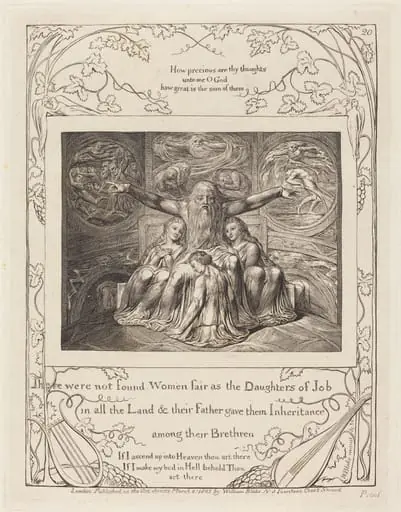
Own this work as a print
Artist & collection
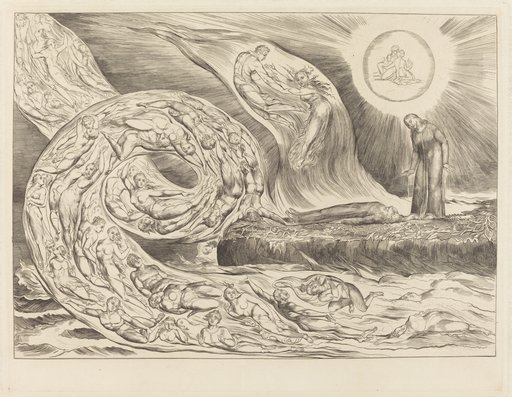
Artist
William Blake (28 November 1757 – 12 August 1827) was an English poet, painter and printmaker.

 Job and His Family Restored to Prosperity
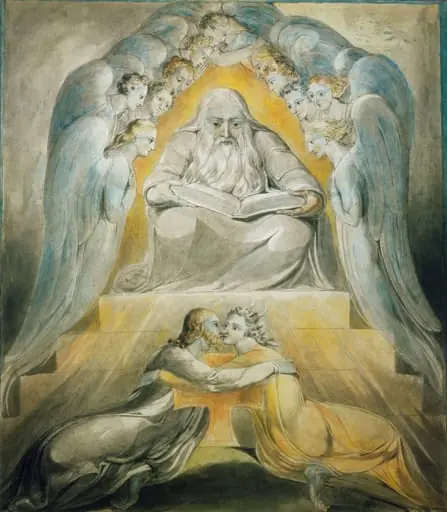 Mercy and Truth are met together, Righteousness and Peace have kissed each other
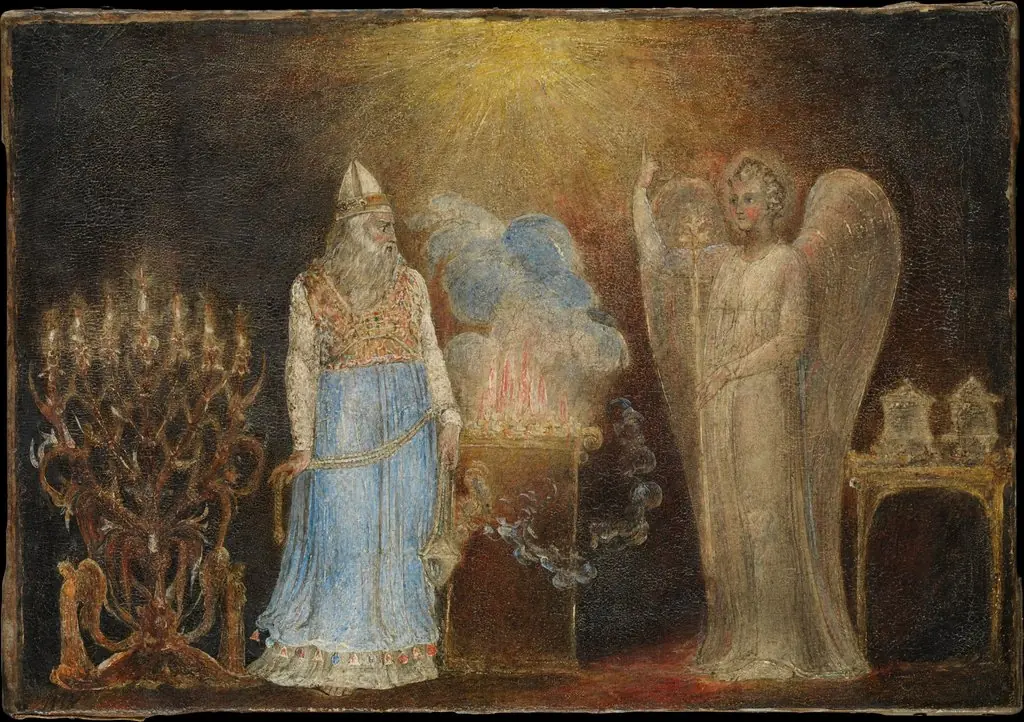
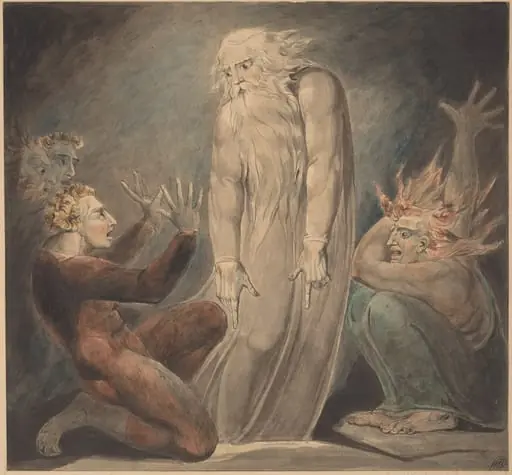 The Ghost of Samuel Appearing to Saul
![Dream of Thiralatha [from "America," cancelled plate d], by William Blake](https://artifactworldgallery.com/img/william-blake--dream-of-thiralatha-from-america-cancelled-plate-d--5757b22438efa26a-w320.webp) Dream of Thiralatha [from "America," cancelled plate d]
Dream of Thiralatha [from "America," cancelled plate d]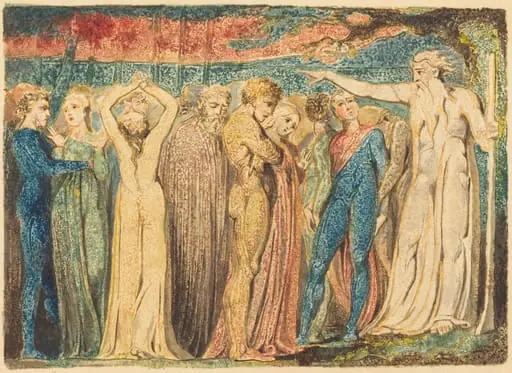 Joseph of Arimathea Preaching to the Britons
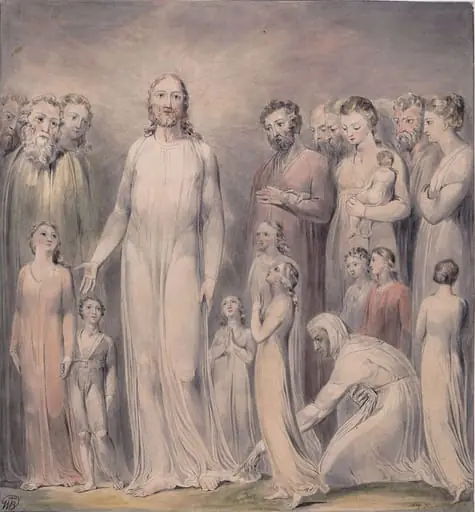 The healing of the woman with an issue of blood
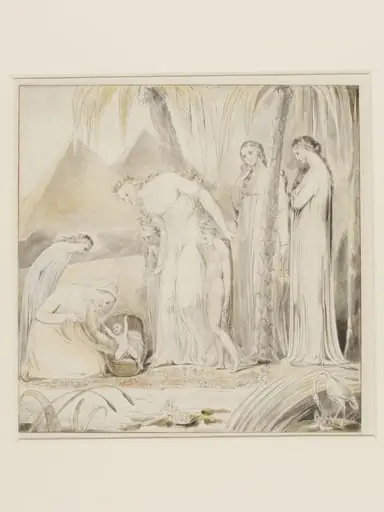 The Compassion of Pharoah's Daughter
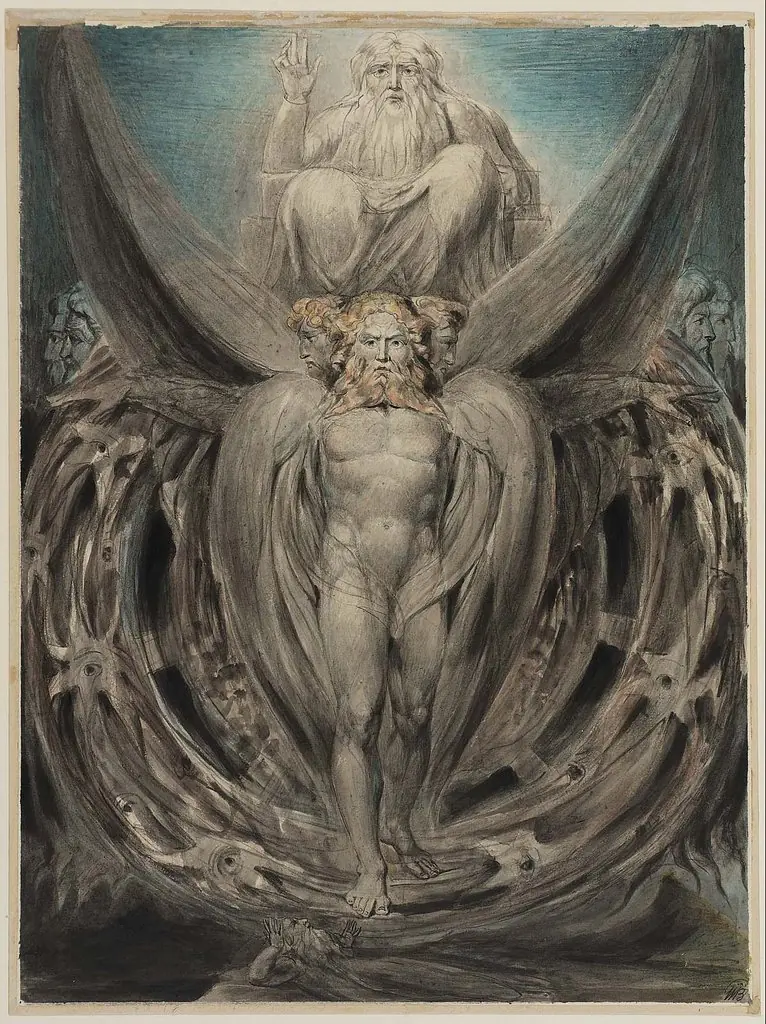 Ezekiel's Wheels
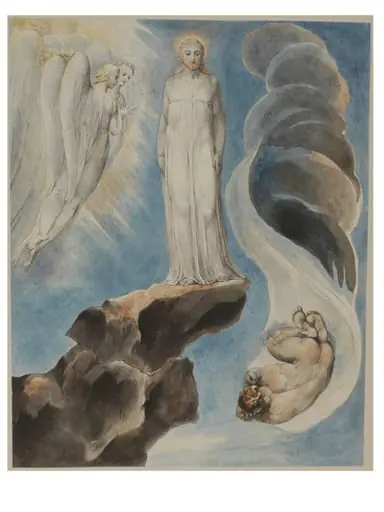 The Third Temptation
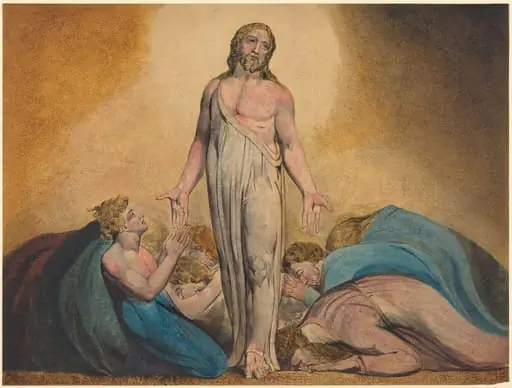 Christ Appearing to His Disciples After the Resurrection
 The Great Red Dragon and the Woman Clothed with the Sun
- Job and His Daughters