Artwork
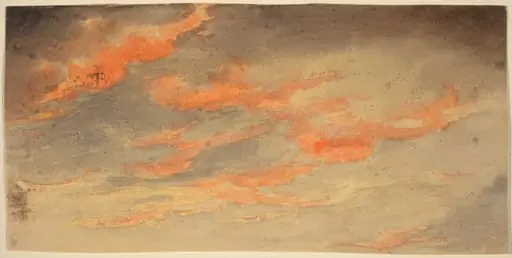
Clouds over the Sea
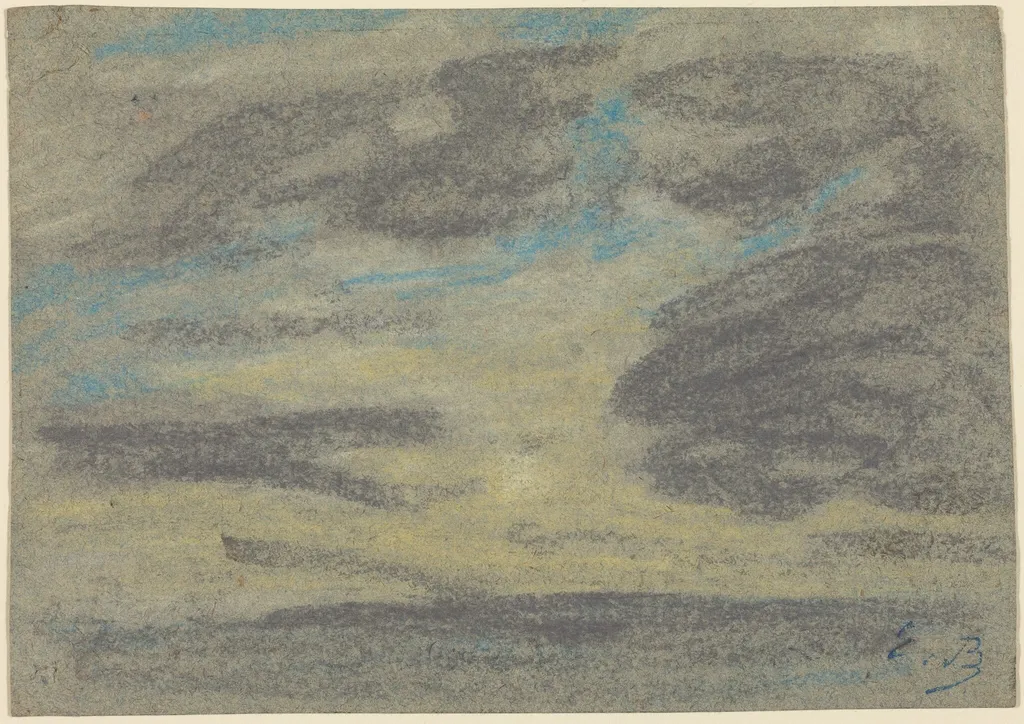
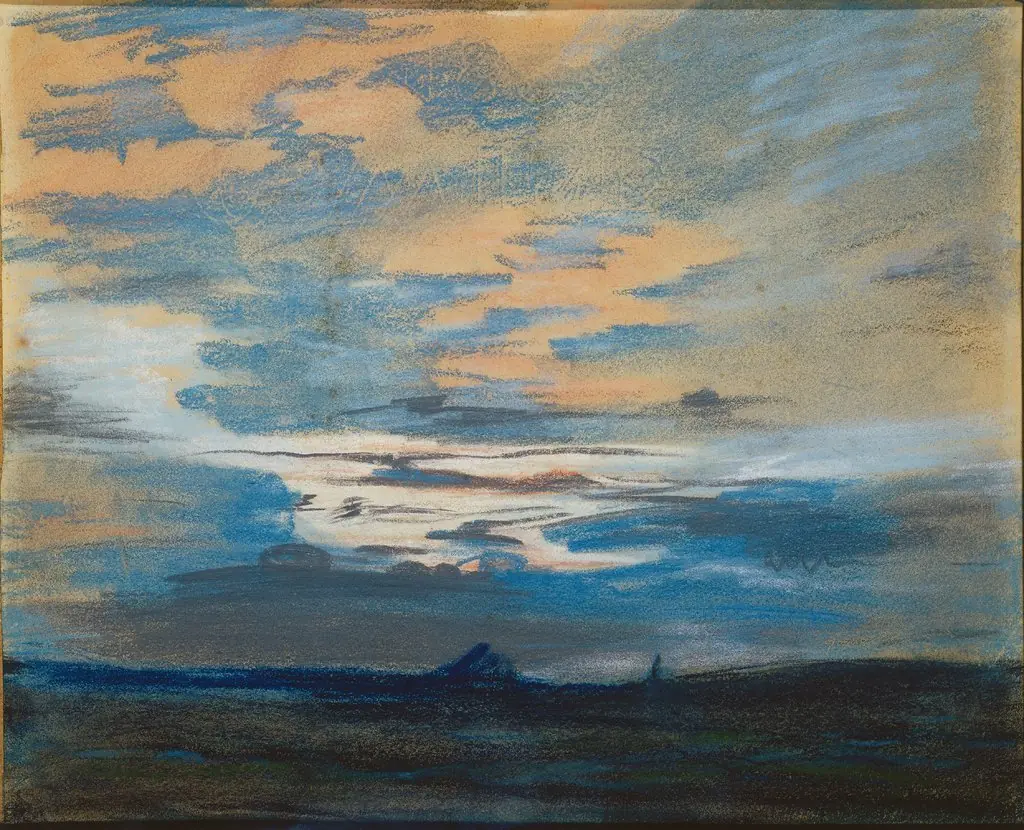
Clouds over the Sea is a pastel drawing by the Impressionist artist Eugène Louis Boudin. It dates from 1862 and is held in the collection of the National Gallery of Art.
- Inscription
- Inscribed:by artist: lower right in pen and blue ink: E.B
About this work
Overview
It is recognized as an example of Boudin's pioneering focus on atmospheric effects and en plein air observation, which anticipated the Impressionist movement.
Clouds over the Sea is a pastel drawing on blue-gray wove paper by the French artist Eugène Louis Boudin, dated between 1860 and 1865. Measuring 11.5 by 16 centimeters, the work is a study of maritime weather, capturing a cloud-filled sky above a calm sea. The drawing is part of the collection of the National Gallery of Art in Washington, where it holds the accession number 2009.70.49. It is recognized as an example of Boudin's pioneering focus on atmospheric effects and en plein air observation, which anticipated the Impressionist movement.
Subject & Meaning
The composition divides horizontally into two primary zones: layered clouds dominate the upper two-thirds, while a darker, flatter band representing the sea occupies the lower third. No human figures or vessels clearly appear, though a small, dark, indistinct shape floats above the horizon line at the lower left, possibly a distant boat or bird. The clouds are the central motif, with denser masses in the upper corners and streaks of lighter blue breaking through near the center, where a faint, diffused brightness suggests a concealed sun. Stripped of narrative detail, the work emphasizes the transient and ethereal qualities of weather, evoking the sublime power of nature over human presence.
Technique & Style
Executed in pastel on blue-gray wove paper, the drawing relies on soft, blended marks to achieve its atmospheric effect. The palette is muted, consisting of soft grays, blues, and pale yellowish tones. Boudin's handling is summary and economic, creating a granular, textured surface with a matte finish and no hard edges or precise contours. The chosen support contributes to the overall tonality, allowing the pastel to sit softly on the toned ground. The artist signed the work in the lower right corner with the initials E.B in pen and blue ink. This approach aligns with the artist's practice of working quickly outdoors to capture the shifting conditions of light and air before they changed.
History & Provenance
Created between 1860 and 1865, the drawing passed into the collection of Joseph F. McCrindle in New York. Following McCrindle's death in 2008, the work was transferred to the Joseph F. McCrindle Foundation that same year. In 2009, the foundation gifted the drawing to the National Gallery of Art in Washington. Its documented exhibition history includes a 2012 display at the National Gallery of Art, where it was featured in the exhibition catalog The McCrindle Gift: A Distinguished Collection of Drawings and Watercolors, edited by Margaret M. Grasselli and Arthur K. Wheelock, Jr.
Context
Eugène Boudin was one of the first French landscape painters to work en plein air, a practice encouraged by his friend Johan Jongkind. A marine painter deeply knowledgeable about the sea and its shores, Boudin earned the nickname the King of the skies from Jean-Baptiste-Camille Corot. His pastels, characterized by their summary and economic execution, also received high praise from the critic Charles Baudelaire. During the late 1850s, Boudin befriended a young Claude Monet, persuading him to pursue landscape painting and instilling in him a love of bright hues and the play of light on water. Boudin's focus on capturing fleeting weather and atmospheric changes directly influenced the development of Impressionism, though he never considered himself a radical innovator.
Legacy
Boudin's dedication to observing weather and capturing ephemeral skies established a critical foundation for Impressionism. By mentoring Claude Monet and demonstrating how to record the shifting conditions of light and air outdoors, Boudin helped shape the movement that would redefine modern painting. His concentrated studies of clouds, such as this one, stand as a lasting record of his belief that the sky dictates the mood of a scene. While his own reputation developed gradually, culminating in a gold medal at the 1889 Exposition Universelle and a knighthood in the Légion d'honneur in 1892, his most enduring legacy remains his role as a bridge between traditional landscape painting and the modern focus on optical sensation.
Own this work as a print
Artist & collection

Artist
Eugène Louis Boudin (French: ; 12 July 1824 – 8 August 1898) was one of the first French landscape painters to paint outdoors.