Artwork
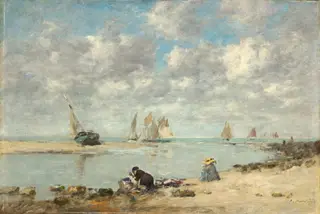
Washerwomen on the Beach of Etretat
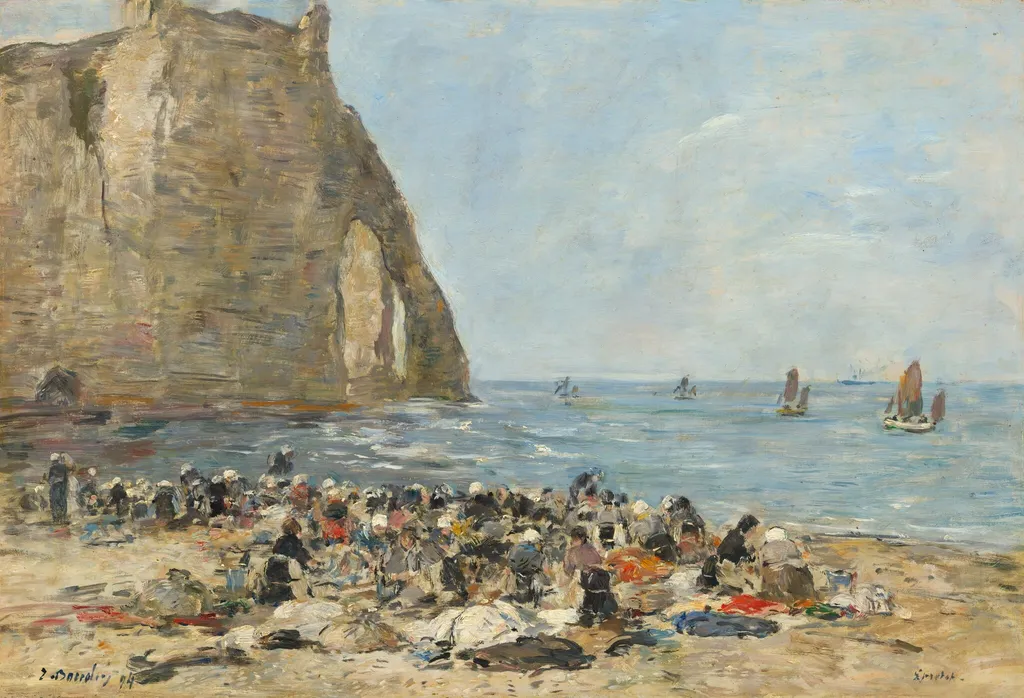
Washerwomen on the Beach of Etretat is an oil painting by the Impressionist artist Eugène Louis Boudin. It dates from 1894 and is held in the collection of the National Gallery of Art.
- Inscription
- Inscribed:lower left: E. Boudin 94; lower right: Etretat.
About this work
A woman bends over wet laundry on Etretat's pebbled beach while waves lap the rocks of the Porte d'Aval, the bright sky leaving everything soft and hazy. Boudin painted this in 1894, fifty years after he first sketched here with Monet, drawn to how fog blurs the line between sea and sky.
Subject & Meaning
As a marine genre painting, the work records a slice of everyday coastal life while emphasizing the interplay of light, sea, and stone that fascinated Boudin.
Washerwomen on the Beach of Etretat portrays a group of washerwomen laboring on the sandy shore beneath the iconic chalk cliffs and natural arch of Porte d’Aval at Étretat. As a marine genre painting, the work records a slice of everyday coastal life while emphasizing the interplay of light, sea, and stone that fascinated Boudin. The depiction of this familiar Normandy locale, combined with the figures’ humble activity, reflects the artist’s interest in capturing transient atmospheric effects and the quiet dignity of ordinary labor along the coast.
Technique & Style
Washerwomen on the Beach of Etretat is an oil painting on a wood panel created by Eugène Boudin in 1894. The work belongs to the marine genre and measures 37.2 cm in height by 54.9 cm in width. It depicts the Beach of Étretat with the Porte d'Aval, rendered in oil paint on a wooden support. The painting is now in the collection of the National Gallery of Art in Washington, D.C.
History & Provenance
Eugène Boudin executed this oil-on-panel work in 1894. The painting's documented ownership begins with Georges Ibos of Paris, whose estate sold the piece at Hôtel Drouot on June 19, 1900. The dealer Durand-Ruel purchased it at that auction and retained it until November 14, 1935, when it was sold to E.J. van Wisselingh and Co. in Amsterdam.
Shortly thereafter, the work entered the collection of M.P. Voûte, Jr., also in Amsterdam. In 1937, van Wisselingh repurchased the painting and subsequently sold it to M. Knoedler and Co. in New York. By December 12, 1942, the gallery had transferred the work to Harry MacNeill Bland Galleries, which sold it later that year to Ailsa Mellon Bruce.
Upon Bruce's death in 1969, the painting was bequeathed to the National Gallery of Art in Washington, D.C., entering the collection in 1970.
The painting is held by the National Gallery of Art, Washington, D.C., accessioned as a bequest from Ailsa Mellon Bruce in 1970. It entered the collection via Harry MacNeill Bland Galleries, New York, which purchased it in 1942. Prior to that, the work passed through M. Knoedler and Co., New York, and E.J. van Wisselingh and Co., Amsterdam, which acquired it in 1937.
Earlier, it was sold by M.P. Voûte, Jr., Amsterdam, to van Wisselingh in 1937. The Durand-Ruel gallery, Paris, had acquired it from the 1900 Ibos sale in Paris and then sold it in 1935 to van Wisselingh.
Overview
Washerwomen on the Beach of Etretat, painted by Eugène Boudin in 1894, depicts a coastal scene at Étretat, France, focusing on the daily labor of laundry workers against a dramatic seascape. Executed in oil on wood, the composition centers on a woman in a long dress bending over wet linens on the pebbled shore. To her side, the waves of the English Channel lap against the rocks near the famous Porte d'Aval arch.
Boudin captures the specific atmospheric conditions of the Normandy coast, utilizing a bright, hazy sky to soften the forms and create a sense of luminous diffusion. This work was created late in the artist's career, fifty years after his initial sketches of the location alongside Claude Monet. It exemplifies Boudin's enduring commitment to plein air painting and his mastery of rendering the transient effects of light and weather.
While often associated with the origins of Impressionism, this 1894 piece reflects his mature style, balancing the documentary observation of working-class life with a poetic treatment of the marine environment. The painting stands as a testament to his lifelong fascination with the Étretat cliffs and the rhythmic interaction between human activity and the natural elements.
Context
This work from 1894 reflects Boudin's enduring fascination with the Étretat coast, a location he had first explored and sketched five decades prior alongside Claude Monet. Throughout his career, Boudin returned to such coastal motifs, consistently observing and depicting the shifting atmospheric conditions. This painting exemplifies his sustained interest in capturing the nuanced effects of light and weather on the landscape.
Own this work as a print
Artist & collection

Artist
Eugène Louis Boudin (French: ; 12 July 1824 – 8 August 1898) was one of the first French landscape painters to paint outdoors.