Artwork
Father and Son
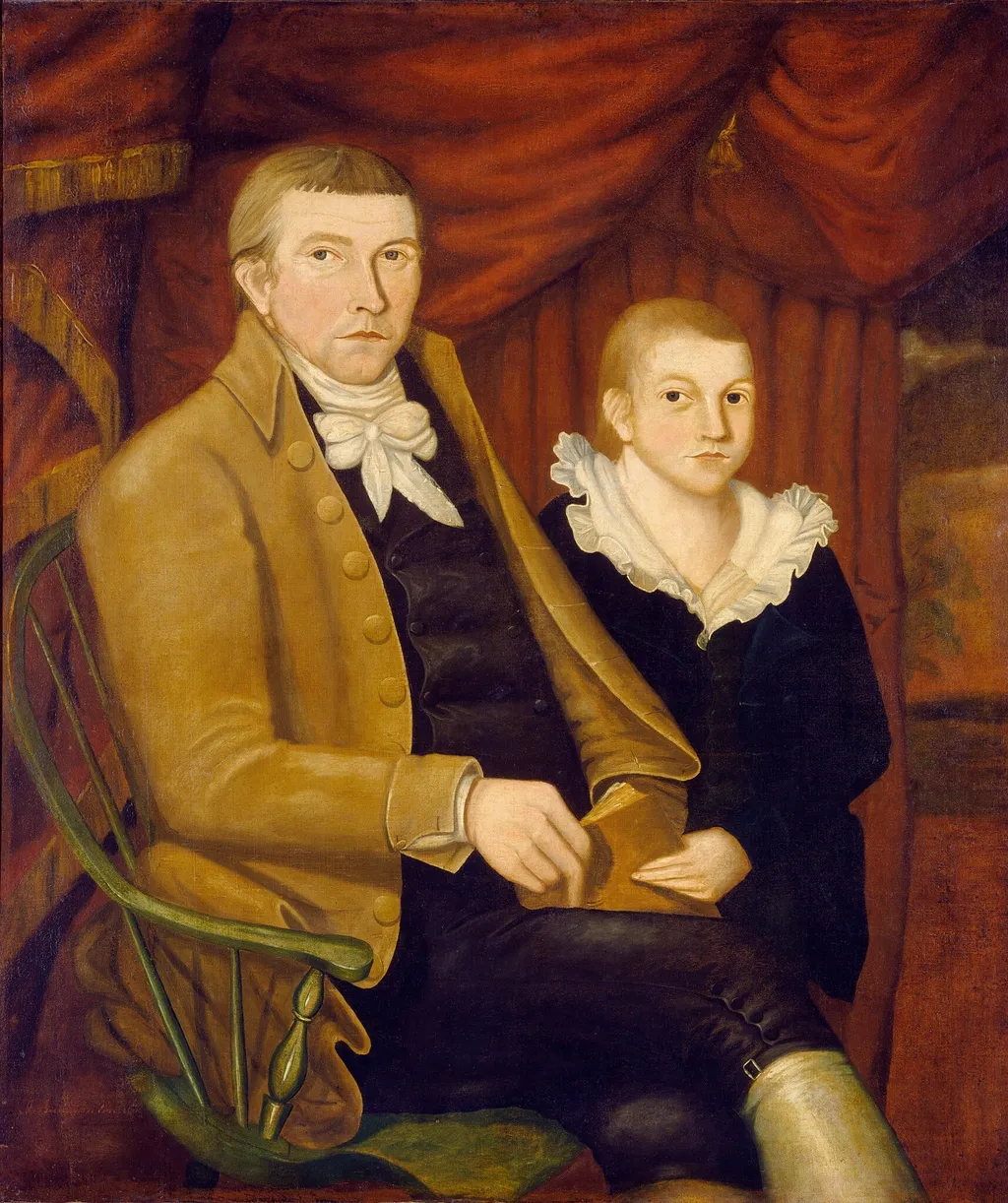
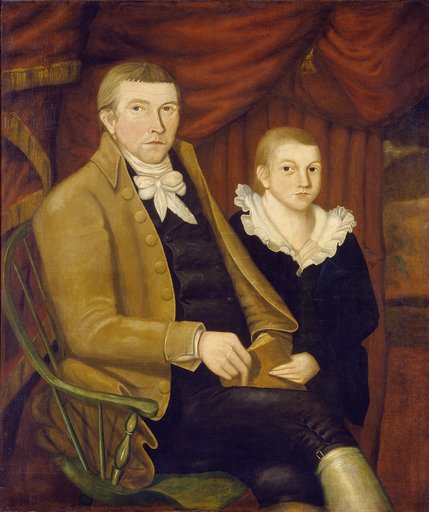
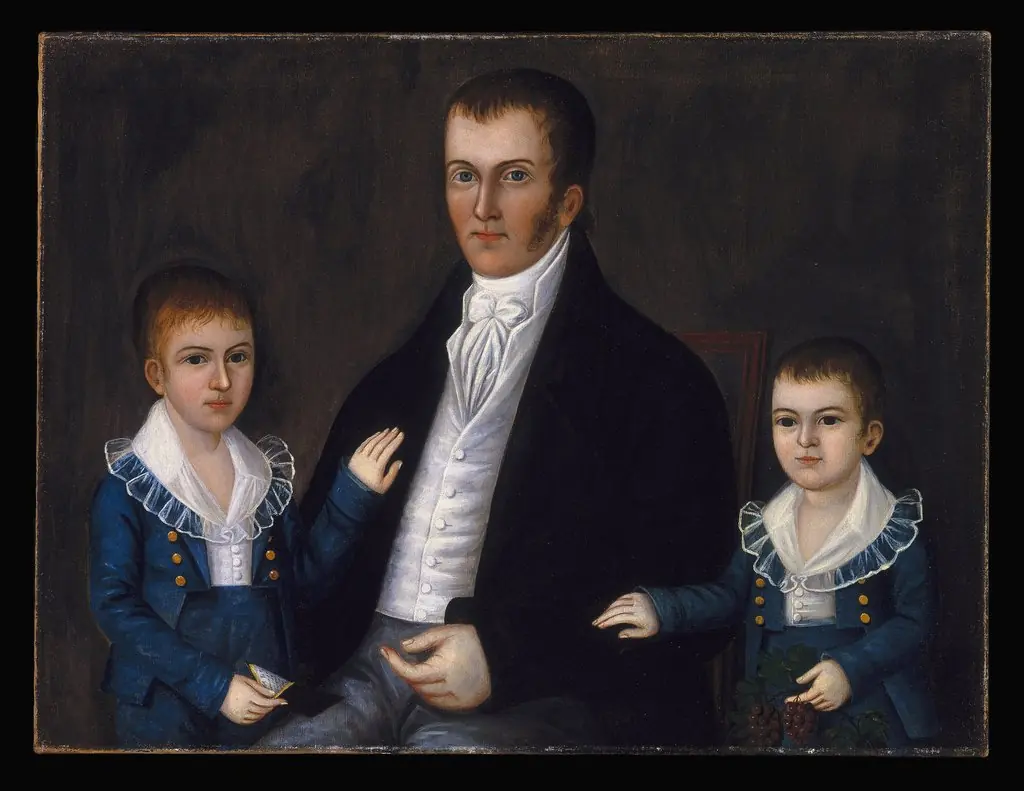
Father and Son is an oil painting by the American Folk Art artist Jonathan Budington. It dates from 1800 and is held in the collection of the National Gallery of Art.
- Inscription
- Inscribed:lower left: J. Budington Pinxt. 1800
About this work
An older man in a dark coat holds a small boy's hand; the boy wears a plain white shirt. They stand close but look away from each other. Jonathan Budington painted this quiet, personal scene around 1800, the dark ground setting off the pale clothes.
Subject & Meaning
Father and Son is a portrait depicting a father and his son, rendered in oil on canvas by Jonathan Budington in 1800.
Father and Son is a portrait depicting a father and his son, rendered in oil on canvas by Jonathan Budington in 1800. The painting belongs to the genre of portraiture and presents a generational pairing, a common convention in early American domestic imagery where the inclusion of a parent and child conveyed familial continuity and inheritance. The work's identification rests on its subject matter rather than on any documented symbolic program, and no specific iconographic attributes beyond the parent-child relationship are recorded in the available sources.
Its meaning is therefore tied to the straightforward representation of kinship and lineage within a Connecticut household, the Burr family homestead at Greenfield Hill, Fairfield County, from which the painting descended before entering the National Gallery of Art.
Technique & Style
The painting employs oil on canvas, a standard support for early American portraits, with dimensions of approximately 104.1 cm by 89.8 cm. The handling reflects the period's emphasis on clarity and detail, particularly in the rendering of facial features and costume. The composition positions the father and son in a close, intimate arrangement, with the elder figure seated and the younger standing beside him, reinforcing intergenerational bonds. Stylistically, the work aligns with late eighteenth-century American portraiture, characterized by smooth brushwork, subdued modeling, and a restrained palette that prioritizes realism over dramatic effect.
History & Provenance
The portrait Father and Son by Jonathan Budington dates to circa 1800 and is recorded as originating from the Burr family homestead in Greenfield Hill, Connecticut. By the mid-20th century it was in the possession of Mary Allis of Southport, Connecticut, and subsequently handled by dealer Albert Duveen in New York. In 1952 the work was acquired by collectors Edgar William and Bernice Chrysler Garbisch, who donated it to the National Gallery of Art, Washington, D.C., in 1956.
Donor records originally listed the painting's source as 'Green Hills, Connecticut,' but this was corrected to Greenfield Hill, Fairfield County, as no town named Green Hills exists.
Legacy
The painting's accession by the National Gallery of Art in 1956 signaled its recognition as an important example of early American portraiture. Its well-documented provenance, from the Burr family homestead to the Garbisch donation, has made it a useful case study in the collecting patterns of mid-twentieth-century American collectors. Its continued display and scholarly reference underscore its role in shaping the narrative of early American family portraiture.
Overview
Jonathan Budington's oil on canvas painting, Father and Son, dates to approximately 1800. This portrait captures an intimate scene between an older man and a young boy, presumably a father and his child. The work is characterized by its subdued atmosphere, presenting a personal moment rather than a formal depiction. It serves as a quiet observation of familial connection at the turn of the 19th century.
Own this work as a print
Artist & collection