Artwork
La Place des Martyrs et la Taverne du Bagne
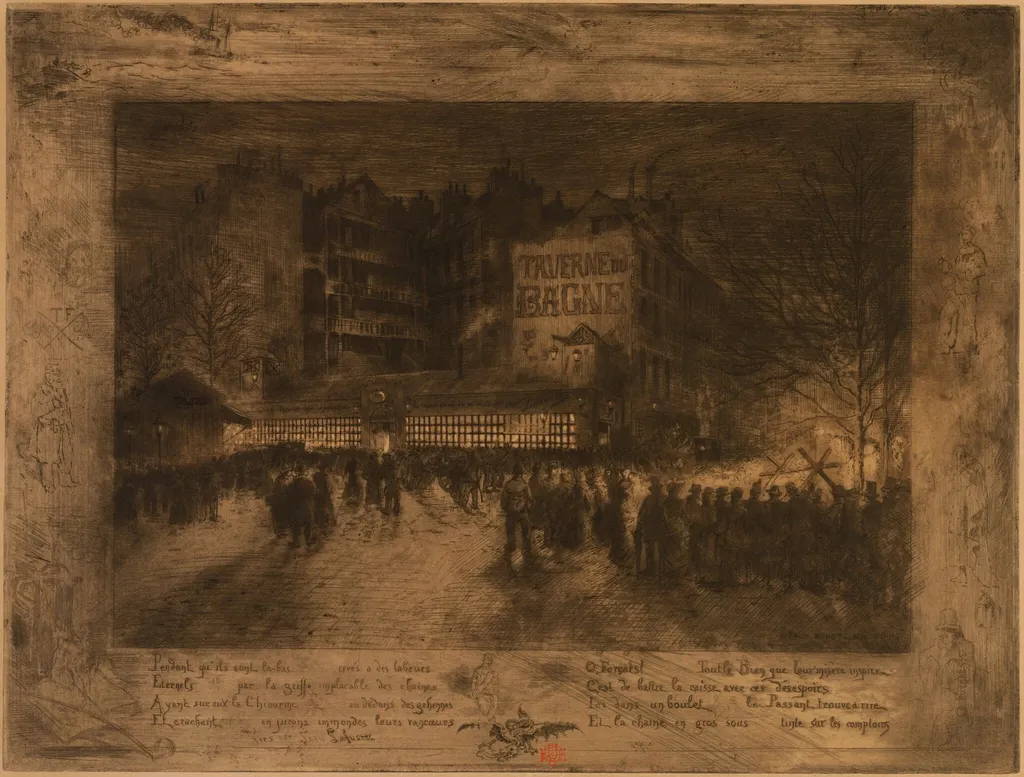
La Place des Martyrs et la Taverne du Bagne is an ink print by the Impressionist artist Félix-Hilaire Buhot. It dates from 1885 and is held in the collection of the National Gallery of Art.
About this work
Overview
The composition emphasizes the interplay of artificial light against dark, looming buildings and bare trees, evoking the specific mood of a Parisian evening.
Created in 1885, La Place des Martyrs et la Taverne du Bagne is a complex etching by the French artist Félix-Hilaire Buhot. The work depicts a nocturnal scene at the Place des Martyrs in Paris, centered on a tavern bearing the sign 'Taverne du Bagne.' Buhot captures a bustling urban atmosphere where figures queue outside the establishment while horses and carriages traverse the wet, reflective street.
The composition emphasizes the interplay of artificial light against dark, looming buildings and bare trees, evoking the specific mood of a Parisian evening. Technically, the piece exemplifies Buhot's experimental approach to printmaking, utilizing a combination of etching, aquatint, lift-ground aquatint, drypoint, roulette, and burnishing. Printed in brown-black ink on turpentine-soaked paper, these varied methods allow for rich tonal gradations and textured surfaces that mimic the shimmer of gaslight on damp pavement.
This work reflects Buhot's significant contribution to the revival of original etching in late 19th-century France, where he prioritized atmospheric effects and technical innovation over strict linear definition. The piece stands as a characteristic example of his ability to translate the transient qualities of modern city life into the permanent medium of the print.
Subject & Meaning
The work captures a moment of urban life in late‑19th‑century Paris, emphasizing the interplay between public space and private leisure. The crowded façade of the tavern, the flickering streetlights, and the wet cobbles convey a sense of immediacy and social interaction, hinting at the bustling, often gritty reality of the city’s working‑class neighborhoods.
Technique & Style
Buhot combined etching, aquatint, lift‑ground aquatint, drypoint, roulette, and burnishing on turpentine‑soaked paper to achieve a rich tonal range. The layered processes produce deep shadows, textured surfaces, and irregular line work; the rough edges and varied marks give the scene a lively, almost spontaneous quality that heightens its atmospheric effect.
History & Provenance
Created in 1885, the print belongs to the period when French artists were experimenting with mixed intaglio methods to enhance tonal depth. While specific ownership records are limited, the work has been documented in catalogues of Buhot’s oeuvre and appears in collections focusing on 19th‑century French printmaking.
Own this work as a print
Artist & collection

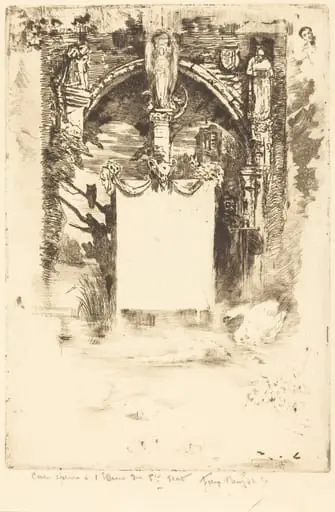 Ex-Libris pour "L'Ensorcelée" (Bookplate for "L'Ensorcelée")
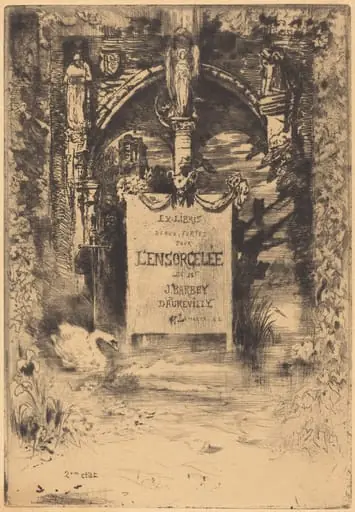 Ex-Libris pour "L'Ensorcelée" (Bookplate for "L'Ensorcelée")
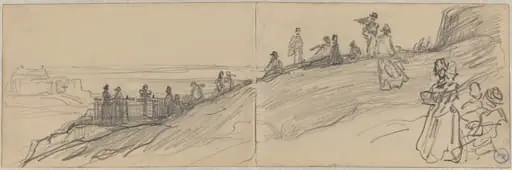 Figures on Top of a Hill, Overlooking the Sea
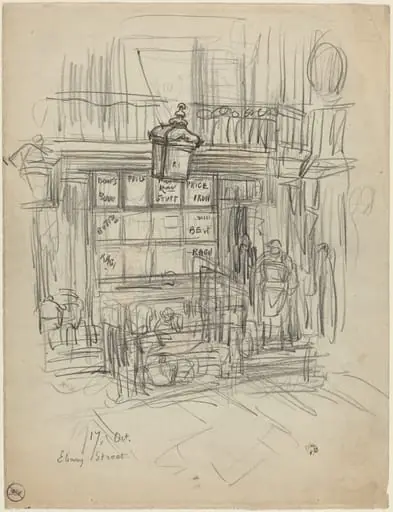 Ebury Street
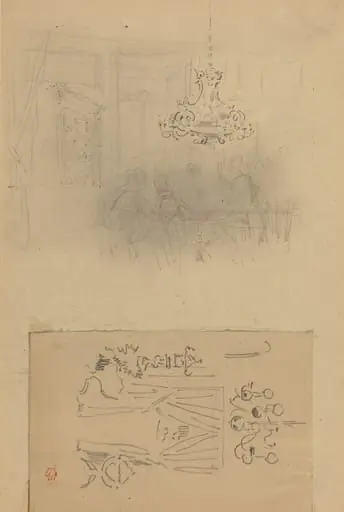 A Gathering in an Interior; A Curtained Doorway
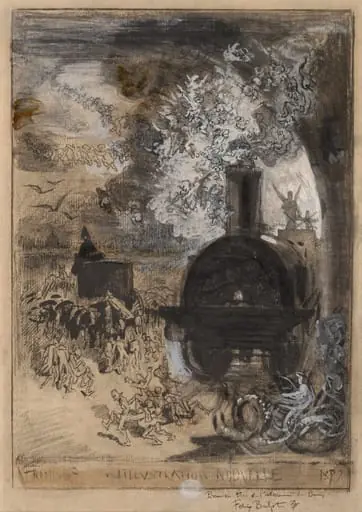 Frontispiece for L'Illustration Nouvelle: The Burial of the Burin
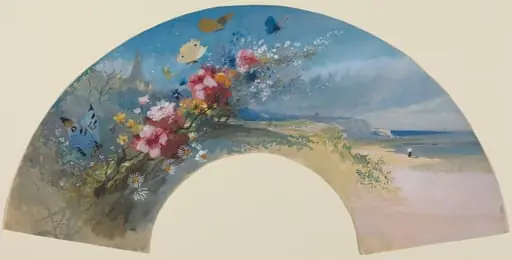 Fan with Wildflowers and Butterflies against the Norman Coast
![Gillingham Pier, London [verso], by Félix-Hilaire Buhot](https://artifactworldgallery.com/img/felix-hilaire-buhot--gillingham-pier-london-verso--641e03dd7de8217b-w320.webp) Gillingham Pier, London [verso]
Gillingham Pier, London [verso]
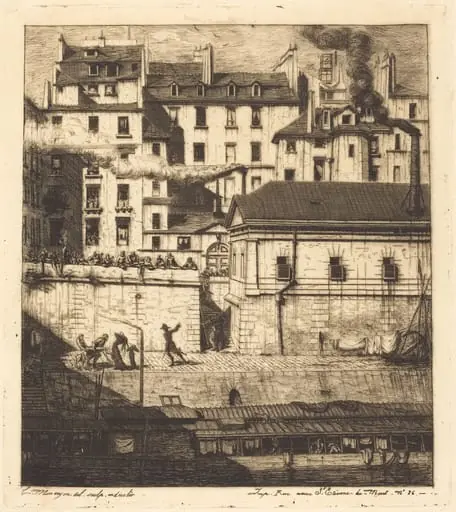 La morgue, Paris (The Mortuary)
 La morgue, Paris (The Mortuary)
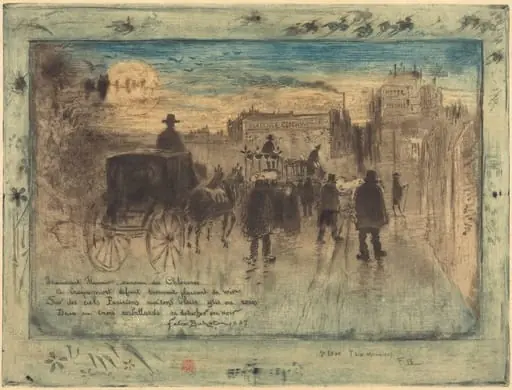 Convoi Funèbre au Boulevard de Clichy (Funeral Procession on the Boulevard de Clichy)
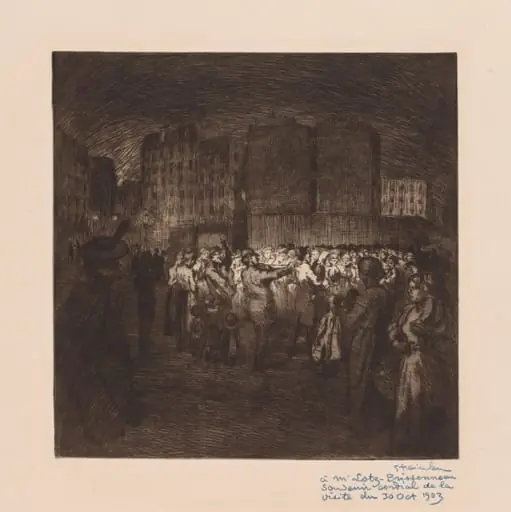 Little Street Singers
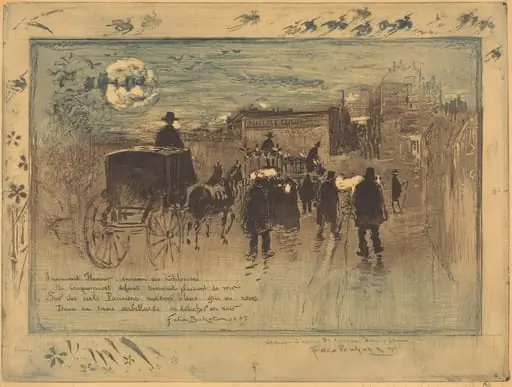 Convoi Funèbre au Boulevard de Clichy (Funeral Procession on the Boulevard de Clichy)
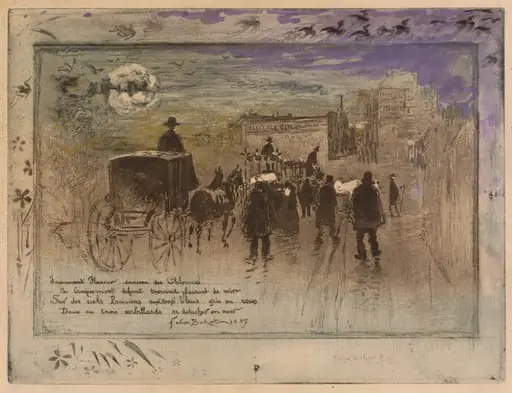 Funeral Procession on the Boulevard de Clichy
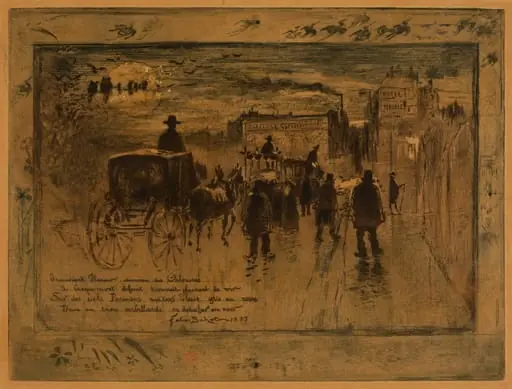 Convoi Funèbre au Boulevard de Clichy (Funeral Procession on the Boulevard de Clichy)
 Untitled