Artwork
Killing the Fatted Calf
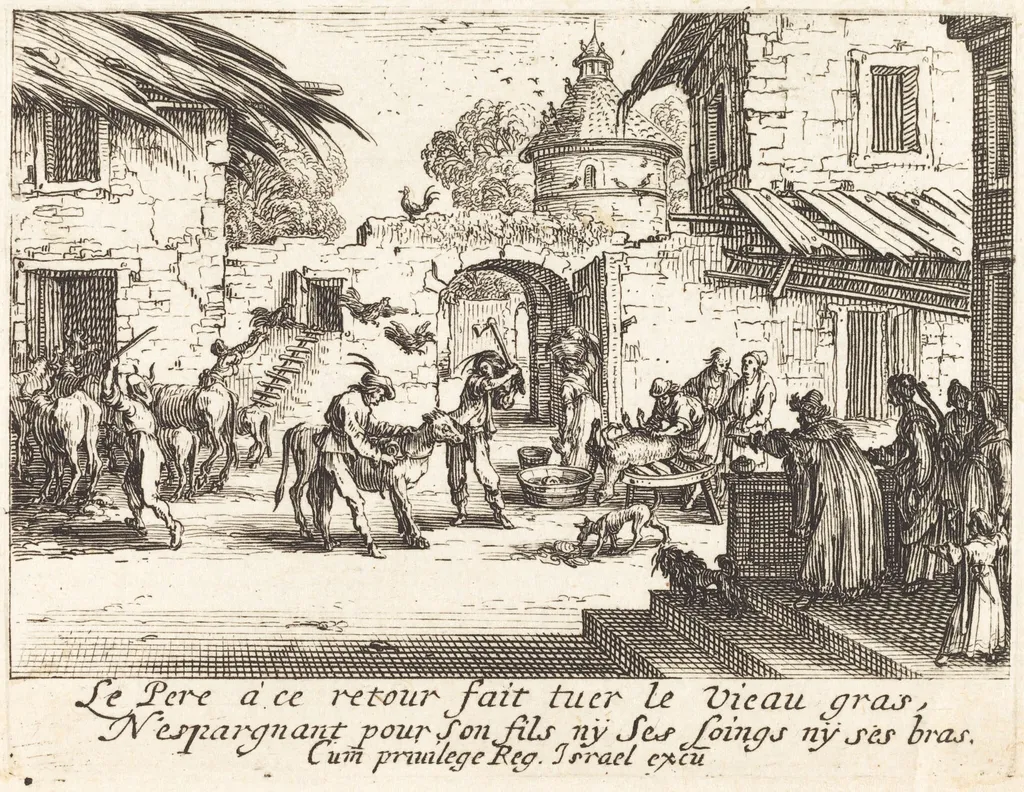
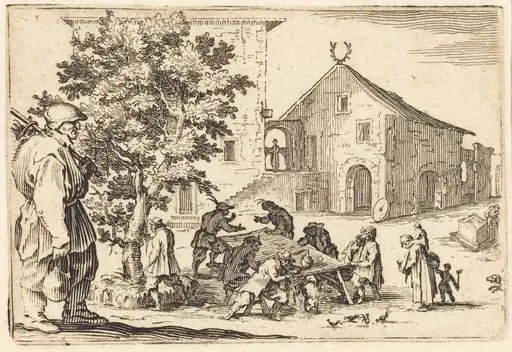
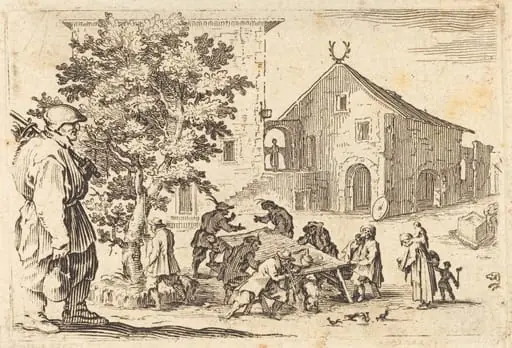
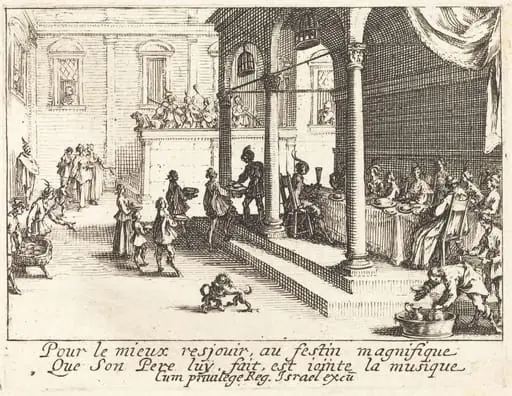
Killing the Fatted Calf is an ink print by the Baroque artist Jacques Callot. It dates from 1635 and is held in the collection of the National Gallery of Art.
- Inscription
- Inscribed:in margin below image, in plate: La Père à ce retour fait tuer le Uieau gras, / N'espargnant pour son fils ny ses soings ny ses bras. / Cum privilege Reg. Israel excu.
About this work
Overview
Created in 1635, Killing the Fatted Calf is an etching on laid paper by Jacques Callot, a prolific French printmaker from the Duchy of Lorraine. The work presents a bustling urban street where a crowd gathers around a central figure slaughtering a cow, set against aging architecture and a distant tower.
Subject & Meaning
The composition depicts a public ritual of animal sacrifice, with onlookers, a dog, and birds overhead. French inscription at the bottom identifies the scene as a sacrifice, suggesting a commentary on communal practices or the stark realities of daily life in the 17th‑century city.
Technique & Style
Callot employs fine, intersecting lines to render shadows, textures, and the intricate details of figures, buildings, and animals. The etching technique allows for a high level of precision, producing a lively yet meticulously ordered visual narrative typical of his baroque sensibility.
History & Provenance
Part of Callot’s extensive output of more than 1,400 prints, the piece reflects his habit of documenting contemporary events, ranging from military subjects to everyday street scenes. Its survival on laid paper attests to the durability of his early modern printmaking practices.
Context
During the early 1630s, Lorraine was a crossroads of cultural and political influences, and Callot’s work often merged courtly and popular themes. This etching aligns with his broader interest in portraying the social fabric of his time, juxtaposing ordinary labor with architectural decay.
Legacy
Killing the Fatted Calf exemplifies Callot’s contribution to the development of narrative printmaking, influencing later artists who sought to combine detailed observation with expressive storytelling in the baroque era.
Own this work as a print
Artist & collection
Artist
Jacques Callot (French: ; c. 1592 – 1635) was a baroque printmaker and draftsman from the Duchy of Lorraine. He is an important person in the development of the old master print. He made more than 1,400 etchings that…

 Holy Family at supper
 Restoration of the Aqueduct at Pisa
 Restoration of the Aqueduct at Pisa
 Square in Paris with Many Figures
 Square in Paris with Many Figures
 Horsemen Attacked by Robbers
 HOW WILL A COVERED PART BE CORRECTED?HOW WIKA A COVERED HEART DEED CORRECTED?
![Christ Walking on the Water [second plate], by Jacques Callot](https://artifactworldgallery.com/img/jacques-callot--christ-walking-on-the-water-second-plate--2069f3bfe4cb2126-w320.webp) Christ Walking on the Water [second plate]
Christ Walking on the Water [second plate]