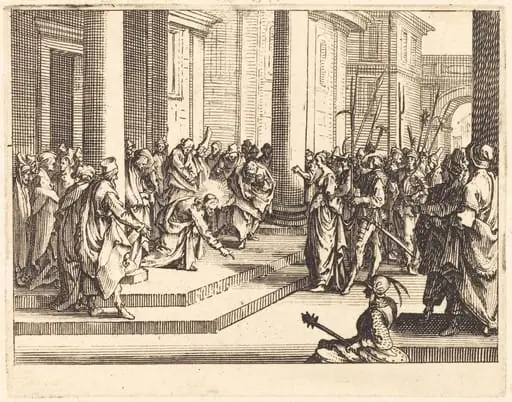
Artwork
The Condemnation to Death
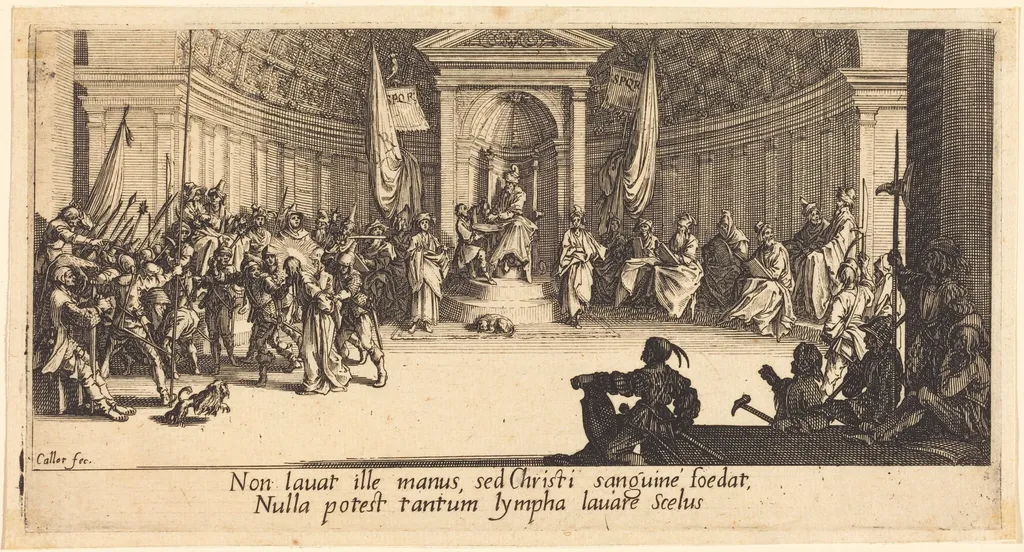
The Condemnation to Death is an ink print by the Baroque artist Jacques Callot. It dates from 1618 and is held in the collection of the National Gallery of Art.
About this work
Overview
Created circa 1618 by Jacques Callot, a French printmaker active in the Duchy of Lorraine, The Condemnation to Death is an etching and engraving executed on laid paper. The work belongs to Callot’s prolific output, which exceeds fourteen hundred prints documenting a range of contemporary subjects.
Subject & Meaning
A Latin inscription at the bottom suggests a formal judicial or punitive event rather than a casual gathering.
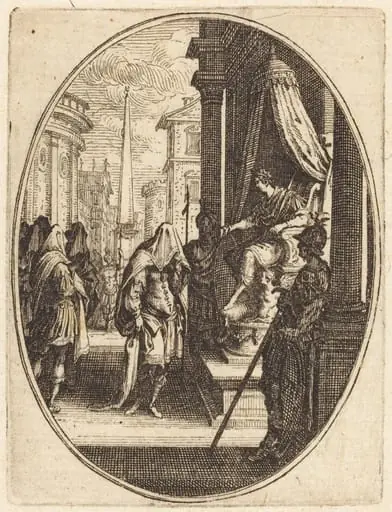
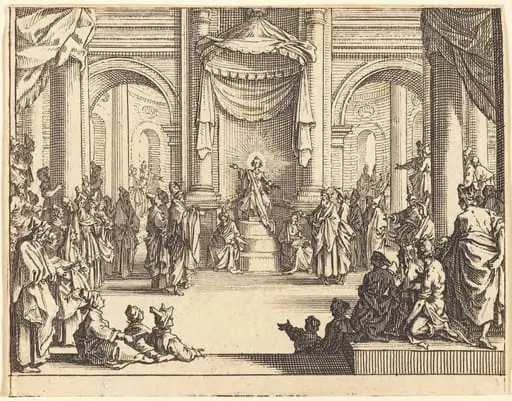
The composition presents a crowded, ritualized scene: a group on the left brandishes flags and weapons, while a central figure sits upon an elevated chair beneath a draped canopy, surrounded by standing and kneeling onlookers. To the right, robed individuals observe from steps, and a figure on the ground clutches a broken column. A Latin inscription at the bottom suggests a formal judicial or punitive event rather than a casual gathering.
Technique & Style
Callot combines etching’s fluid lines with the precise incisions of engraving, allowing both delicate texture and sharp definition. The use of laid paper contributes a subtle ribbed surface that interacts with the dense network of hatching, creating depth and a sense of atmospheric crowding characteristic of his baroque sensibility.
History & Provenance
The print emerged during a period when Callot was actively recording military and religious life, often set against expansive landscapes. While specific ownership records for this particular sheet are scarce, it fits within the broader circulation of his prints, which were widely disseminated across Europe in the early seventeenth century.
Context
Callot’s work reflects the baroque fascination with spectacle and authority, capturing moments of public ceremony that reveal social hierarchies. The detailed crowd and ceremonial accoutrements echo contemporary judicial practices and the performative nature of punishment in early modern Lorraine.
Artist & collection
Artist
Jacques Callot (French: ; c. 1592 – 1635) was a baroque printmaker and draftsman from the Duchy of Lorraine. He is an important person in the development of the old master print. He made more than 1,400 etchings that…

 Holy Family at supper
 Restoration of the Aqueduct at Pisa
 Restoration of the Aqueduct at Pisa
 Square in Paris with Many Figures
 Square in Paris with Many Figures
 Horsemen Attacked by Robbers
 HOW WILL A COVERED PART BE CORRECTED?HOW WIKA A COVERED HEART DEED CORRECTED?
![Christ Walking on the Water [second plate], by Jacques Callot](https://artifactworldgallery.com/img/jacques-callot--christ-walking-on-the-water-second-plate--2069f3bfe4cb2126-w320.webp) Christ Walking on the Water [second plate]
Christ Walking on the Water [second plate]