Artwork
Alexander at the Tomb of Cyrus
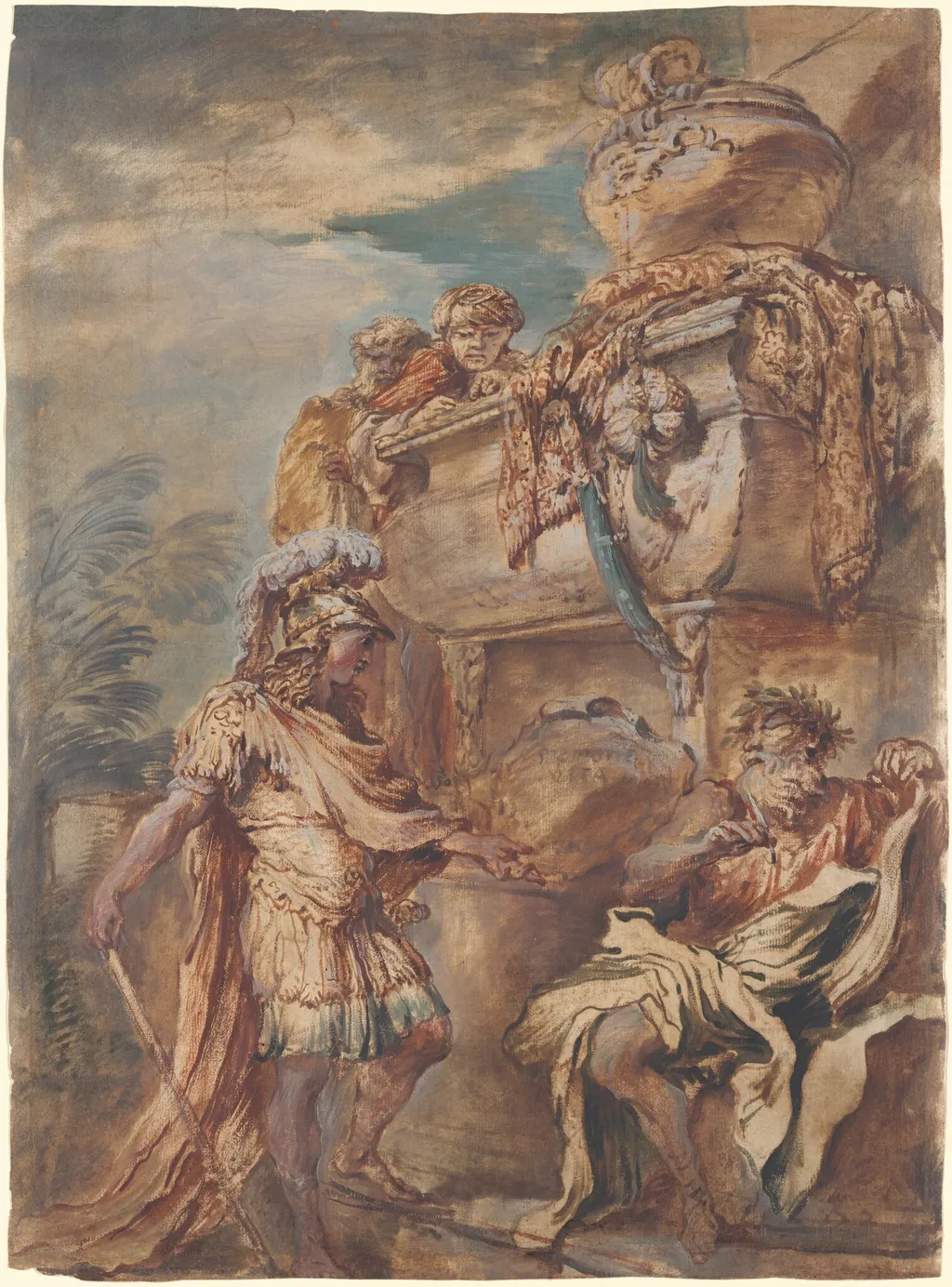
Alexander at the Tomb of Cyrus is an oil drawing by the Baroque artist Giovanni Benedetto Castiglione. It dates from 1648 and is held in the collection of the National Gallery of Art.
- Inscription
- Inscribed:center: Memorie / VITA
About this work
Subject & Meaning
The drawing depicts Alexander the Great kneeling before the Tomb of Cyrus the Great at Pasargadae, a moment drawn from ancient historiography.
The drawing depicts Alexander the Great kneeling before the Tomb of Cyrus the Great at Pasargadae, a moment drawn from ancient historiography. Castiglione renders the ruler in profile, emphasizing reverence and contemplation as Alexander addresses the sepulcher of the Persian founder. The tomb’s stepped structure and arched niche are rendered with clarity, evoking its historical and architectural significance.
Symbolically, the scene contrasts Macedonian ambition with Persian legacy, using Alexander’s gesture of homage to frame themes of conquest, cultural assimilation, and the weight of history. The inclusion of the tomb signals the intersection of power and mortality, a recurring motif in depictions of Alexander.
Technique & Style
The drawing was executed in oil with white highlights on laid paper, a technique that emphasizes fine linear detail and subtle tonal contrast. Its handling of light accentuates the dramatic presence of Alexander within the tomb, while the stylized rendering of architectural elements reflects Baroque influences. The composition is tightly framed, showcasing precise brushwork and delicate surface texture that contribute to its overall formal balance.
History & Provenance
The drawing was created in 1645 by Giovanni Benedetto Castiglione. It entered a private collection belonging to Monsieur E. Pinguely, later acquired by Lorna Lowe in London, and was purchased by the National Gallery of Art in Washington, D.C., in 1981.
Alexander at the Tomb of Cyrus is held by the National Gallery of Art in Washington, D.C., as part of its drawings collection. The work entered the museum in 1981 when it was purchased from the London dealer Lorna Lowe, who had acquired it from Monsieur E. Pinguely. It is catalogued under inventory number NGA 60662.
No prior exhibition history is recorded in the available documentation.
Overview
Created in 1648, Alexander at the Tomb of Cyrus is a small-scale work executed in oil heightened with white on laid paper. The Italian artist Giovanni Benedetto Castiglione, known as Il Grechetto, employed this unusual support to render a compact scene in which the Macedonian ruler stands before the burial monument of the Persian king.
Context
In the mid‑seventeenth century, Italian Baroque artists frequently turned to classical and biblical narratives to explore moral and political ideas. Castiglione’s choice of a relatively obscure historical anecdote reflects the era’s fascination with exempla drawn from antiquity, aligning his oeuvre with contemporary interests in heroic virtue and the legacy of past rulers.
Own this work as a print
Artist & collection
Artist
Giovanni Benedetto Castiglione
Giovanni Benedetto Castiglione (baptized 23 March 1609 – 5 May 1664) was an Italian Baroque painter, printmaker and draftsman, of the Genoese school.

 Scipio Restoring His Captive to Her Lover
 Iconologia or Morall Emblems by Caesar Ripa
 Aeneas Saving Anchises at the Fall of Troy
 Tremblez malheureux Roi, votre Règne est passe
 Saint Benedict Healing the Possessed
 Orpheus and Eurydice
 Saint Florian
 Various Caprices: The Astrologen and the Young Soldier
 The Discovery of Achilles among the Daughters of Lycomedes
 Meeting of King Ferdinand of Hungary and the Cardinal-Infante Ferdinand of Spain at Nördlingen