Artwork
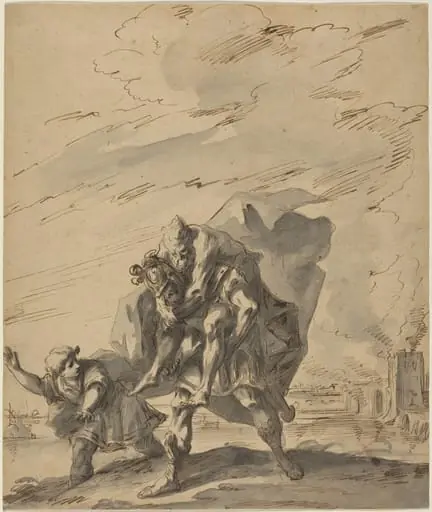
Aeneas Saving Anchises at the Fall of Troy
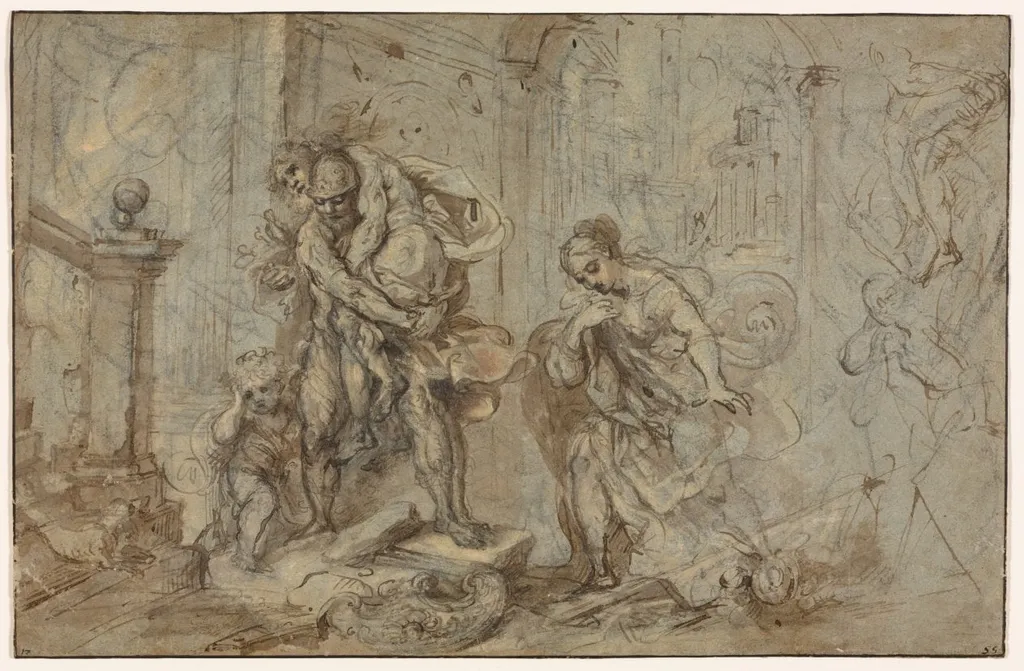
Aeneas Saving Anchises at the Fall of Troy is a drawing by the Renaissance artist Federico Barocci. It dates from 1588 and is held in the collection of the Cleveland Museum of Art. This drawing depicts a pivotal moment from Virgil's The Aeneid, where Aeneas escapes the burning city of Troy with his family.
- Accession no.
- 1960.26
- Credit line
- L. E. Holden Fund
About this work
Overview
This drawing depicts a pivotal moment from Virgil's The Aeneid, where Aeneas escapes the burning city of Troy with his family. The scene showcases Aeneas carrying his father Anchises and leading his son Ascanius, while his wife Creusa lags behind, foreshadowing her demise.
Subject & Meaning
The artwork illustrates the emotional and precarious flight of Aeneas' family amidst the fall of Troy. Creusa's slight separation from the group subtly hints at her tragic fate, emphasizing the personal cost within the broader narrative of war and escape.
Technique & Style
Barocci employed chiaroscuro to capture the dramatic intensity of the scene, contrasting light and shadow to convey the chaos and urgency of the moment. Quick sketches on the sheet reveal the artist's practice in achieving balanced poses, notably Aeneas' burdened stance and Creusa's desperate stride.
History & Provenance
This drawing is linked to a lost Barocci painting and was later translated into an engraving by Agostino Carracci (CMA 1963.456), though the drawing includes unique details not present in the engraving, such as a dog and Creusa's flowing hair.
Artist & collection
Artist
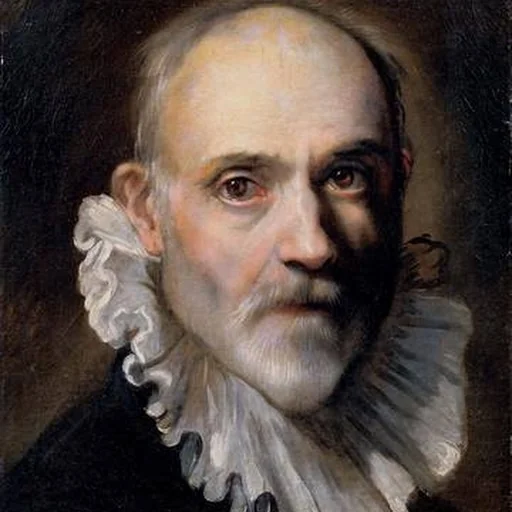
Federico Barocci (also written Barozzi) (c. 1535 – 30 September 1612) was an Italian Renaissance painter and printmaker. His original name was Federico Fiori, and he was nicknamed Il Baroccio. His work was highly…