Artwork
The Fieldfare of Carolina (Turdus migratorius)
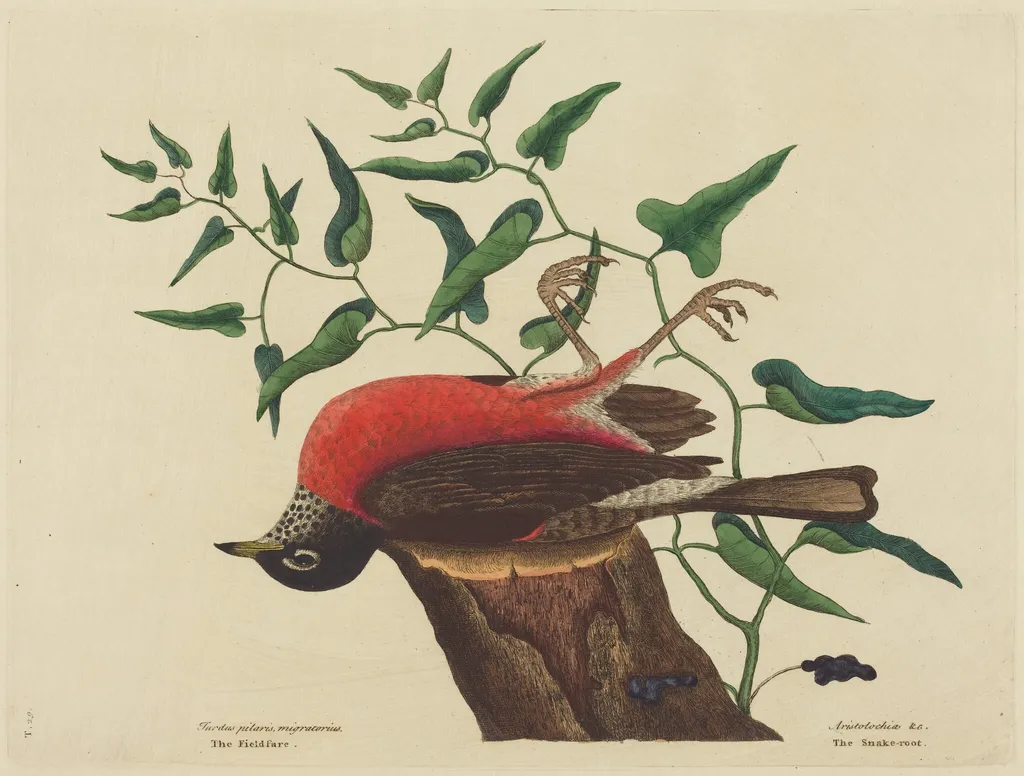
The Fieldfare of Carolina (Turdus migratorius) is an ink print by the Baroque artist Mark Catesby. It dates from 1737 and is held in the collection of the National Gallery of Art.
- Inscription
- Inscribed:lower left in plate: T.29.; lower left in plate: Turdus pilaris,migratorius. / The Fieldfare.; lower left in plate: Aristolochia &c. / The Snake-root.
About this work
Overview
Created in 1737 by English naturalist Mark Catesby, this print combines etching and engraving with hand‑applied color on laid paper. It forms part of Catesby’s extensive illustrated series documenting the plants and animals of Carolina, Florida and the Bahama Islands, a project that unfolded between 1729 and 1747.
Subject & Meaning
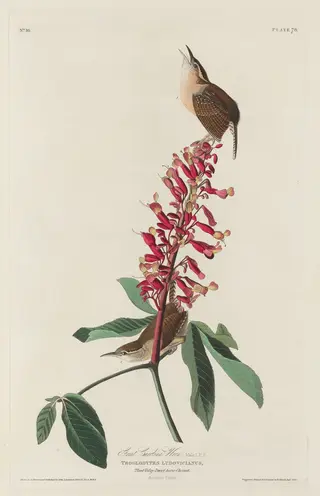
The image portrays a vivid red bird, identified by Catesby as a fieldfare, perched on a twisted branch beside a vine bearing green leaves and small purple berries. The bird’s open beak suggests a moment of feeding or vocalizing, while the accompanying plant, labeled as snake‑root, situates the creature within its natural habitat.
Technique & Style
Catesby employed a combination of etching and engraving to render fine line work, then added color by hand to enhance the bird’s plumage and surrounding foliage. The use of laid paper provides a subtle texture that contrasts with the crisp, precise outlines and the bright, saturated pigments.
History & Provenance
The print was issued as one of the plates in Catesby’s multi‑volume natural history, a pioneering work that introduced European audiences to North American wildlife. Original impressions were circulated among scientific societies and collectors in the 18th century, establishing Catesby’s reputation as a meticulous observer.
Context
During the early 1700s, European naturalists sought reliable visual records of New World species. Catesby’s illustrations, produced with the emerging print technologies of his time, filled a gap in knowledge about the southeastern United States, complementing contemporary botanical and zoological texts.
Legacy
Catesby’s plates, including this fieldfare illustration, remain reference points for historians of science and art. Their blend of scientific accuracy and artistic detail set a standard for later natural history publications, influencing figures such as John James Audubon and subsequent generations of wildlife illustrators.
Own this work as a print
Artist & collection

Artist
Mark Catesby (24 March 1683 – 23 December 1749) was an English naturalist who studied the flora and fauna of the New World.