Artwork
Amusing Dance - Sioux
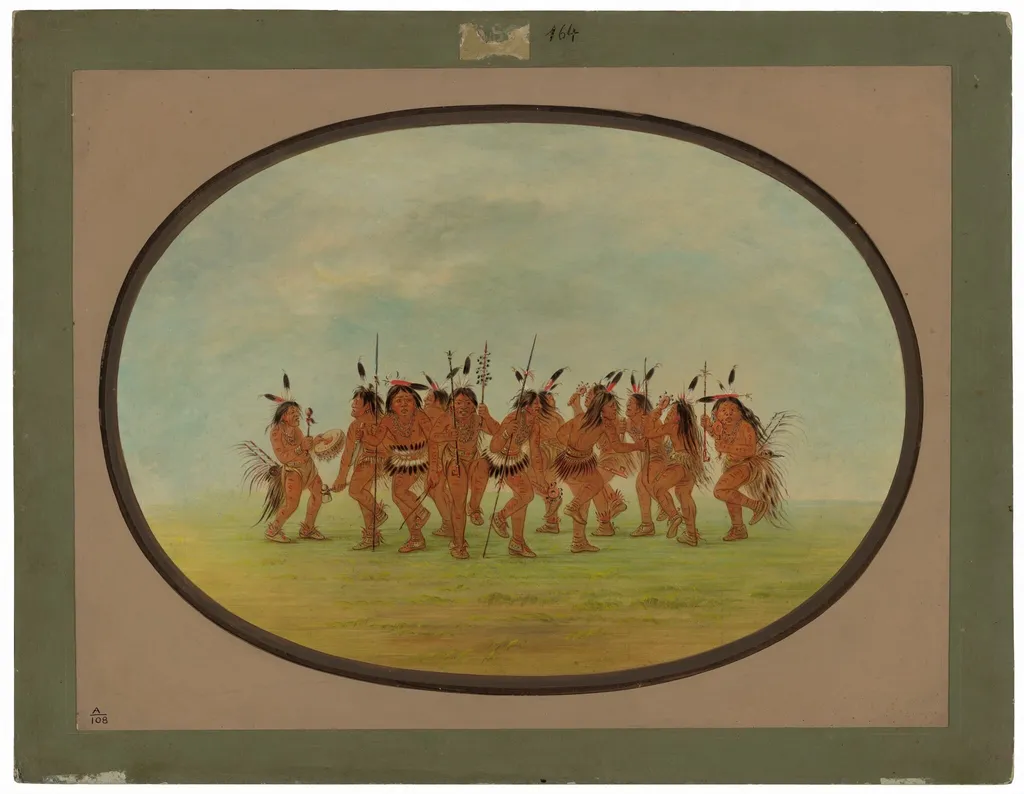
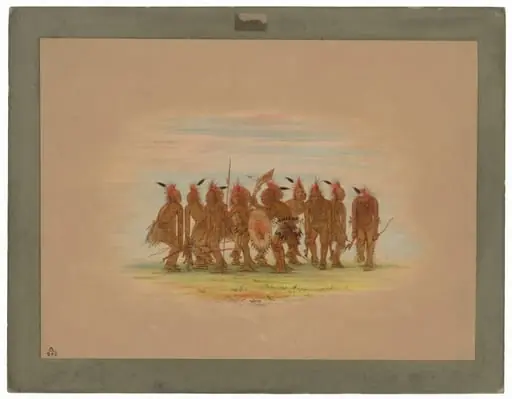
Amusing Dance - Sioux is an oil painting by the Impressionist artist George Catlin. It dates from 1865 and is held in the collection of the National Gallery of Art.
- Inscription
- Inscribed:lower left on card: A/108; upper center on board, remnant of torn paper without numerals partially obscures pink numerals beneath: [1?]58; upper center on board, right of pink numerals in graphite: 164; upper center reverse in orange crayon: 57; upper center reverse in script, possibly the artist's hand, in graphite: This Collection of paintings is now all ready for a thin Coat of Varnish; upper left reverse in graphite, at angle slanting toward center: 57 pas [or nos] in [or on] ticket; lower left reverse in graphite: Look up; center right reverse in graphite, inverted: Var
About this work
Check out Catlin’s other paintings at the National Gallery of Art, Washington.
George Catlin painted a lively dance scene in 1861. Bright colors show people in motion under a clear sky. Their clothes are simple but full of energy.
This work stands out because Catlin spent years with Plains tribes. He recorded their customs before modern life changed them forever. The brushwork is quick and lively, like the dance itself.
Want to see more Native American art? Check out Catlin’s other paintings at the National Gallery of Art, Washington.
Overview
Amusing Dance - Sioux is an oil painting by American artist George Catlin (1796-1872), dated 1861, measuring 46.7 by 61.7 centimeters (18 3/8 by 24 5/16 inches). The work is executed in oil on card mounted on paperboard and is held in the collection of the National Gallery of Art in Washington, D.C., under accession number 1965.16.17. It belongs to Catlin's second major body of work, known as the "Cartoon Collection," which he produced during the 1850s and 1860s after his earlier "Indian Gallery" of the 1830s. The painting is significant as both an ethnographic record and an artistic document of 19th-century Native American life, reflecting Catlin's lifelong project to preserve the visual culture of Indigenous peoples he believed were facing extinction.
Subject & Meaning
The painting depicts approximately twelve Sioux dancers arranged in a line across a flat green landscape beneath a pale blue sky with soft clouds. According to Catlin's own 1871 catalog entry for this work, then titled "Chiefs' Dance," the dance was performed in his honor by venerable chiefs of a Sioux village who had not danced for many years. The figures wear feathered headdresses, fringed garments, and moccasins, with some carrying spears, rattles, or staffs. A drummer appears at the far left. Their bodies are captured in active poses with bent knees, many with arms raised or extended toward neighbors, conveying rhythmic communal movement. The subject thus documents a specific ceremonial occasion rather than a generic scene, with Catlin positioning himself as honored witness to a performance by elders who had resumed a practice long dormant. The iconography of regalia and instruments serves both documentary and aesthetic purposes, preserving details of material culture while organizing the figures into a coherent visual rhythm.
Technique & Style
The painting is executed in oil on card mounted on paperboard, a support characteristic of the Cartoon Collection works. The composition is oval, set within a rectangular tan mat with a darker green border. The palette consists of warm ochre and brown tones for skin, black and white for regalia details, and muted greens and blues for the environment. The brushwork appears smooth and detailed, with careful attention to costume and the rhythmic arrangement of figures. The overall finish is polished and illustrative, consistent with Catlin's documentary aims. Inscriptions on the work include "A 108" stamped at lower left, the number "164" at upper center, and various notations on the reverse including a note possibly in the artist's hand stating "This Collection of paintings is now all ready for a thin Coat of Varnish." The handling prioritizes clarity of information and legibility of gesture over atmospheric or expressive effects, aligning with the work's ethnographic function.
History & Provenance
The painting remained in Catlin's possession until his death in 1872, then descended to his daughters Clara Gregory Catlin, Louise Catlin Kinney, and Elizabeth Wing Catlin. In 1912, the American Museum of Natural History purchased the work from Elizabeth Wing Catlin. It was deaccessioned in 1959 and sold through Kennedy Galleries in New York to Paul Mellon of Upperville, Virginia. Mellon gifted it to the National Gallery of Art in 1965. The work has been exhibited extensively: at the Salle du Jardin Botanique in Brussels in 1870 (as no. 158); at Somerville Gallery, New York, in 1871 (as no. 157) for Catlin's own exhibition of the Cartoon Collection; at the Smithsonian Institution in 1872; possibly at the Centennial Exhibition in Philadelphia in 1876; at Kennedy Galleries in 1956; on long-term loan to the Whitney Gallery of Western Art at the Buffalo Bill Historical Center in Cody, Wyoming, from 1964 to 1974; and in a 1989 exhibition at the Buffalo Bill Historical Center. From 1990 to 1995 it traveled in the National Gallery of Art's National Lending Service to venues including the Delaware Art Museum, Palm Springs Desert Museum, Boise Art Museum, Hofstra Museum, West Bend Gallery of Fine Arts, Payne Gallery at Moravian College, and Lore Degenstein Gallery.
Context
George Catlin produced two major collections of paintings documenting Native American life. The first, his "Indian Gallery" of more than 500 works from the 1830s, is now largely at the Smithsonian American Art Museum. The second, the "Cartoon Collection" of more than 600 works from the 1850s and 1860s, included this painting and was acquired by the American Museum of Natural History in 1912. Paul Mellon's purchase of over 300 deaccessioned works from that collection, and his 1965 gift of 351 paintings to the National Gallery of Art, ensured the survival and public accessibility of this major portion of Catlin's oeuvre. Catlin's project was motivated by the Indian Removal Act of 1830 and his conviction that Indigenous peoples were a "dying nation" without their own historians. He spent eight years visiting more than 45 tribes, producing works that he claimed offered "probably the most truthful" view of Indian life yet presented to the public. Critical reception in his lifetime noted the "roughness and energy" of his subject matter, and his introduction of previously un-depicted tribes including the Blackfoot, Crow, Plains Cree, and Yanktonai Sioux.
Legacy
As part of the Cartoon Collection, Amusing Dance - Sioux represents the later phase of Catlin's documentary project, when he was working from memory and earlier sketches rather than direct observation. The painting's afterlife has been shaped by its inclusion in major institutional collections and its role in circulating Catlin's imagery to wide audiences through the National Gallery of Art's lending program. The work exemplifies the tensions in Catlin's legacy: his genuine commitment to preserving visual records of Indigenous cultures, and the problematic framing of those cultures as vanishing or doomed. The painting continues to serve as a primary source for understanding 19th-century Sioux ceremonial practice and Catlin's particular mode of ethnographic art, even as scholars interrogate the colonial frameworks within which it was produced and initially received. Its polished illustrative quality and specific documentary claims make it a touchstone for discussions of visual anthropology, American art, and the representation of Indigenous peoples in the 19th century.
Own this work as a print
Artist & collection

Artist
George Catlin ( KAT-lin; July 26, 1796 – December 23, 1872) was an American lawyer, painter, author, and traveler, who specialized in portraits of Native Americans in the American frontier.

 Bulls Fighting
 Expedition Encamped on a Texas Prairie. April 1686
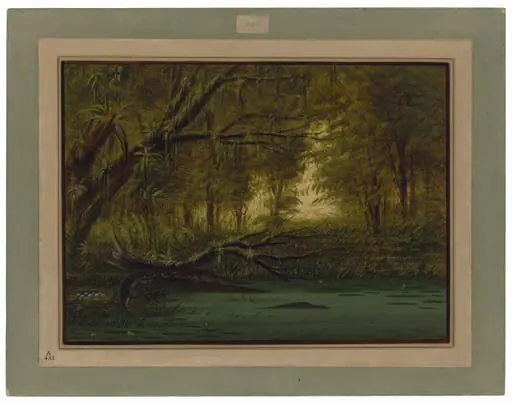 An Alligator's Nest
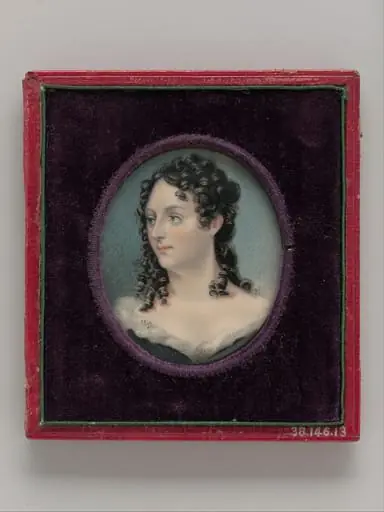 Mrs. George Catlin (Clara Bartlet Gregory)
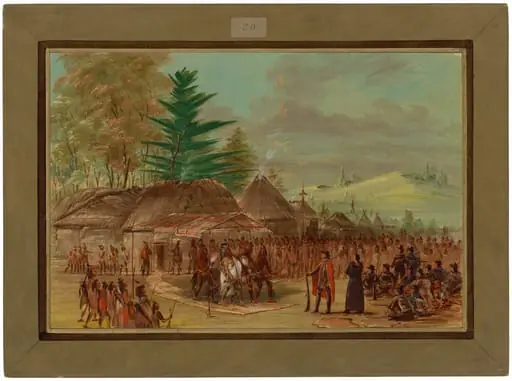 Chief of the Taensa Indians Receiving La Salle. March 20, 1682
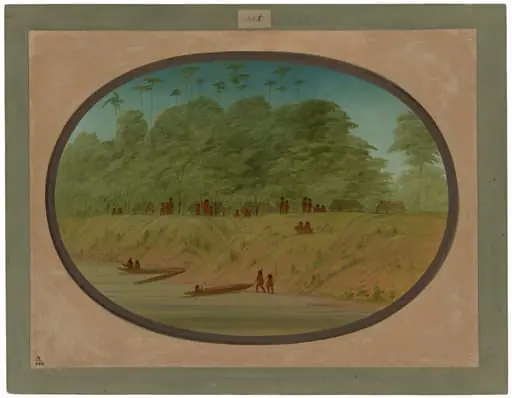 A Small Village - Payaguas Indians
 Omaha Chief, His Wife, and a Warrior
 Father Hennepin Leaving the Mississippi to Join La Salle. May 8, 1680