Artwork
Dog Dance - Sioux
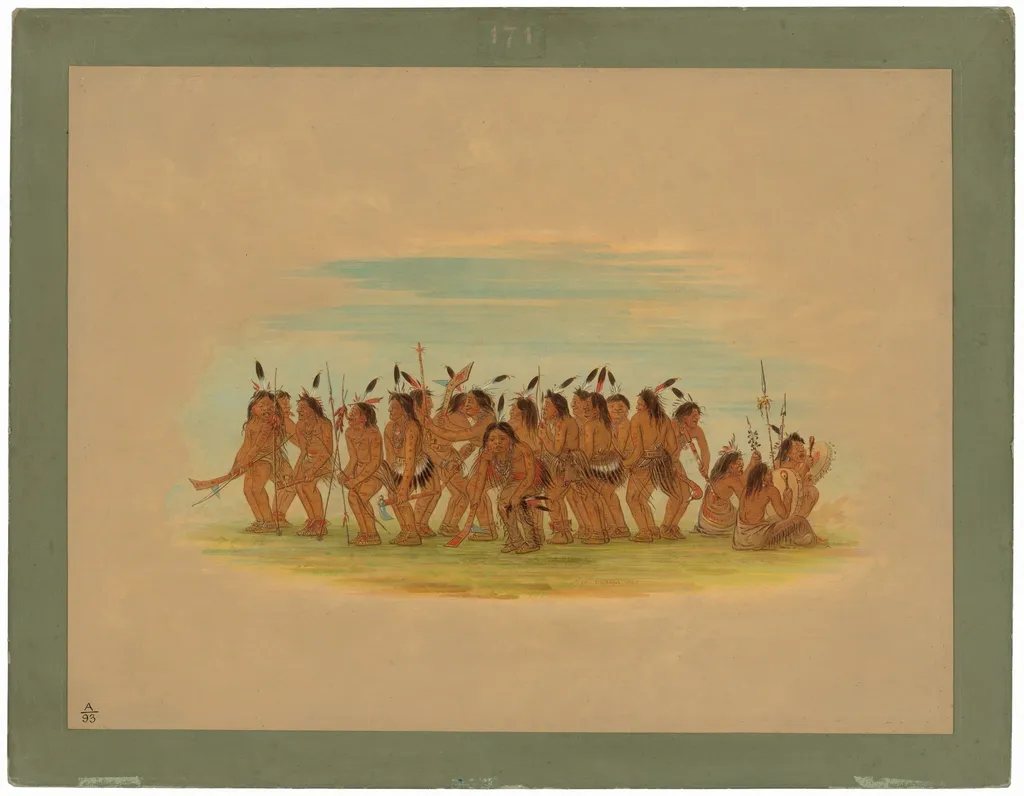
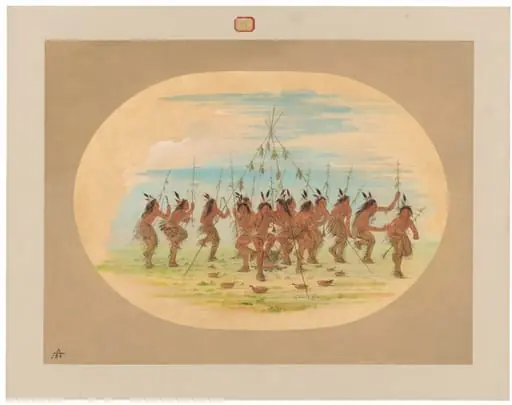
Dog Dance - Sioux is an oil painting by the Impressionist artist George Catlin. It dates from 1861 and is held in the collection of the National Gallery of Art.
- Inscription
- Inscribed:lower center on card: Geo. Catlin. 1861; lower left on card: A/93; upper center on board in pink paint: 171; upper center reverse in graphite: 170; left center reverse in graphite: Var
About this work
Overview
2 centimeters, it depicts a ceremonial dance of the Sioux people and is now held in the collection of the National Gallery of Art in Washington, D.
Dog Dance - Sioux is an oil painting on card mounted on paperboard by American artist George Catlin, dated 1861. Measuring 46.7 by 62.2 centimeters, it depicts a ceremonial dance of the Sioux people and is now held in the collection of the National Gallery of Art in Washington, D.C., as part of the Paul Mellon Collection, accessioned in 1965 under the number 1965.16.6. The work belongs to Catlin's second major collection of Native American subjects, known as the Cartoon Collection, which he produced during the 1850s and 1860s following his earlier Indian Gallery of the 1830s. While Catlin's first collection is celebrated for its extensive documentation of Native American life during his western travels, the Cartoon Collection represents a later phase in which the artist revisited and expanded upon his earlier subjects. Dog Dance - Sioux exemplifies Catlin's sustained commitment to recording Indigenous customs and rituals, a project he pursued with the stated aim of preserving the appearance and practices of what he believed were vanishing cultures.
Subject & Meaning
The painting portrays the Dog Dance, a ritual Catlin described as peculiar to the Sioux tribe. According to the artist's own 1871 catalog entry for this work, the ceremony involved killing a dog, removing its heart, cutting it into hanging pieces, and suspending them from a stake. To enter the dance, each participant boasted of having swallowed a piece of an enemy's heart killed in battle; if no one denied the claim, the dancer approached the stake, bit off a piece of the dog's heart, swallowed it, and joined the dance. Visually, the composition presents a horizontal arrangement of Indigenous men in tight cluster, with standing figures wearing feathered headdresses, loincloths, and moccasins, many holding long staffs, spears, or ceremonial objects. Several grasp curved wooden sticks. Their bodies lean forward in unison, suggesting coordinated movement. Three seated figures to the right appear to play drums or rattles, providing musical accompaniment. The minimal background, a pale sky with soft horizontal bands of blue and cream above a narrow strip of green and yellow ground, focuses attention on the ritual action. The iconography reflects Catlin's documentary intent, capturing regalia and movement with ethnographic specificity.
Technique & Style
Catlin executed Dog Dance - Sioux in oil on card mounted on paperboard, a support characteristic of his Cartoon Collection works. The surface appears smooth with delicate, precise brushwork and flat, even color application, producing a polished and illustrative finish. The palette is dominated by warm ochres, browns, and tans, with touches of red, black, and white in the regalia. The artist paid careful attention to anatomical detail and decorative elements, rendering feathered headdresses, moccasins, and ceremonial objects with clarity. The overall handling suggests a work designed for reproduction and exhibition, consistent with the Cartoon Collection's function as a second, more accessible iteration of Catlin's Indian subjects. Inscriptions on the work include the artist's signature and date faintly near the bottom edge of the painted field, the number 171 at top center, and A 93 at lower left. The dimensions of 46.7 by 62.2 centimeters indicate a modest scale suited to intimate viewing and portability, fitting the collection's intended circulation.
History & Provenance
The painting remained in Catlin's possession until his death in 1872, then descended to his daughters Clara Gregory Catlin, Louise Catlin Kinney, and Elizabeth Wing Catlin. In 1912, the American Museum of Natural History purchased the work from Elizabeth Wing Catlin, acquiring it as part of a larger group of Cartoon Collection survivals. The museum deaccessioned the work in 1959, selling it through Kennedy Galleries in New York to Paul Mellon of Upperville, Virginia. Mellon, a major collector of American art, purchased more than 300 paintings from the deaccessioned Cartoon Collection. He gave 351 works from this collection to the National Gallery of Art in 1965, including Dog Dance - Sioux. The work was exhibited during Catlin's lifetime at the Salle du Jardin Botanique, Brussels, in 1870 as number 171, and at the Somerville Gallery, New York, in 1871 as number 170 in Catlin's Indian Cartoons exhibition. It appeared at the Smithsonian Institution in Washington, D.C., in 1872, and possibly at the Centennial Exhibition in Philadelphia in 1876. Later exhibitions include George Catlin, American Indians at Kennedy Galleries in 1956, a loan to the Buffalo Bill Historical Center in Cody, Wyoming, from 1964 to 1974, and an extended loan to Justice Sandra Day O'Connor at the Supreme Court of the United States from 1981 to 1991, with temporary returns to the National Gallery of Art.
Context
George Catlin occupies a complex position in American art history. Born in 1796, he had little formal artistic training, having first pursued law before turning to portraiture in Philadelphia. His encounter with a delegation of Indians in Philadelphia around 1828 redirected his career toward Native American subjects. Catlin traveled extensively in the West during the 1830s, producing over 500 works for his Indian Gallery, and later created the Cartoon Collection of more than 600 works during the 1850s and 1860s. Critical assessment of Catlin has been mixed. In his lifetime, he was considered a secondary painter, yet his collection represents the largest body of pre-photographic material on Native Americans. Some scholars have noted his empathetic portrayal of Indigenous peoples as fellow human beings rather than savages, uncommon for his era, while others have examined the theatrical and commercial dimensions of his exhibitions. The Cartoon Collection, to which Dog Dance - Sioux belongs, has received particular scholarly attention as a later reworking of earlier themes, raising questions about authenticity and repetition in Catlin's practice. The work appears in National Gallery of Art catalogues from 1970, 1980, and 1992, and is discussed in Nancy K. Anderson's 2008 publication George de Forest Brush: The Indian Paintings.
Legacy
Dog Dance - Sioux endures as a significant document of Catlin's sustained engagement with Native American subject matter across four decades of his career. As part of the Paul Mellon Collection at the National Gallery of Art, it benefits from institutional prominence and accessibility to researchers and the public. The work's inclusion in Justice Sandra Day O'Connor's chambers from 1981 to 1991 indicates its continued relevance in American cultural and political contexts. More broadly, the Cartoon Collection has facilitated ongoing scholarly examination of Catlin's methods, his relationships with Native subjects, and the ethics of ethnographic representation in nineteenth-century American art. The painting's afterlife is intertwined with debates about the preservation and interpretation of Catlin's vast archive, which remains divided among several institutions. Its value lies less in aesthetic innovation than in documentary persistence, offering contemporary viewers a window, however mediated, into ceremonial practices that Catlin sought to record and preserve.
Own this work as a print
Artist & collection

Artist
George Catlin ( KAT-lin; July 26, 1796 – December 23, 1872) was an American lawyer, painter, author, and traveler, who specialized in portraits of Native Americans in the American frontier.

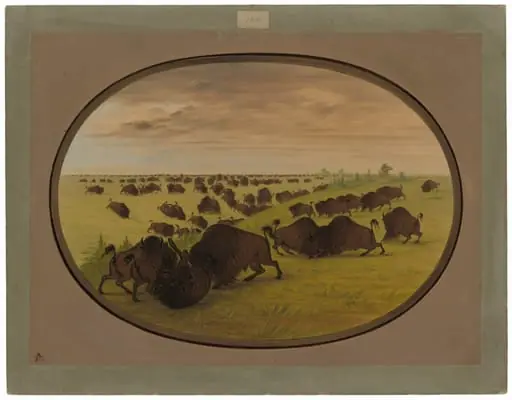 Bulls Fighting
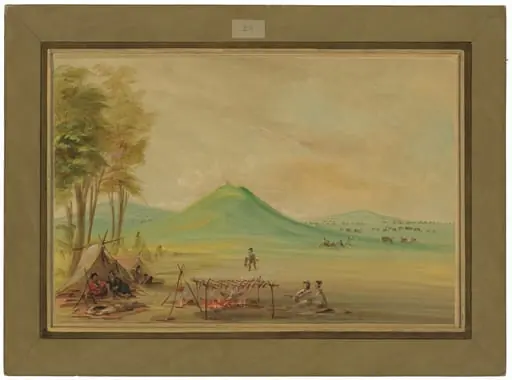 Expedition Encamped on a Texas Prairie. April 1686
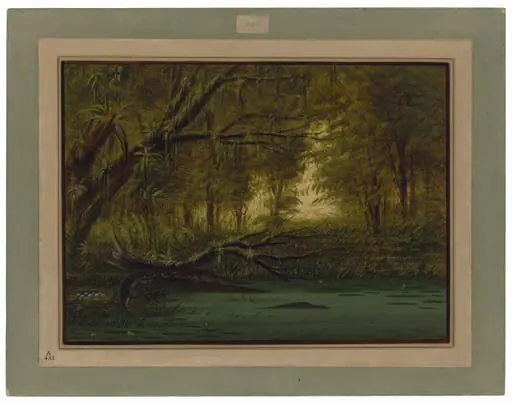 An Alligator's Nest
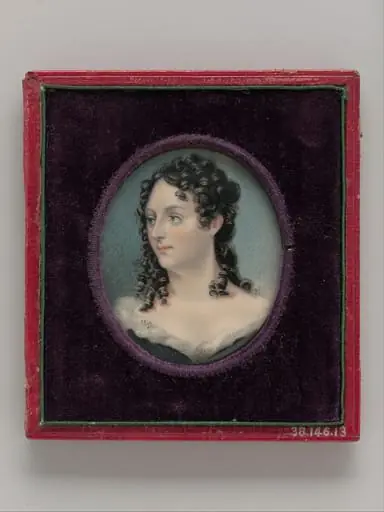 Mrs. George Catlin (Clara Bartlet Gregory)
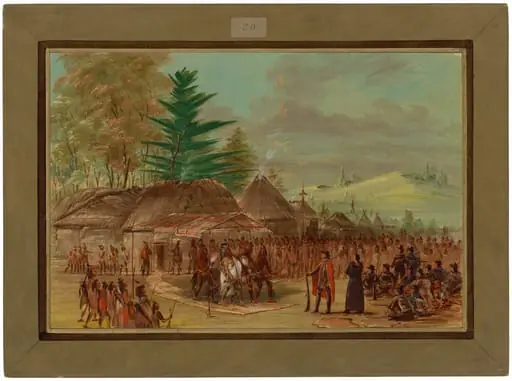 Chief of the Taensa Indians Receiving La Salle. March 20, 1682
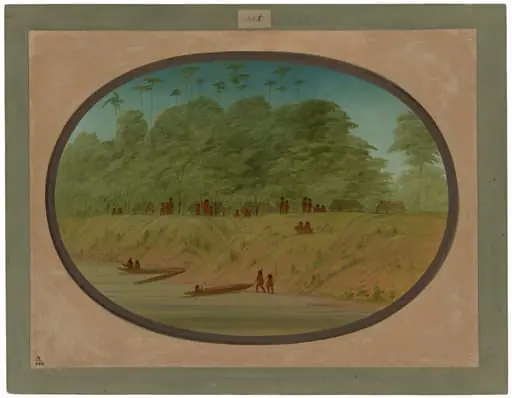 A Small Village - Payaguas Indians
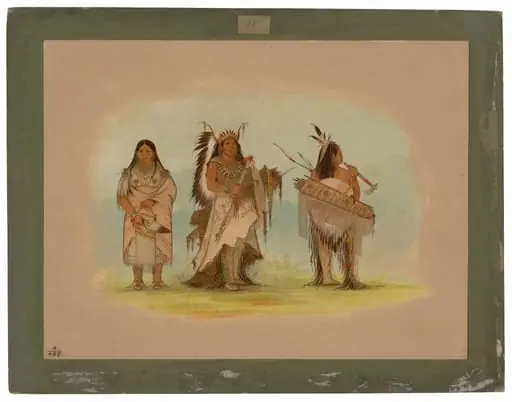 Omaha Chief, His Wife, and a Warrior
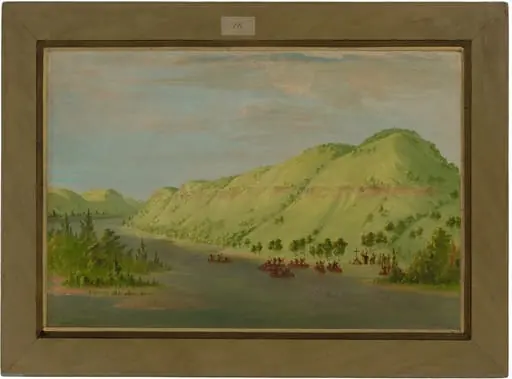 Father Hennepin Leaving the Mississippi to Join La Salle. May 8, 1680