Artwork
The Sheepfold
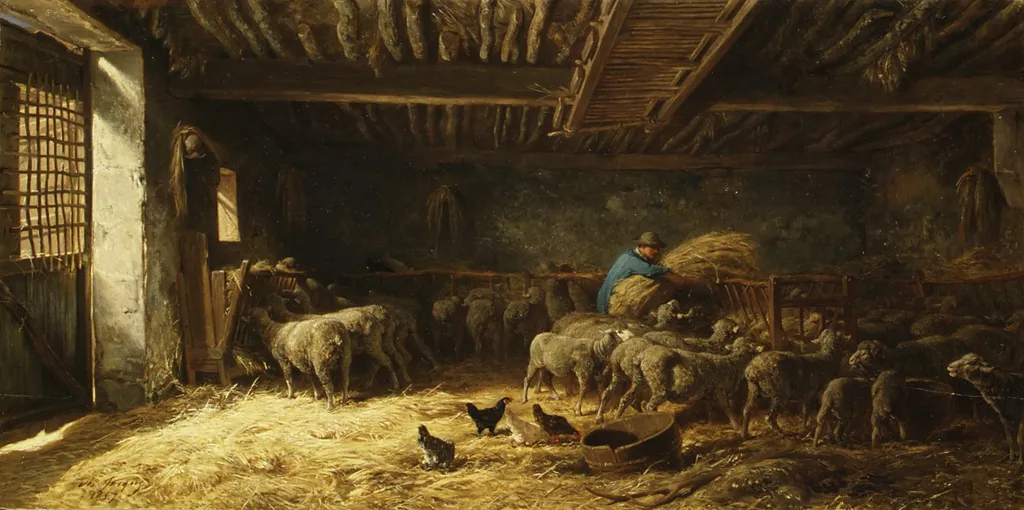
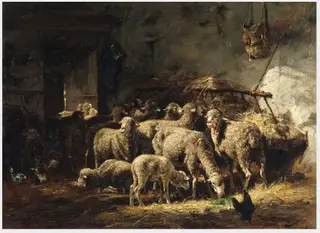
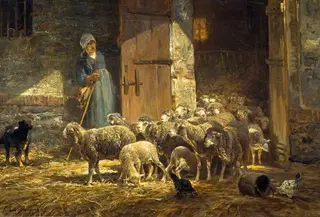
The Sheepfold is an oil painting by the Barbizon school artist Charles-Émile Jacque. It dates from 1857 and is held in the collection of the Metropolitan Museum of Art.
About this work
Subject & Meaning
The Sheepfold (1857) by Charles Jacque depicts a farmer tending a flock of sheep alongside a chicken, a scene that embodies the everyday labor of rural life.
The Sheepfold (1857) by Charles Jacque depicts a farmer tending a flock of sheep alongside a chicken, a scene that embodies the everyday labor of rural life. The composition foregrounds the shepherd’s activity, suggesting the dignity of agricultural work and the harmony between humans and livestock. By presenting the farmer within a pastoral setting, Jacque conveys an idealized vision of the countryside, where toil is linked to stewardship and communal sustenance.
The painting’s focus on ordinary rural figures reflects 19th‑century French interest in genre scenes that celebrate agrarian rhythms.
Technique & Style
Created in 1857, The Sheepfold is an oil painting executed by Charles Jacque on a panel support. The work measures 46 centimeters in height and 91.8 centimeters in width. As a painting classified within the medium of oil paint, the piece depicts a rural scene featuring a man, a farmer, sheep, and a chicken engaged in work.
The formal composition utilizes these figures to construct a pastoral narrative typical of the artist's focus on agricultural life. The physical construction combines the durability of the panel with the textural qualities of oil paint, resulting in a stable artwork currently held in the collection of the Metropolitan Museum of Art.
History & Provenance
Charles Jacque created the oil painting The Sheepfold in 1857. Executed on a panel measuring 46 by 91.8 centimeters, the work depicts a rural scene featuring a farmer, a man, sheep, and a chicken. The painting eventually entered the collection of the Metropolitan Museum of Art, where it is currently housed.
No specific details regarding the original commission or the intermediate ownership chain between its creation in 1857 and its acquisition by the museum are provided in the available records.
The Sheepfold (1857) is an oil on panel painting by Charles Jacque, classified as a painting. The work measures 46 cm in height by 91.8 cm in width and is held by the Metropolitan Museum of Art, where it is recorded in the museum’s collection. Its title, date, and medium are documented in the catalog entry, and the piece is listed under the museum’s inventory as a Charles Jacque painting. No exhibition history is noted in the available sources.
Context
The Sheepfold (1857) is an oil‑on‑panel painting measuring 46 × 91.8 cm that belongs to the Metropolitan Museum of Art’s collection. Charles Jacque’s work depicts a farmer alongside a man, chicken, sheep and other farm animals, a subject that aligns with his broader focus on rural labor. The depicted scene of a farmer with livestock exemplifies the agrarian subjects that characterize Jacque’s oeuvre, illustrating his contribution to 19th‑century French pastoral genre painting and highlighting the work’s significance within the historical documentation of agrarian life.
Overview
Charles Jacque, a French painter and engraver, completed The Sheepfold in 1857 using oil paint. This work exemplifies his characteristic focus on pastoral subjects, depicting a farmer attending to his livestock, sheep and chickens, within a rustic barn interior. The painting reflects Jacque's association with the Barbizon School, an artistic movement dedicated to portraying unidealized rural life and natural environments.
Artist & collection

Artist
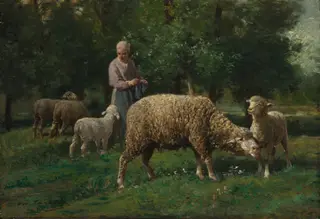
Charles-Émile Jacque (23 May 1813 – 7 May 1894) was a French painter of Pastoralism and engraver who was, with Jean-François Millet, part of the Barbizon School. He first learned to engrave maps when he spent seven years in the French Army.