Artwork
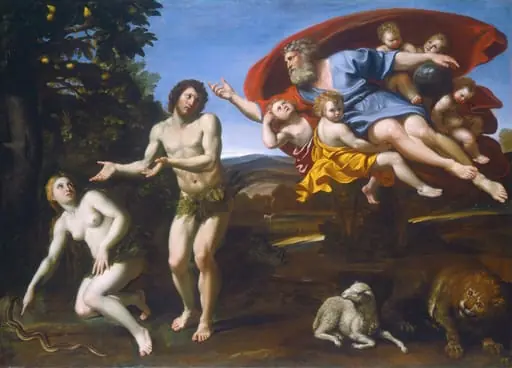
The Rebuke of Adam and Eve
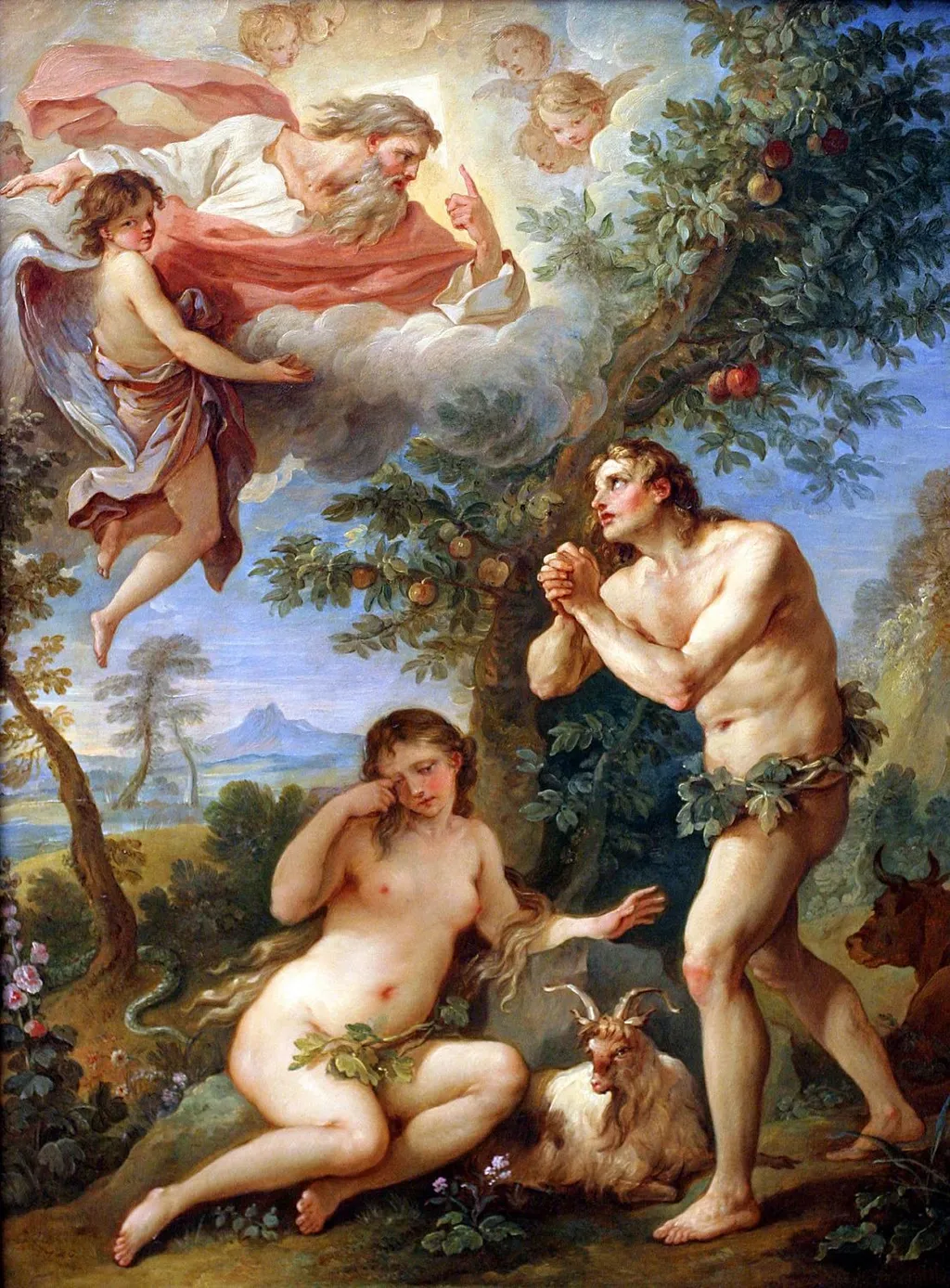
The Rebuke of Adam and Eve is an oil painting by the Rococo painting artist Charles-Joseph Natoire. It dates from 1740 and is held in the collection of the Metropolitan Museum of Art.
About this work
Subject & Meaning
The scene depicts the moment after Adam and Eve's expulsion from Paradise, when God confronts them for their disobedience.
The scene depicts the moment after Adam and Eve's expulsion from Paradise, when God confronts them for their disobedience. Natoire's composition centers on a radiant divine figure, likely God the Father, raising an admonishing hand toward the first parents, who recoil in shame and remorse. An angel to the right reinforces the divine rebuke, while the surrounding landscape features a barren tree and livestock (cattle and goat) to underscore the Fall's consequence: the loss of Eden's fertility and humanity's new burden of labor. The goat, a traditional symbol of sin and penitence, reinforces the moral weight of the scene.
Technique & Style
Created in 1740, The Rebuke of Adam and Eve is an oil painting executed on a canvas support by Charles-Joseph Natoire. The work measures 67.9 centimetres in height and 50.2 centimetres in width. Classified as a religious painting, the artist utilized oil paint to depict a narrative scene containing figures of Adam, Eve, an angel, and a deity, alongside natural elements such as a tree and livestock including cattle and a goat.
The piece is currently held within the collection of the Metropolitan Museum of Art. The medium and support combination reflects standard 18th-century European painting practices for works of this scale and genre.
History & Provenance
The Rebuke of Adam and Eve is an oil on canvas painting executed in 1740 by French artist Charles-Joseph Natoire. It portrays a biblical scene with Adam, Eve, an angel, a tree, cattle and a goat. According to the documented record, the work was created in that year and later entered the collection of the Metropolitan Museum of Art, where it remains on view.
No earlier owners or sale records are noted in the available sources, and the painting was evidently produced as an independent religious composition rather than as part of a series or patron-driven commission.
Overview
This oil painting, titled The Rebuke of Adam and Eve, depicts a pivotal moment from the biblical narrative. Set within a verdant landscape, the composition features four distinct figures. An angelic messenger and a divine presence hover above, while Adam and Eve occupy the foreground, seemingly in the aftermath of their transgression. The work captures a quiet, contemplative scene, rendered with a delicate palette and subtle illumination.
Artist & collection

Artist
Charles-Joseph Natoire (3 March 1700 – 23 August 1777) was a French painter in the Rococo manner, a pupil of François Lemoyne and director of the French Academy in Rome, 1751–1775.