Artwork
Entry of Napoleon I into Berlin, 27th October 1806
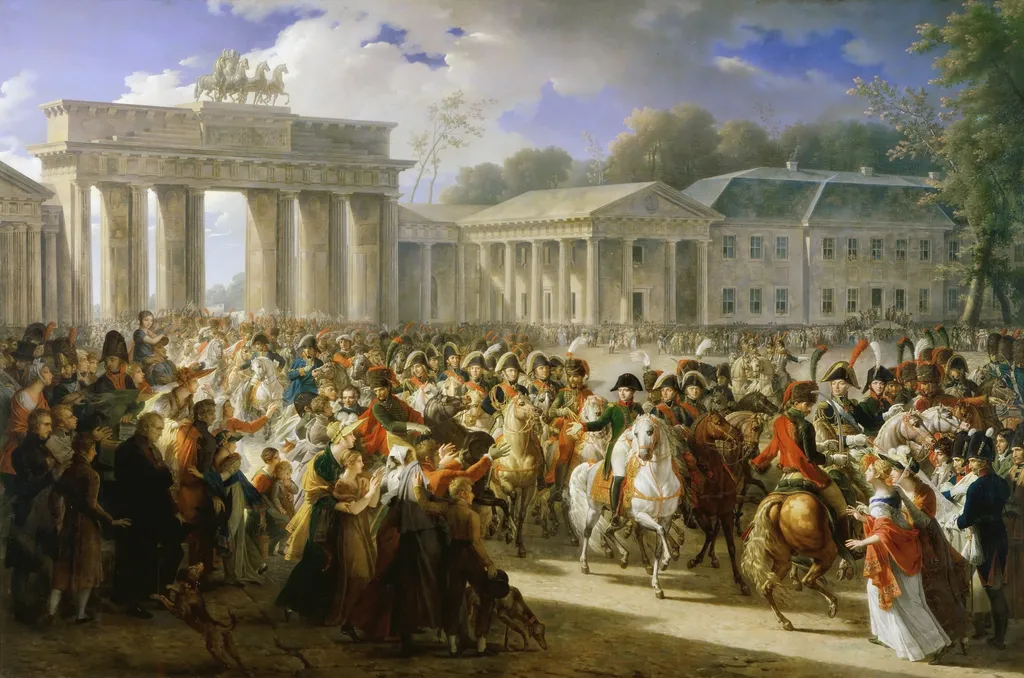
Entry of Napoleon I into Berlin, 27th October 1806 is an oil painting by Charles Meynier. It dates from 1810 and is held in the collection of the Palace of Versailles.
About this work
Subject & Meaning
The scene is historically anchored in the 21st Bulletin of the Grande Armée, which records the city's surrender and the presentation of its keys to the Emperor.
The painting depicts the French Emperor Napoleon I entering Berlin on October 27, 1806, following his decisive victories at Jena and Auerstedt. Napoleon is shown riding at the head of his troops through the Brandenburg Gate, viewed from Pariser Platz, symbolizing the peak of his military success and the imposition of French control over Prussia. The composition includes marshals such as Berthier, Davout, and Augereau, alongside the Imperial Guard, illustrating the grandeur of the Grande Armée. The scene is historically anchored in the 21st Bulletin of the Grande Armée, which records the city's surrender and the presentation of its keys to the Emperor. By portraying this moment under a sunlit sky with crowds lining the route, the work functions as imperial propaganda, celebrating the establishment of the Continental System and the subjugation of a major European power.
Technique & Style
Charles Meynier executed this history painting in 1810 using oil paint on a canvas support. The work is monumental in scale, measuring 363 cm in height and 493 cm in width. Stylistically, the composition depicts Napoleon leading his troops through the Brandenburg Gate as viewed from the Pariser Platz, with the Emperor positioned in the foreground acknowledging a crowd of onlookers. The scene is illuminated by bright sunlight, reflecting the official account of a superb day described in the 21st Bulletin of the Grande Armée. As a military painter, Meynier structured the narrative to glorify the Grande Armée's campaign, surrounding the central figure with marshals and imperial guards to emphasize imperial authority and victory.
History & Provenance
Charles Meynier painted Entry of Napoleon I into Berlin, 27th October 1806 in 1810, commissioned by Napoleon I for the Galerie de Diane at the Tuileries Palace in 1809, though the work remained in his studio until acquired by the French state and installed in the Musée national des châteaux de Versailles et de Trianon. The painting, executed in oil on canvas, measures 363 cm in height and 493 cm in width, and was first exhibited at the Salon of 1810. It depicts Napoleon's victorious entry into Berlin following the Battle of Jena, with the Brandenburg Gate in the background, and draws on official bulletins from the Grande Armée to render the historical scene with accuracy. The work has remained in the collection of the Palace of Versailles since its acquisition.
The painting is housed in the Palace of Versailles, specifically within the Musée national des châteaux de Versailles et de Trianon. Its inventory identifiers include MV 1552, INV 6628, and MR 2134 as recorded in the Joconde database. The work was exhibited at the Salon of 1810 and has been part of the Versailles collection since it was commissioned by Napoleon I for the Galerie de Diane at the Tuileries Palace in 1809.
Context
Critical reception of Charles Meynier’s Entry of Napoleon I into Berlin has largely emphasized its propagandistic function within Napoleonic visual culture. Contemporary French audiences praised the work’s dramatic composition and patriotic vigor, viewing it as a triumphant record of imperial expansion (source 1). 19th‑century scholarship, particularly the studies of Tulard and Schurr, situates the painting within the broader output of Meynier as a military painter who chronicled the Grande Armée’s campaigns, linking it to the tradition established by Jacques‑Louis David (source 3). Modern analyses, such as those by Mayer‑Michalon, interpret the canvas as a visual embodiment of the Berlin Decree and the Continental System, highlighting its role in consolidating Napoleon’s political narrative (source 5). The work’s placement in the Musée national des châteaux de Versailles underscores its status as a canonical example of French historic painting from the early 19th century (source 6).
Legacy
The painting was widely recognized as a visual celebration of Napoleon's dominance after his victory at Jena and Auerstedt, and it was reproduced in lithographs around 1830, cementing its place in the popular memory of the Napoleonic era. Contemporary reviews praised its dramatic composition and its role in promoting the myth of the Grande Armée, influencing later military art that emphasized heroic leadership and imperial triumph. The work's display at the Salon of 1810 helped establish a genre of historical painting that combined patriotic narrative with precise topographical detail, a model that French academic painters followed throughout the 19th century. Its presence in the Palace of Versailles reinforced the connection between Napoleonic power and French cultural heritage, while later historians cited it as a key artifact for understanding how visual culture shaped public perception of the 1806 Prussian campaign.
Own this work as a print
Artist & collection
Artist
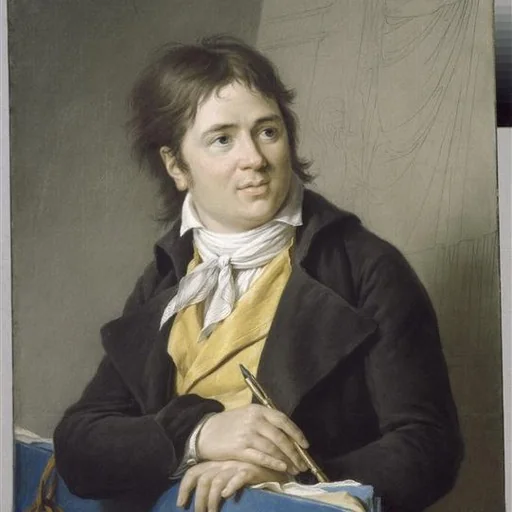
Charles Meynier (1763 or 1768, Paris – 1832, Paris) was a French painter of historical subjects in the late 18th and early 19th century. He was a contemporary of Antoine-Jean Gros and Jacques-Louis David.

 Napoleon's Return to the Island of Lobau After the Battle of Essling
 Marshal Ney hands over their flags to the soldiers of the 76th Line Regiment, November 7, 1805
 Portrait of Joseph Fesch
 Milo of Croton, Attempting to Test His Strength, Is Caught and Devoured by a Lion
 Telemachus, Urged by Mentor, Leaving the Island of Calypso
 Polyhymnia, Muse of Eloquence
 Apollo, God of Light, Eloquence, Poetry, and the Fine Arts with Urania, Muse of Astronomy
 Clio, Muse of History
 Napoleon I decorated a soldier of the Russian army in Tilsitt with the cross of the Legion of Honor
 Invalid handing a petition to Napoleon at the parade in the court of the Tuileries Palace
 Surrender of Mantua, February 2, 1797
 Napoleon dismounting with an injured foot at Regensburg, aided by the Surgeon, Yvan, April 23, 1809
 Attentat de Fieschi. Revue de la Garde nationale, 28 juillet 1835
 Napoléon harangue les troupes bavaroises et wurtembourgeoises à Abensberg, 20 avril 1809
 Life Guards Horse Regiment During the Uprising of December 14, 1825 at the Senate Square
 The Distribution of the Eagle Standards