Artwork
Jean Baptiste Simeon Chardin
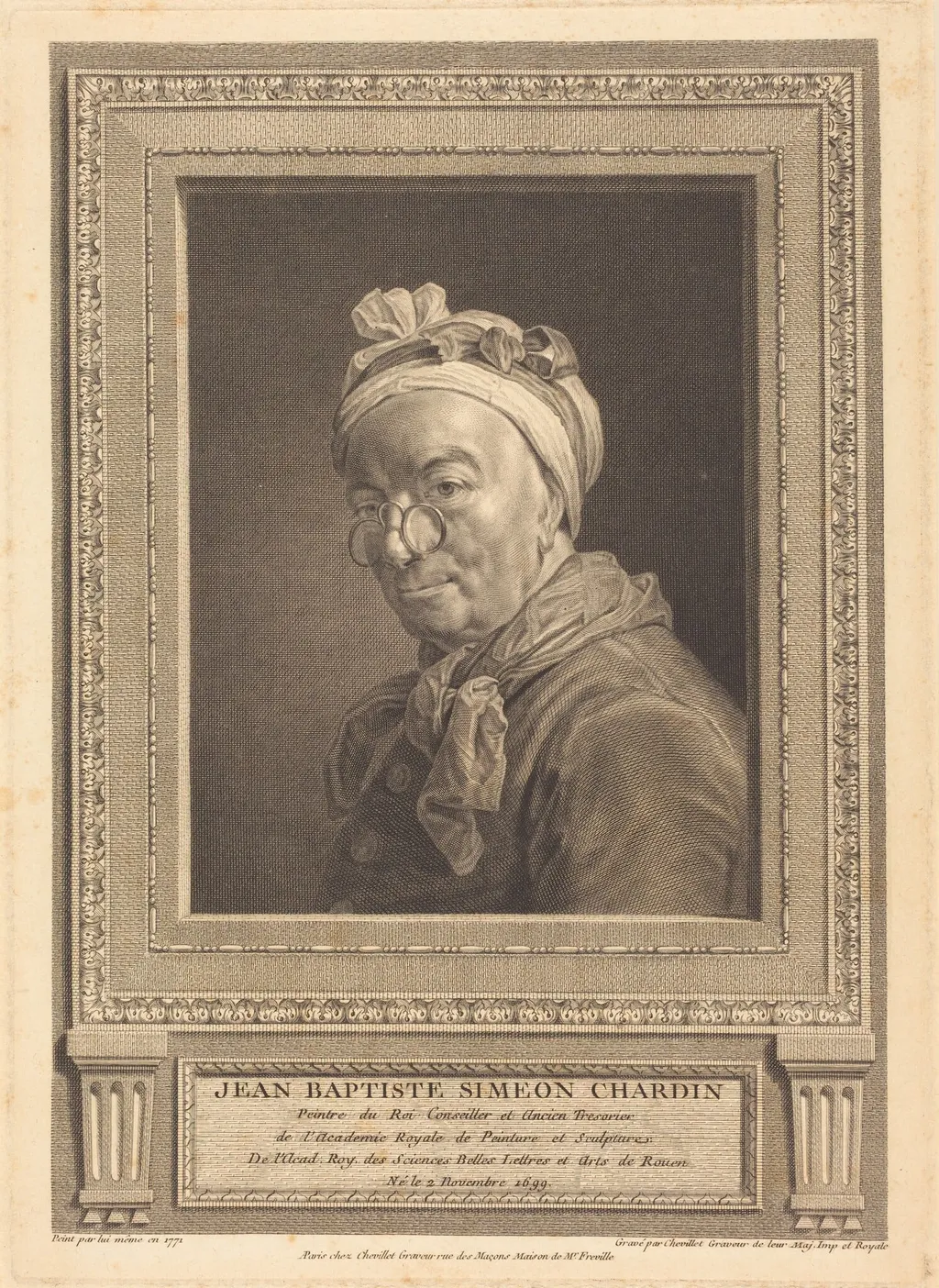
Jean Baptiste Simeon Chardin is an ink print by the Romanticist artist Juste Chevillet. It dates from 1771 and is held in the collection of the National Gallery of Art.
- Inscription
- Inscribed:recto: in plate, in image, below center: JEAN BAPTISTE SIMEON CHARDIN / Peintre du Roi Conseiller et Ancien Tresorier / de l'Academie Royale de Peinture et Sculpture / De l'Acad. Roy. des Sciences elles Lettres et Arts de Rouen / Né le 2 Novembre 1699; in plate, below image, at left: Peint par lui même en 1771; in plate, below image, at center: A Paris chez Chevillet Graveur rue des Maçons Maison de Mr. Freville; in plate, below image, at right: Gravé par Chevillet Graveur de leur Maj. Imp et Royale; verso: at center in brown ink: [unidentified name or paraph]; at lower left in graphite in later hand: Boch 2; at lower right in graphite in later hand: 1301 / RRR [?] 800
- Markings
- Marked:recto: none; verso: Lessing J. Rosenwald and National Gallery of Art
About this work
Overview
Created in 1771, this print is an etching and engraving on laid paper executed by the French printmaker Juste Chevillet. It presents a portrait of an elderly gentleman, identified by the inscription as Jean‑Baptiste‑Simeon Chardin, rendered in monochrome with a plain background that concentrates attention on the sitter.
Subject & Meaning
The figure wears round spectacles and a white cap, his expression a blend of seriousness and gentle amusement, suggested by a faint smile. The straightforward composition, devoid of extraneous detail, emphasizes the individuality and calm demeanor of the portrayed artist.
Technique & Style
Chevillet employed traditional etching methods, incising lines into a metal plate before printing onto laid paper, then enhancing the image with engraving to achieve fine tonal variation. The decorative carved lines framing the image function as a secondary ornamental border, a common device in 18th‑century portrait prints.
History & Provenance
Although the sitter is the painter Jean‑Baptiste‑Simeon Chardin, the work itself is not a painting but a print produced by Chevillet, a noted engraver of the period. The piece reflects the practice of commemorating artists through printed portraiture, a popular means of dissemination in the late Enlightenment.
Context
In the 1770s, French printmaking flourished as a medium for both artistic expression and the circulation of images of cultural figures. Chevillet’s portrait aligns with contemporary conventions that favored clear, dignified representations of intellectuals and artists, often accompanied by ornamental framing.
Own this work as a print
Artist & collection