Artwork
Grapevine
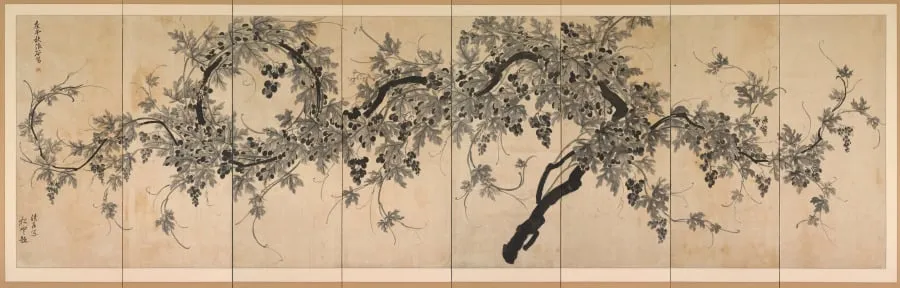
Grapevine is an unspecified painting by the Korean Minhwa artist Choe Seok-hwan. It dates from 1804 and is held in the collection of the Cleveland Museum of Art.
- Accession no.
- 2015.510
- Credit line
- Gift from the Collection of George Gund III
About this work
The artist used different shades of ink to make the vines look like they’re swaying in a summer storm, even though there’s no wind or rain in the picture.
You see a tall folding screen made of eight panels, covered with twisting grapevines and clusters of deep-blue grapes.
These grapes weren’t just food, they were a symbol of good luck in Korea’s Joseon dynasty. The artist used different shades of ink to make the vines look like they’re swaying in a summer storm, even though there’s no wind or rain in the picture.
If you like this, look up Joseon dynasty (1392–1910) to see more art from the same time.
Overview
This eight-panel folding screen depicts grapevines in dynamic, looping forms that span the entire surface. Painted in varying tones of ink, the vines appear to surge and twist as if caught in a summer storm. Created during the late Joseon dynasty, the work merges natural observation with symbolic meaning, transforming a botanical subject into a visual metaphor for abundance and continuity.
Subject & Meaning
Grapes, introduced to Korea via the Silk Road in the 7th century, evolved from ornamental motifs on lacquer and porcelain to potent symbols of fertility by the 19th century. Their clustered fruit, ripening in July, came to represent prolific lineage and familial stability. In this screen, the dense clusters and winding vines convey not just botanical realism but a cultural ideal of generational continuity and prosperity.
Technique & Style
The artist used gradations of ink, from pale washes to deep, saturated strokes, to suggest motion and depth without depicting wind or rain explicitly. The vines are rendered with fluid, calligraphic lines that echo the spontaneity of brushwork in ink painting traditions. The absence of literal weather elements heightens the sense of internal energy, as if the vines themselves generate the turbulence.
History & Provenance
Grape imagery appeared in Korean art as early as the Silla period, but its symbolic weight shifted over centuries. By the late Joseon dynasty, it became a favored theme in decorative arts and screen paintings, particularly among elite households. This screen likely originated in a scholarly or aristocratic residence, where such imagery reinforced values of lineage and harmony with nature.
Context
During the Joseon dynasty, nature was often interpreted through Confucian ideals of order and moral resonance. While landscapes and scholarly pursuits dominated elite art, fruit-bearing vines offered a more intimate, accessible symbol of prosperity. The grape’s seasonal ripening aligned with agricultural cycles and familial rituals, embedding it in daily life as much as in aesthetic expression.
Legacy
This screen reflects a broader trend in late Joseon art where botanical subjects carried layered cultural meanings beyond decoration. The grapevine motif continued to appear in folk art and household objects into the 20th century, preserving its association with fertility and abundance. Its presence here underscores how natural forms were adapted to express enduring social values through visual language.
Artist & collection
Artist
Choe Seok-hwan painted delicate ink-and-wash paintings in 19th-century Korea. His brush traced everyday subjects like the curling tendrils and plump purple fruits in "Grapevine," a study of nature’s quiet rhythms. The…