Artwork
Seven Jeweled Mountain
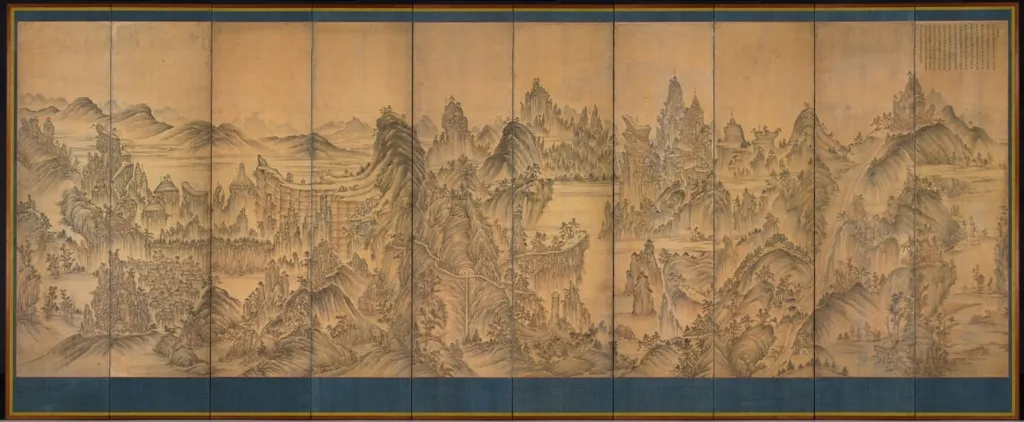
Seven Jeweled Mountain is an unspecified painting by the Korean Minhwa artist Unknown. It dates from 1804 and is held in the collection of the Cleveland Museum of Art.
- Accession no.
- 1989.6
- Credit line
- Mr. and Mrs. William H. Marlatt Fund
About this work
Overview
The work belongs to a Korean tradition of topographic landscape painting that emerged in the 18th century, valuing accurate representation over idealization.
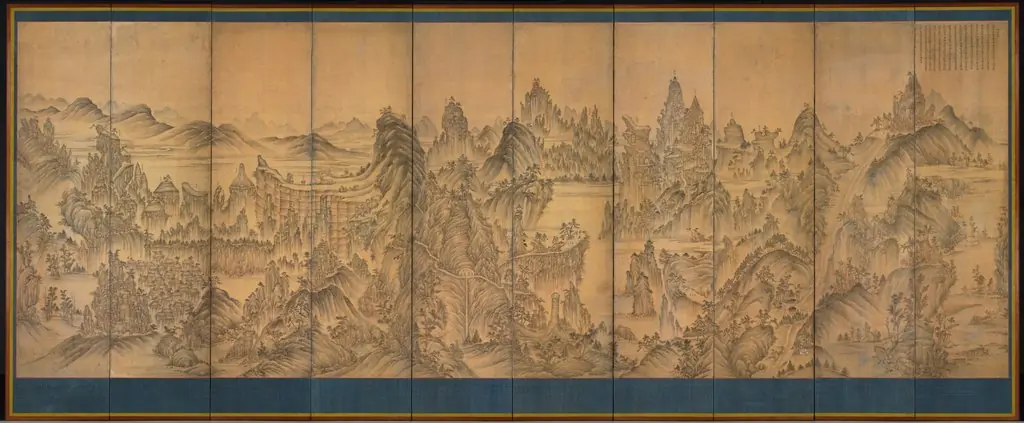
This ten-panel folding screen depicts the Seven Jeweled Mountain, a geologically distinctive site in North Korea. Rendered in vivid greens, browns, and blues, the composition presents a continuous bird’s-eye view of the mountain’s dramatic formations. Two artists collaborated: one focused on the terrain, the other on architectural and vegetative details.
The work belongs to a Korean tradition of topographic landscape painting that emerged in the 18th century, valuing accurate representation over idealization.
Subject & Meaning
The painting captures specific geological features of the mountain, towering phallic spires, a massive flat-topped cliff, and jagged metamorphic ridges, each clearly delineated across the panels. These formations were historically sites of pilgrimage and tourism, imbued with cultural and spiritual significance. After the Korean War, access to the region ceased, transforming the screen into a visual record of a place now out of reach, evoking absence as much as presence.
Technique & Style
The artists employed fine brushwork to render rock textures and vegetation with precision, avoiding romantic embellishment. Colors are naturalistic yet heightened, emphasizing the mountain’s mineral richness. The composition flows seamlessly across panels, mimicking the mountain’s sinuous, dragon-like spine.
Architectural elements and trees are rendered with delicate detail, contrasting with the rugged geology, suggesting human presence within an untamed landscape.
History & Provenance
Created in the 20th century, the screen reflects a continuation of 18th-century Korean landscape traditions that documented real sites. Its origin is tied to North Korea, where such locations became inaccessible after 1953. The work entered the collection of The Cleveland Museum of Art, where it serves as a rare visual archive of a landscape no longer viewable by outsiders, preserving its form through art rather than direct experience.
Context
In pre-war Korea, natural landmarks like the Seven Jeweled Mountain were celebrated in travel literature and painting as symbols of national beauty. The 1700s saw a shift toward topographic accuracy in landscape art, distinguishing Korean practice from more abstract Chinese traditions. After the division of the peninsula, these sites became politically sealed, turning artistic depictions into primary records of a lost cultural geography.
Legacy
The screen endures as a quiet testament to a landscape now inaccessible, offering a visual anchor for memory and imagination. It exemplifies how Korean artists documented the natural world with observational rigor, preserving regional identity through detail. In contemporary contexts, it functions not as decoration but as a historical document, evidence of a place whose physical presence is gone, yet whose image lingers.
Artist & collection