Artwork
Witches' sabbath
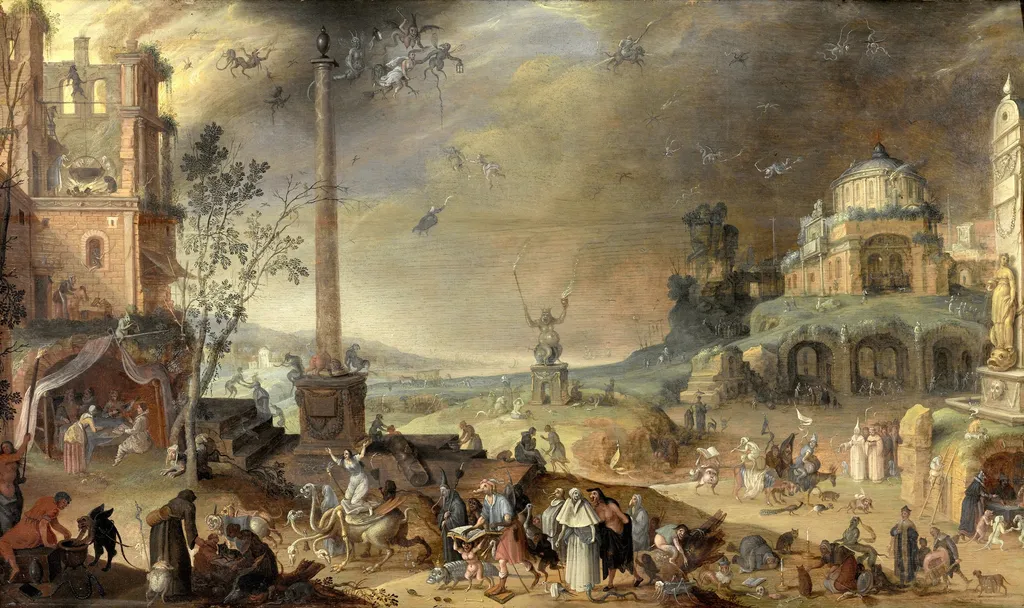
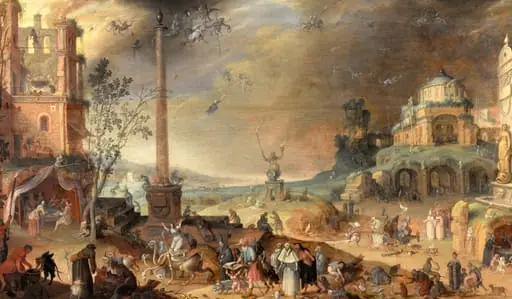
Witches' sabbath is an oil painting by the Dutch Golden Age artist Claes Jacobsz van der Heck. It dates from 1636 and is held in the collection of the Rijksmuseum.
About this work
Subject & Meaning
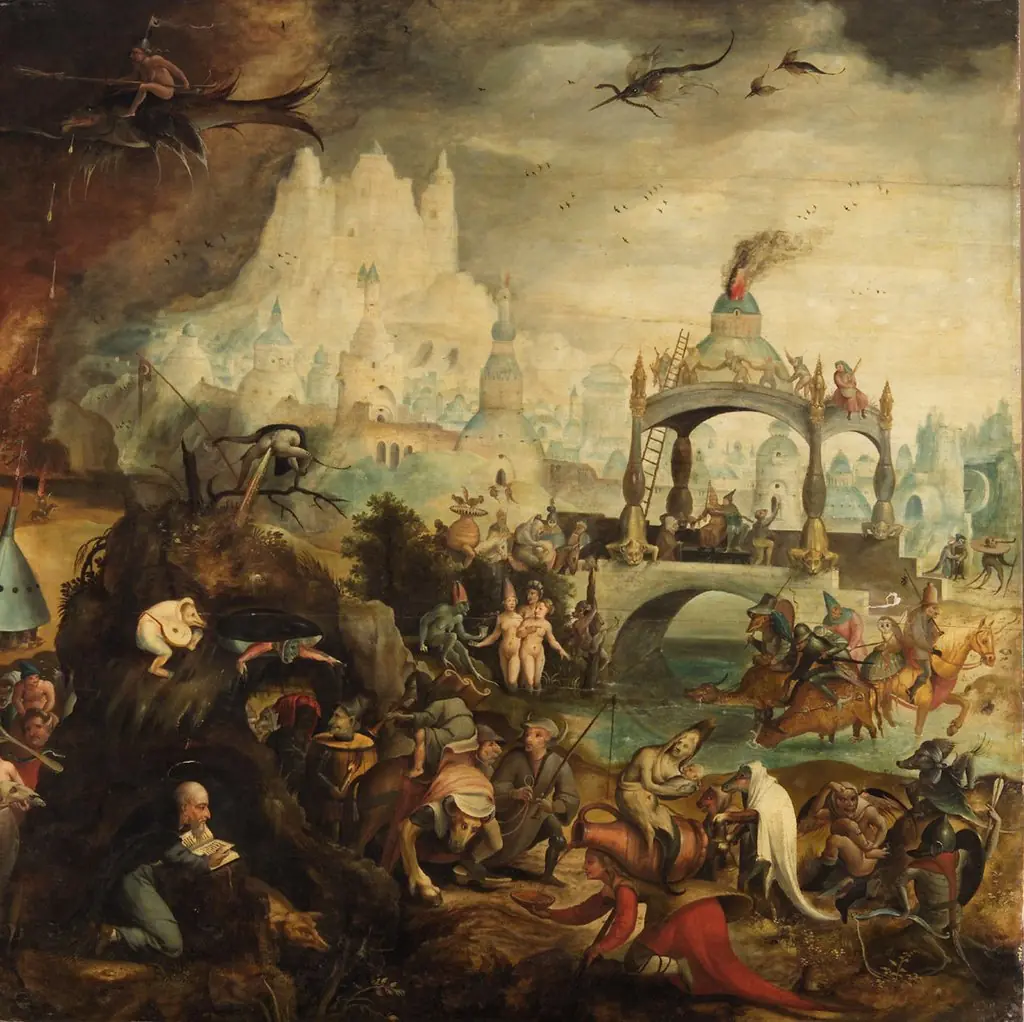
Around an obelisk in the sky, witches fly on broomsticks guided by devils with lanterns, and three devils sit on the obelisk's plinth engaged in grotesque acts.
Witches' sabbath depicts a witches' sabbath, a medieval delusion in which witches and sorcerers were believed to gather on pagan holidays to worship the devil. Van der Heck places the gathering in a sweeping nocturnal landscape populated by antique ruins, devils, monsters, and witches. At the center stands a large statue of a crowned devil seated on a globe, surrounded by a group of witches who adore the idol.
To the right, two women kneel with cats before two candlesticks, encouraged by a sphinx-like monster and watched by a priest in a fur-lined cloak, while a procession led by a sorcerer in white and a monk approaches from behind.
A second procession of monsters advances across the foreground, one carrying a banner bearing a crescent moon, a symbol of evil, and led by a woman with raised arms seated on a many-headed griffin, a figure derived from the Whore of Babylon in the Book of Revelation and used in Andrea Alciato's emblem book as a symbol of Ficta Religio, or false religion. In an open structure at the left, figures in contemporary dress make music around a table, while three monsters brew a potion in a great cauldron above. Around an obelisk in the sky, witches fly on broomsticks guided by devils with lanterns, and three devils sit on the obelisk's plinth engaged in grotesque acts.
Technique & Style
The painting is executed in oil on panel, a medium typical of Dutch landscape traditions in the early seventeenth century. Measuring 57 by 97 centimeters, the composition unfolds across a nocturnal, expansive landscape thick with supernatural figures and architectural elements. Stylistically, the work merges realistic landscape detail with grotesque fantasy, featuring a central obelisk topped by a crowned devil seated upon a globe, around which he witches congregate in ritual obeisance.
Flanking the obelisk, two women kneel before candelabra, overseen by a sphinx-like monster and a fur-cloaked cleric, while processions of hybrid beings advance through the scene. The foreground teems with monsters and banner-bearing fiends, including a female figure on a multi-headed griffin, evoking the Whore of Babylon, and flying witches circle above an open structure where figures play music. The handling shows careful modeling of light and shadow to heighten the uncanny atmosphere, with sharp contrasts between the dark landscape and the luminous, eerie glow of supernatural elements.
History & Provenance
The painting Witches' Sabbath was created by Claes Jacobsz. van der Heck in 1636, as confirmed by the signature 'C. Heck / fecit / 1636' located on the obelisk pedestal. Historically, works bearing this signature were attributed to Claes Dircksz. van der Heck until 1943, when historian Dick Wortel established through archival evidence that they were actually the work of Claes Jacobsz. The piece first appeared in the public record during the auction of the Evert Moll Sr. collection at Frederik Muller & Co. in Amsterdam on December 15–16, 1908.
In January 1909, the merchant Ernst Heldring donated the work to the Rijksmuseum in Amsterdam. It remained there until 1978, when it was loaned to the Mauritshuis in The Hague until 1994. Since the year 2000, the painting has been held on loan at the Stedelijk Museum in Alkmaar.
First recorded at the Frederik Muller & Co. auction in Amsterdam on December 15–16, 1908, the painting was donated to the Rijksmuseum in January 1909 by the businessman Ernst Heldring. From 1978 until 1994, the institution loaned the work to the Mauritshuis (Galerij Prins Willem V) in The Hague. Since 2000, it has been held on long-term loan by the Stedelijk Museum in Alkmaar.
Overview
Created in 1636 by Claes Jacobsz van der Heck, a native of Alkmaar who worked there until his death in 1652, this oil on canvas belongs to the Dutch Golden Age. The work is classified as a landscape and is presently held by the Rijksmuseum in Amsterdam.
Context
During the early 17th century, Dutch artists often explored moralizing themes through allegorical scenes of witchcraft and ruin, reflecting contemporary anxieties about superstition and disorder. Van der Heck’s depiction aligns with this tradition, integrating landscape elements with a narrative of nocturnal transgression that resonated with viewers of his time.
Own this work as a print
Artist & collection
Artist
Claes Jacobsz van der Heck (Nicolaes Jacobsz van der Heck) (c. 1575 in Alkmaar – 1652 in Alkmaar) was a Dutch Golden Age painter.