Artwork
Temptation of St. Athony
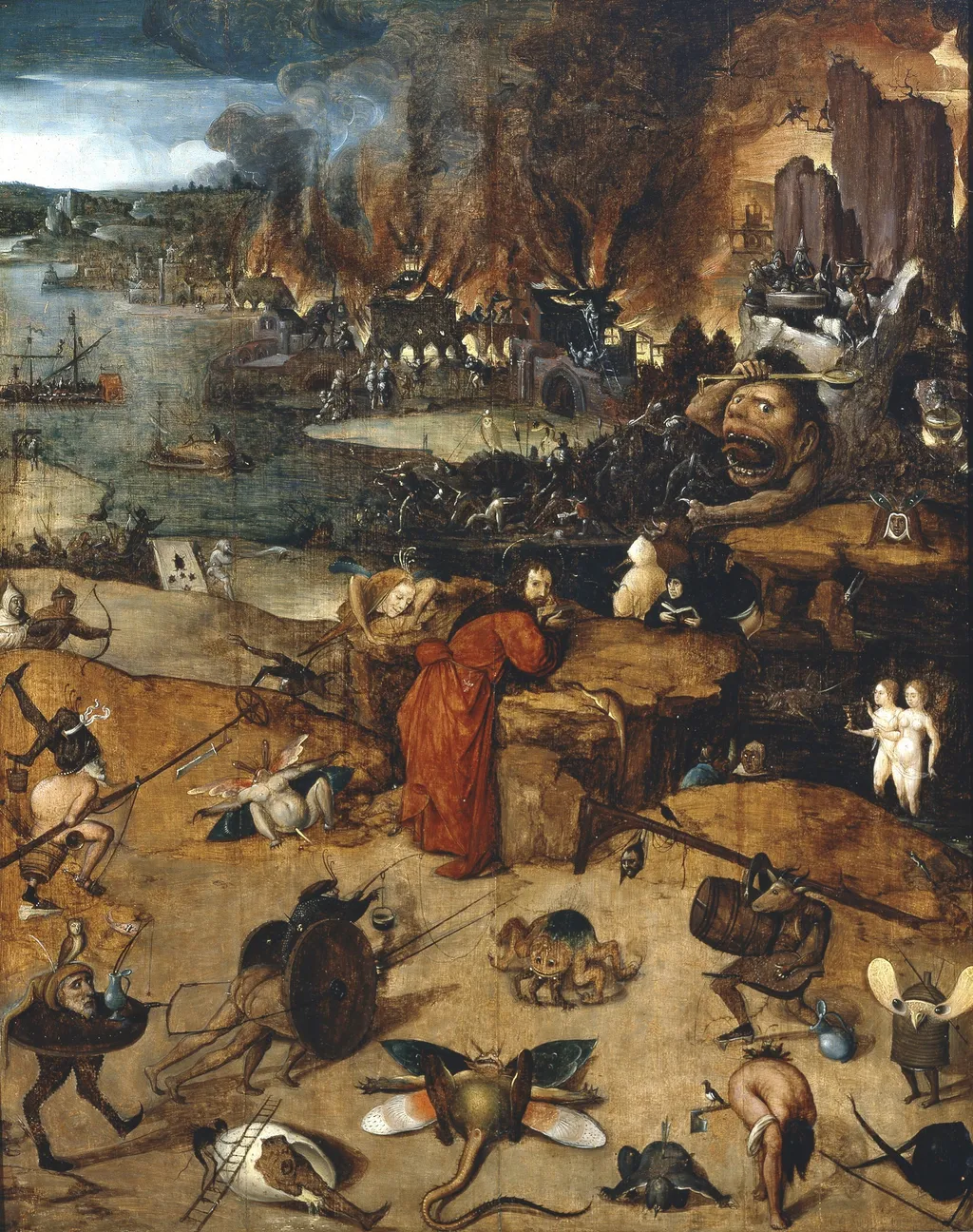
Temptation of St. Athony is an oil painting by the Northern Renaissance artist Hieronymus Bosch. It is held in the collection of the Museo del Prado.
About this work
Subject & Meaning
Around him swarm varied demons, grylles, zoomorphic creatures, and armed nude figures, attempting to break his contemplation.
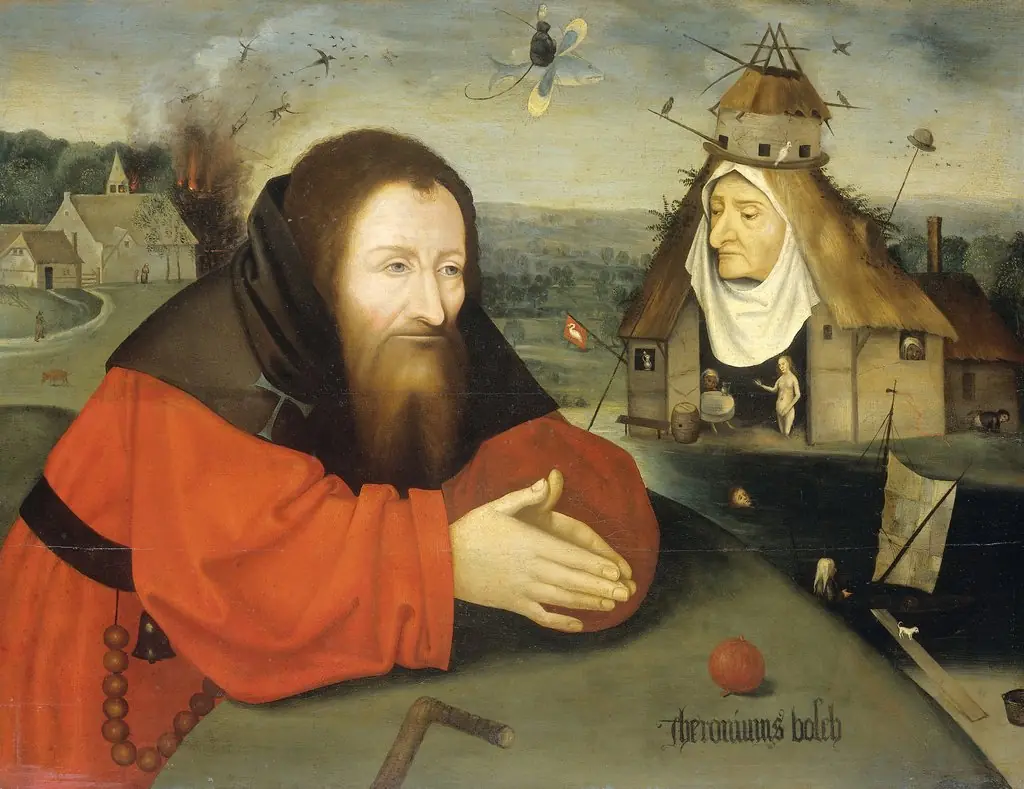
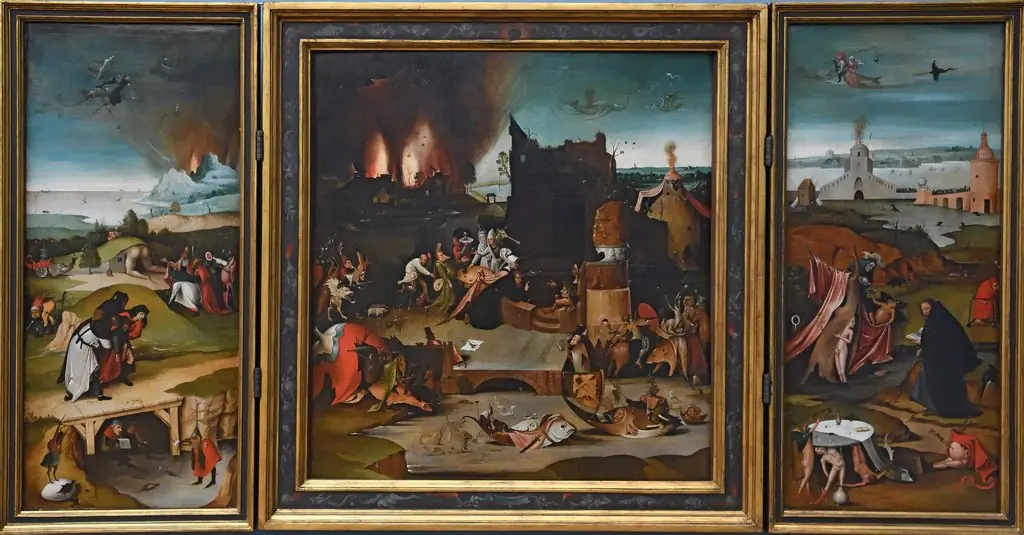
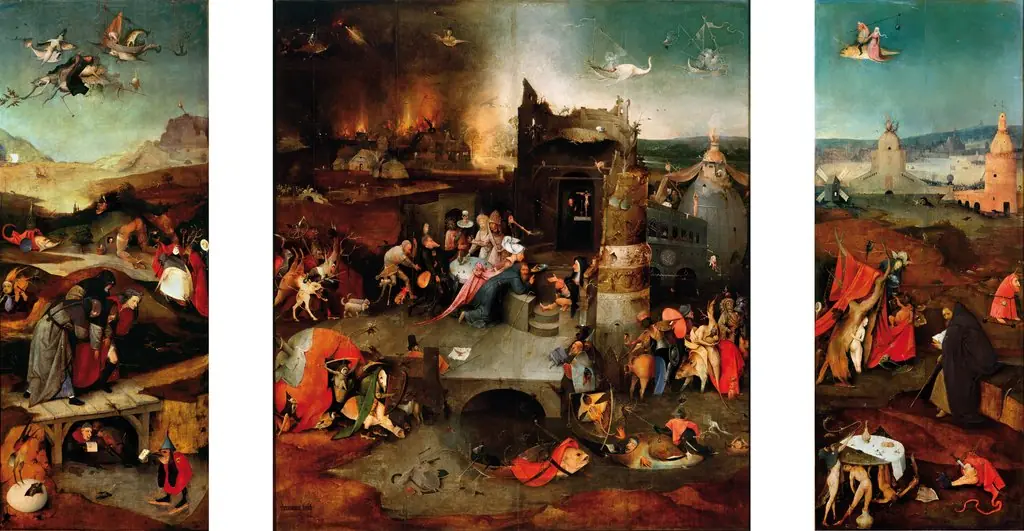
The painting depicts the Temptation of Saint Anthony, a popular religious subject in which the desert hermit Anthony the Great is assailed by demons while meditating. At the center, the haloed saint, identified by the Tau cross on his garment, leans on a rock reading scripture and turns his gaze toward the viewer, a composition borrowed from the central panel of Bosch's Lisbon Triptych.
Around him swarm varied demons, grylles, zoomorphic creatures, and armed nude figures, attempting to break his contemplation. In the middle distance, two fantastic galleons sail on water from which two nude temptresses emerge, while the background shows a burning city, marching armies, and a gaping monster issuing from a cave-like tree stump topped by an infernal banquet. At least two owls, traditional symbols of evil, appear in the scene.
The work represents the spiritual struggle of the hermit saint against worldly and demonic temptations, a theme central to Christian iconography of monastic life.
Technique & Style
The work is an oil painting on oak panel measuring 88.3 cm by 70 cm, depicting Saint Anthony the Great amid a chaotic assembly of demons, hybrid creatures, and temptresses. The saint, haloed and clothed in a tau cross garment, sits on a rock while turning toward the viewer, echoing the central panel of Bosch’s early triptych of Saint Anthony. Around him, grotesque figures include grylles, winged monsters, armed nude youths, a fleet of fantastical galleons on a distant waterway, and a colossal infernal beast emerging from a tree‑like cave that bears a banquet.
Owls, symbols of evil, appear in the composition, a motif Bosch also employed. The handling of color shows transparent glazes that reveal underdrawings, with highlights of white, contributing to a composition organized in a spiral rhythm.
History & Provenance
The painting was created around 1550–1560, likely several decades after Hieronymus Bosch's death. It was owned by Marie-Thérèse Brocheton before entering the collection of Philippe II, passing to his grandson Don Fernando and then to the Duchess of Benavente y Osuna. By 1905 it was part of the Duchess of Dueña's inheritance in Madrid.
The work later belonged to the Belgian patrons David and Alice van Buuren in the 1950s and was donated to the Museo del Prado by Alice van Buuren between 1964 and 1965.
The painting, executed in oil on oak panel measuring 88.3 cm by 70 cm, depicts Saint Anthony the Great reading a book while surrounded by demons, fantastical creatures, and symbolic animals such as owls. It may have served as the central panel of a triptych, distinct from the Lisbon triptych associated with Bosch. The attribution to Bosch was proposed in 1955 by Gaston van Camp, but later scholars such as Cinotti and Unverfehrt questioned its authenticity, suggesting it could be the work of a follower. The Prado Museum currently dates the work to 1550–1560.
The painting is housed in the Museo del Prado in Madrid. It bears the inventory number P003085 and was acquired by the museum through the bequest of Alice van Buuren in 1964-1965. Its provenance includes ownership by Marie-Thérèse Brocheton before its donation, and earlier associations with the collections of Philippe II and the Duchess of Benavente y Osuna.
The work entered the public record in the 1940s and was owned by the Belgian patrons David and Alice van Buuren in the 1950s.
Context
Attributed to a follower of Hieronymus Bosch rather than the master himself, this mid-16th century panel represents a significant example of the widespread pictorial tradition surrounding the Temptation of Saint Anthony. Scholarship has evolved significantly regarding its authorship; while Gaston van Camp argued in 1955 for Bosch's authenticity based on technical qualities like underdrawing transparency, later experts such as Mia Cinotti and Gerd Unverfehrt rejected this, citing a haphazard assembly of motifs from Bosch's repertoire. Current consensus among Prado curators dates the work to approximately 1550–1560, decades after Bosch's death, aligning it with the output of Antwerp-based disciples like Herri met de Bles who frequently employed symbolic owls and fantastical landscapes.
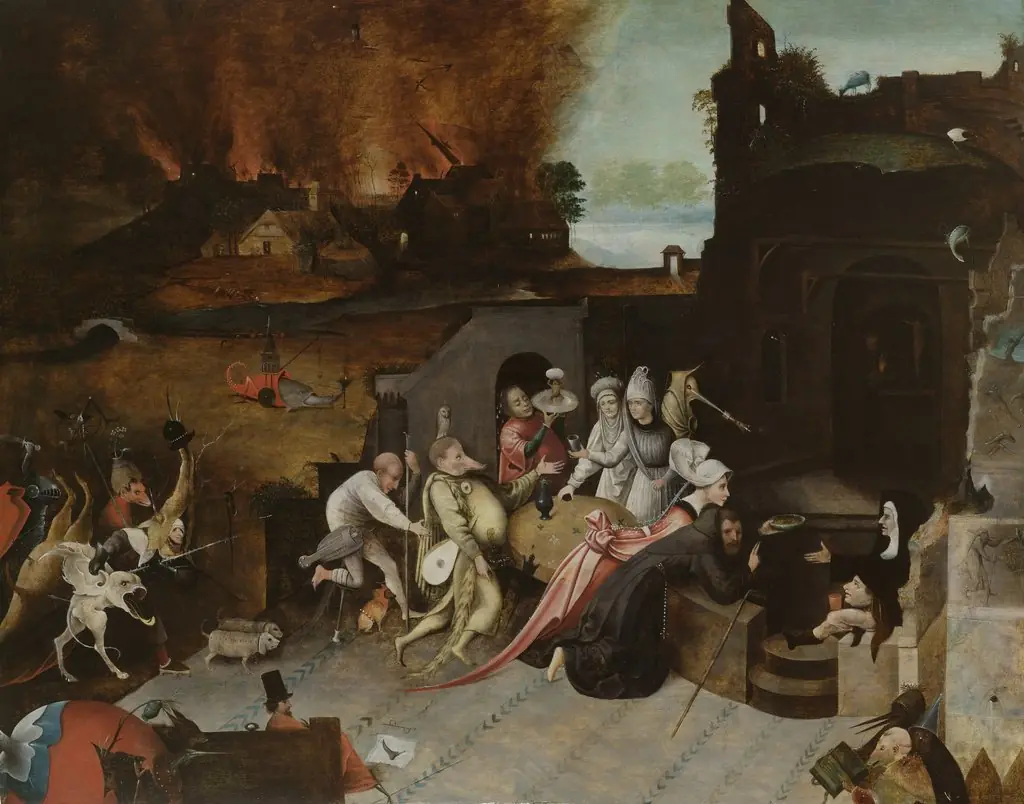
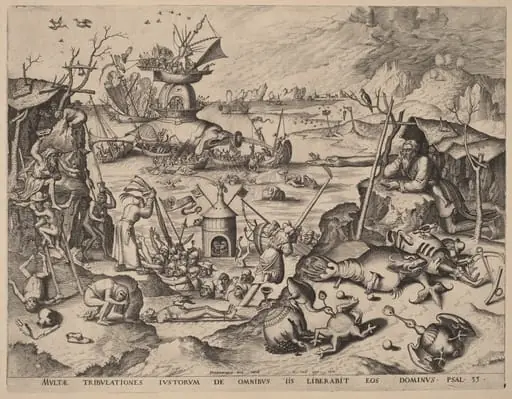
The composition borrows specific elements from other works, including a chariot detail found in an Ashmolean Museum study now also attributed to a disciple, illustrating the complex reception and adaptation of Bosch's iconography by his successors.
Legacy
The painting has been regarded as a significant example of Boschian influence beyond the master’s own hand. Contemporary scholars view it as a work of a follower, possibly Herri met de Bles, whose nocturnal owls and fantastical landscapes echo Bosch’s iconography of temptation. The Prado’s curators place its execution in the 1550‑1560 period, several decades after Bosch’s death, and trace a fragmented provenance that links the piece to the Spanish Habsburg court, to the van Buurens of Brussels, and finally to a 1964‑65 donation by Alice van Buuren.
Its attribution has oscillated since the 1950s; early advocates such as Gaston van Camp highlighted technical similarities with Bosch’s known works, while later authorities like Cinotti and Unverfehrt argued for the hand of a disciple, citing compositional borrowings from other Bosch‑related panels and drawings.
Overview
Hieronymus Bosch’s Temptation of St. Anthony is an oil painting dating from around 1550. Executed in the Northern Renaissance idiom, the work presents a densely populated tableau that centers on a serene, red‑clad saint absorbed in a small book while a host of grotesque, hybrid creatures swirl around him. The composition is dominated by a turbulent sky and a chaotic backdrop of battles and monstrous forms.
Own this work as a print
Artist & collection
Artist
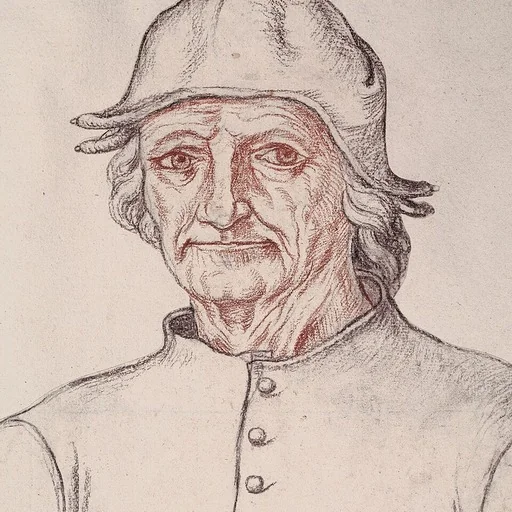
Hieronymus Bosch (; Dutch:; born Jheronimus van Aken; c. 1450 – 9 August 1516) was a Dutch painter from Brabant. He is one of the most notable representatives of the Early Netherlandish painting school. His work,…