Artwork
Still life of fish with a candlestick
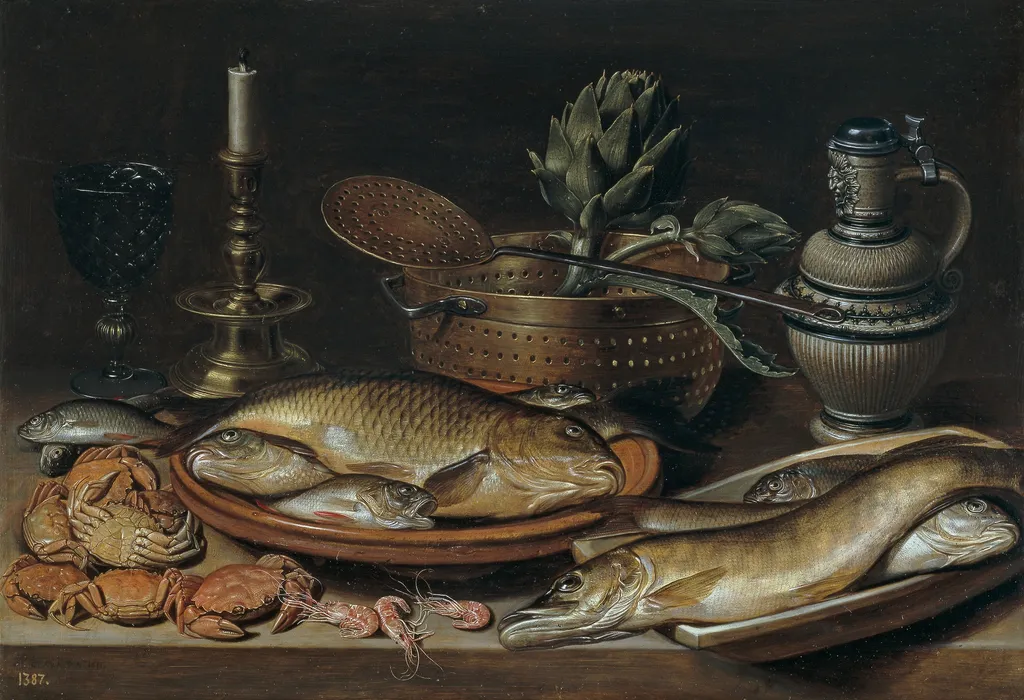
Still life of fish with a candlestick is an oil painting by the Dutch Golden Age artist Clara Peeters. It dates from 1611 and is held in the collection of the Museo del Prado.
About this work
Subject & Meaning
Scholars note the absence of overt religious or moralizing allegory, classifying the work instead as a straightforward depiction of objects.
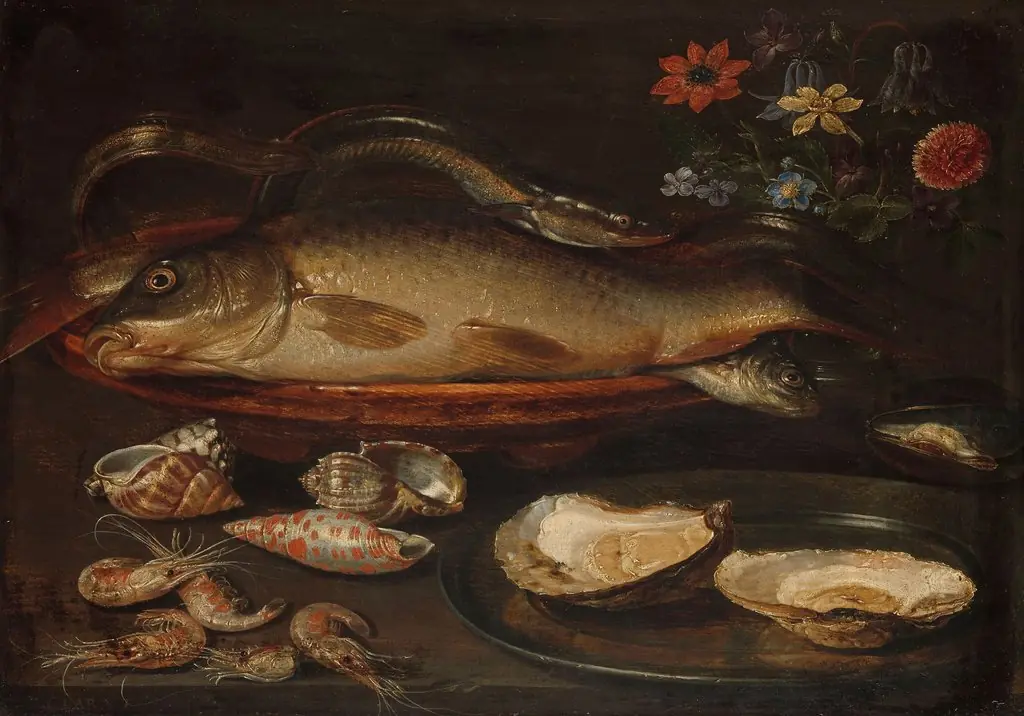
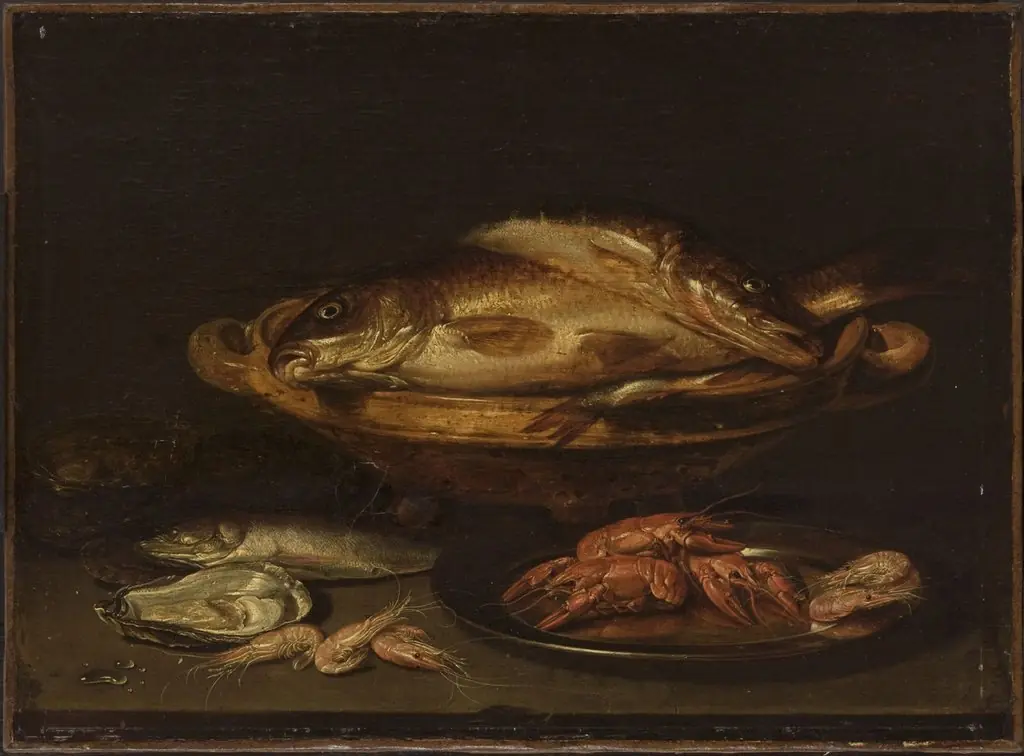
The painting presents a still-life arrangement centered on freshwater fish (including carp and pike), cooked crustaceans (crabs and shrimp), and a partially burned candle atop a brass candlestick, alongside kitchen implements such as a copper skimmer and a dark glass goblet. Its iconography emphasizes abundance and transience: perishable foodstuffs, a guttering candle, and reflective metal surfaces signal the fleeting nature of earthly pleasures.
Scholars note the absence of overt religious or moralizing allegory, classifying the work instead as a straightforward depiction of objects. The inclusion of a Rheinish stoneware jug bearing Peeters’s reflected self-portrait, visible among the items, has been interpreted as a deliberate assertion of authorship in a field dominated by male practitioners, underscoring themes of recognition and professional identity rather than symbolic exegesis.
Technique & Style
Executed in 1611, this still life is an oil painting on an oak panel manufactured by Guilliam Aertssen, as indicated by the red initials G and A on the reverse. The work measures 50 by 72 centimeters and displays a meticulous handling of light and texture, particularly in the rendering of fish scales, the perforations of a copper colander, and the contrast between curved and angular forms.
Infrared reflectography reveals that Peeters made subtle compositional adjustments during the creative process, such as lowering the eye of a foreground fish and modifying the holes in the colander. Technical analysis also shows that the dark glass goblet and artichokes were painted after the application of the dark background layer, demonstrating a deliberate and refined approach to building the image.
History & Provenance
The painting was created by Clara Peeters in 1611, executed in oil on oak panel. The support bears the superimposed red letters "G" and "A" on its reverse, indicating that Guilliam Aertssen manufactured the panel in Antwerp, which supports the theory that Peeters worked there.
The work is first documented in the inventory of the Royal Alcázar of Madrid, where it appeared unattributed, described simply as one of a pair of fish and bird still lifes. It is believed to correspond to entries in later royal inventories after 1734 that were attributed to Peeters. One theory proposes that the painting, together with three other Peeters works now at the Prado, formed a series representing the four elements, with this composition symbolizing water, though this remains unconfirmed.
The painting entered the collection of Ferdinand VII of Spain and is now held by the Museo del Prado in Madrid. In 2016 it was included in the exhibition "El arte de Clara Peeters," the first monographic show devoted to a woman artist at the Prado.
Clara Peeters' Still life of fish with a candlestick (1611) is held in the collection of the Museo del Prado in Madrid, Spain. The work is currently located within the Royal Palace of Madrid, having historically been owned by Ferdinand VII of Spain. While specific inventory numbers are not provided in the available records, the painting was first documented in the inventories of the Real Alcázar de Madrid, where it appeared without attribution simply as "one of fish" alongside a painting of birds.
Later royal inventories after 1734 explicitly attributed the work to Peeters. In terms of exhibition history, the painting was featured in the 2016 exhibition titled El arte de Clara Peeters at the Museo del Prado, which marked the first exhibition dedicated to a female artist held by the museum.
Context
Clara Peeters is recognized as a pioneer for introducing fish as a primary subject in still-life painting, with this 1611 work likely representing the genre's first example of such a theme. Scholars note her distinctive practice of embedding self-portraits in reflective surfaces, such as the ceramic jug depicted here, signaling an early assertion of authorship by a female artist in a male-dominated field. Technical analysis via infrared reflectography reveals her meticulous compositional adjustments, including the lowering of a fish's eye and the modification of a copper strainer's holes, which underscores her deliberate artistic process.
The painting is frequently cited as one of her most delicate compositions, characterized by the precise rendering of scales, curved artichokes, and angular metalwork. While a theory suggesting the work belongs to an allegorical series representing the four elements remains unconfirmed, its inclusion in the 2016 exhibition "El arte de Clara Peeters" marked a significant moment as the first Prado show dedicated to a woman artist.
Legacy
Still life of fish with a candlestick, painted in 1611, is regarded as a milestone in early Spanish still‑life for being among the first to treat fish as a central motif. Its technical sophistication is evident in infrared studies that reveal compositional adjustments and subtle handling of light on the candlestick and copper strainer. The work entered the Royal Palace of Madrid collection, later passing to King Ferdinand VII, and remains in the Museo del Prado.
A 2016 retrospective devoted to Clara Peeters highlighted the painting’s delicacy, its role in a presumed series of the four elements, and its significance as one of the few examples where the artist inserted a self‑portrait on a vessel, underscoring her effort to gain recognition as a female specialist in fish still‑life.
Overview
Clara Peeters, a Flemish painter active in the early 17th century, created Still life of fish with a candlestick in 1611. This oil painting exemplifies the Netherlandish ontbijtjes tradition, a type of still life often featuring food and domestic items. Peeters was a notable female artist of her period, recognized for her detailed compositions. The work is currently housed in the collection of the Museo del Prado in Madrid.
Own this work as a print
Artist & collection

Artist
Clara Peeters (Dutch pronunciation: ; fl. 1607–1676) was a Flemish still-life painter from Antwerp who worked in both the Spanish Netherlands and Dutch Republic. Peeters is the best-known female Flemish artist of this…