Artwork
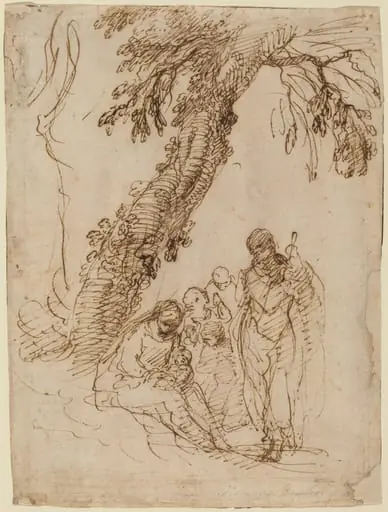
Madonna and Child with Saints John and Luke
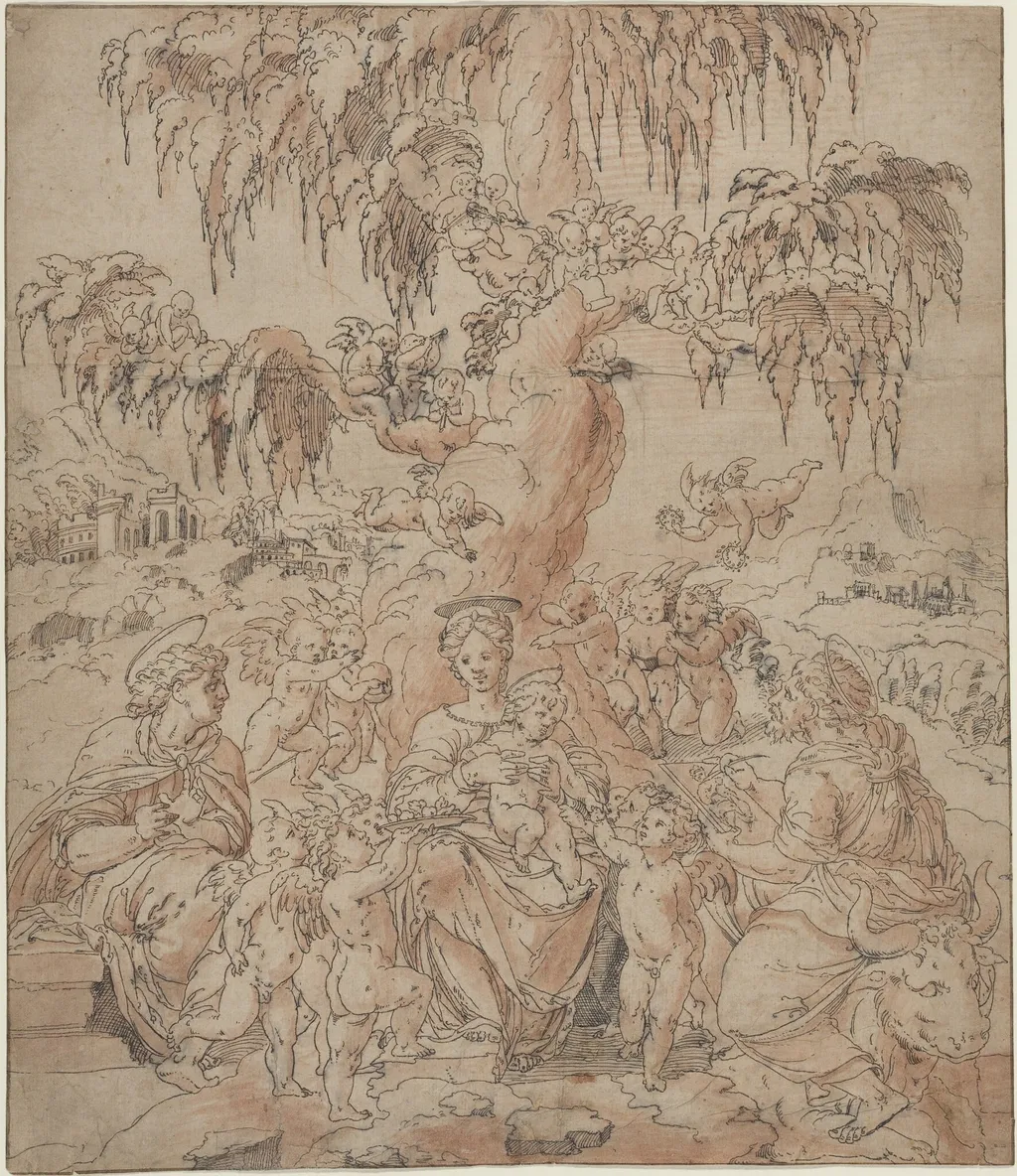
Madonna and Child with Saints John and Luke is an ink drawing by the Renaissance artist Jean Cousin the Younger. It dates from 1558 and is held in the collection of the National Gallery of Art.
- Inscription
- Inscribed:lower left verso in graphite: N.M. Deutsch / 1484-1530; lower left verso:Ck; lower center verso: (A.J. Sachs Coll.) (actually: P.J. Sachs Coll.); lower right verso in brown ink: Jean Cousin
About this work
Overview
The work serves as a significant example of his mastery in combining precise draftsmanship with atmospheric wash techniques to convey religious devotion.
Created in 1558 by Jean Cousin the Younger, this drawing depicts the Madonna and Child flanked by Saint John the Baptist and Saint Luke the Evangelist, accompanied by a cherubic figure. Executed in pen and black ink with brown wash over red chalk, the work exemplifies the French Mannerist style through its dense, vertical composition where figures are tightly clustered within a shallow pictorial space. The Virgin Mary occupies the central axis, holding the Christ Child, while the surrounding saints engage in a dynamic, interlocking arrangement that emphasizes emotional intimacy and spiritual unity.
Cousin employs loose, fluid hatching and rapid, overlapping strokes to render the flowing drapery and anatomical forms, creating a sense of movement and texture characteristic of his preparatory studies. The background features architectural elements and wispy clouds that frame the sacred group without distracting from the foreground interaction. This piece reflects Cousin's role as a leading figure in the School of Fontainebleau, bridging Italian Renaissance influences with a distinct French sensibility.
The work serves as a significant example of his mastery in combining precise draftsmanship with atmospheric wash techniques to convey religious devotion.
Subject & Meaning
At the composition’s core, a seated Virgin cradles the infant Christ, flanked by two male saints, identified as John the Evangelist and Luke the Evangelist, and a cherubic infant figure. The intimate arrangement underscores the theological connection between the Madonna, the Christ Child, and the evangelists who authored the Gospel narratives.
Technique & Style
Cousin employs rapid, overlapping pen strokes to suggest the drapery of the robes and the ethereal clouds behind the figures. A subtle brown wash overlays the red chalk, unifying the drawing with a warm tonal harmony while allowing the underlying sketch lines to remain visible. The hatching creates tonal depth without precise modeling.
History & Provenance
Created in 1558, the drawing reflects Cousin the Younger’s practice of producing detailed studies for larger commissions. Its survival in a private collection suggests it functioned as a preparatory design, possibly for an altarpiece or panel painting that has not been identified.
Context
The work belongs to the mid‑sixteenth‑century French Renaissance, a period when artists blended Northern linear precision with Italian compositional ideals. The inclusion of Saints John and Luke aligns with contemporary devotional trends that emphasized the evangelists’ role in the dissemination of Christ’s teachings.
Legacy
Although not a finished painting, the drawing offers insight into Cousin’s creative process and the pedagogical methods of the time, illustrating how artists used quick ink washes and hatching to experiment with composition and lighting before committing to a final work.
Own this work as a print
Artist & collection


- The Resurrection
 The Resurrection
 The Daughters of the Po with River Gods
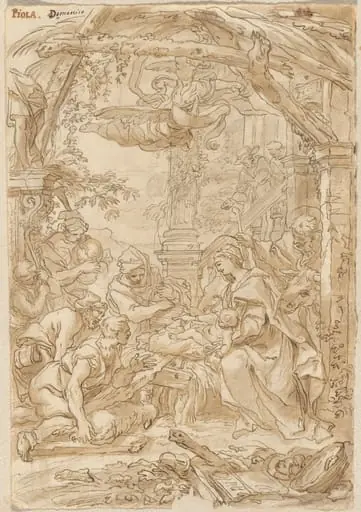 The Adoration of the Shepherds
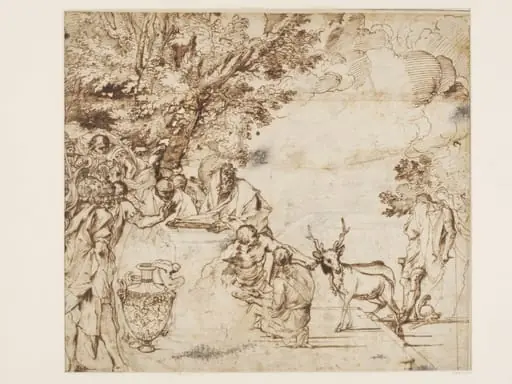 The Sacrifice of Iphigenia
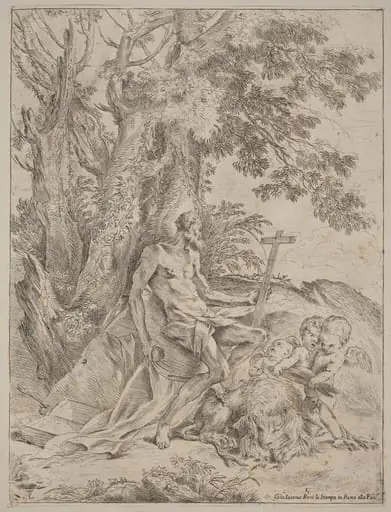 Saint Jerome
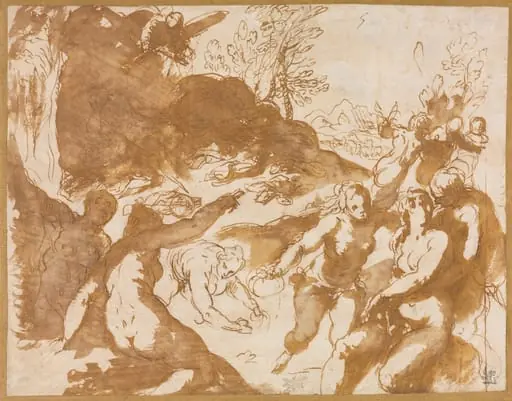 Apollo and the Muses Awakened by the Call of Fame
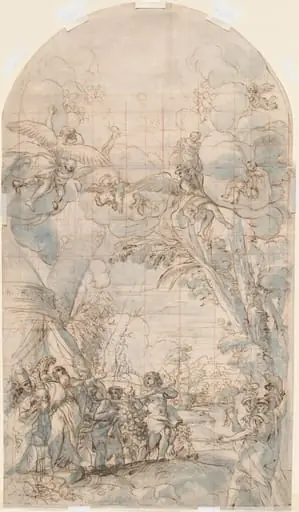 The Spies Returning from Canaan
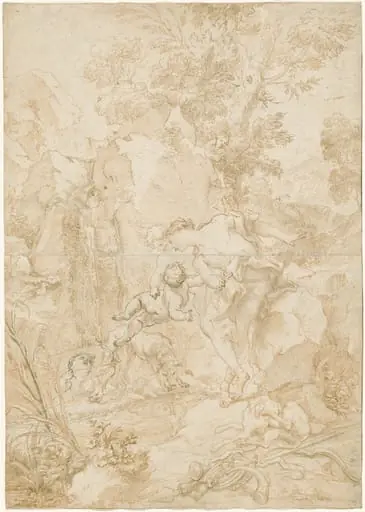 Echo and Narcissus
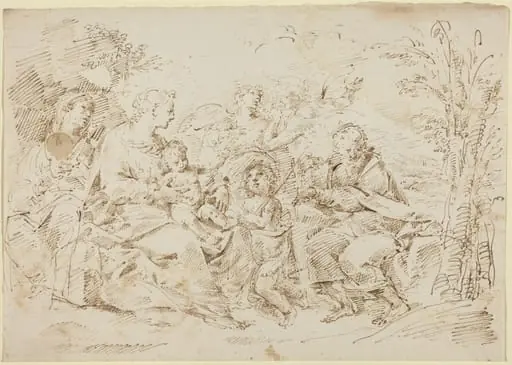 Holy Family with St. Elizabeth, St. John the Baptist, and Two Angels in a Landscape
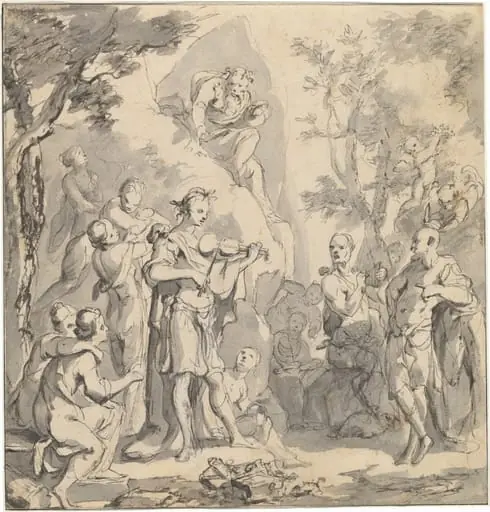 The Contest between Apollo and Pan before King Midas
 The Holy Family under a Tree