Artwork
The Crucifixion with the Converted Centurion
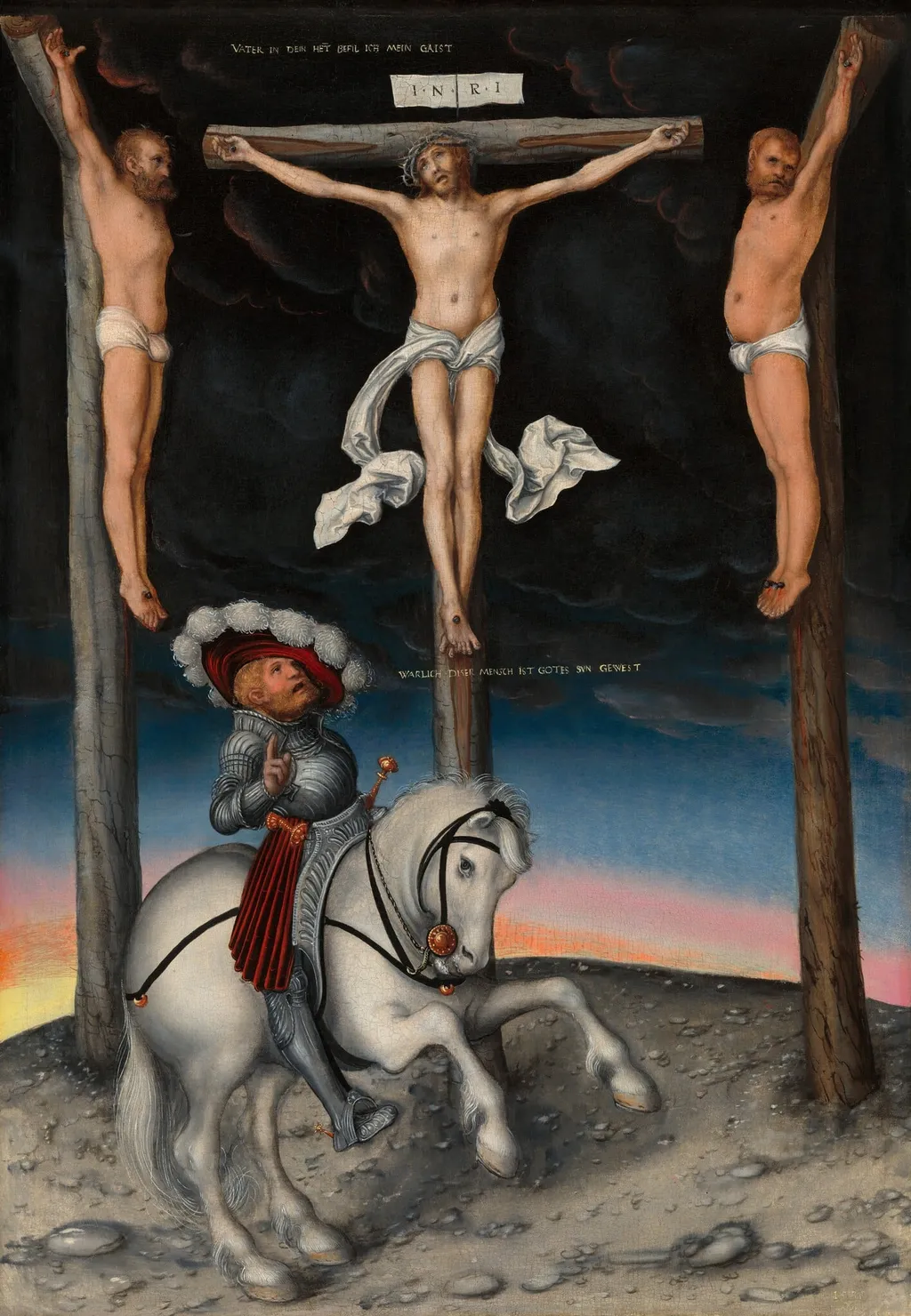
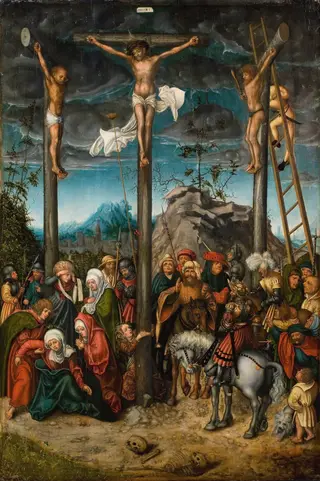
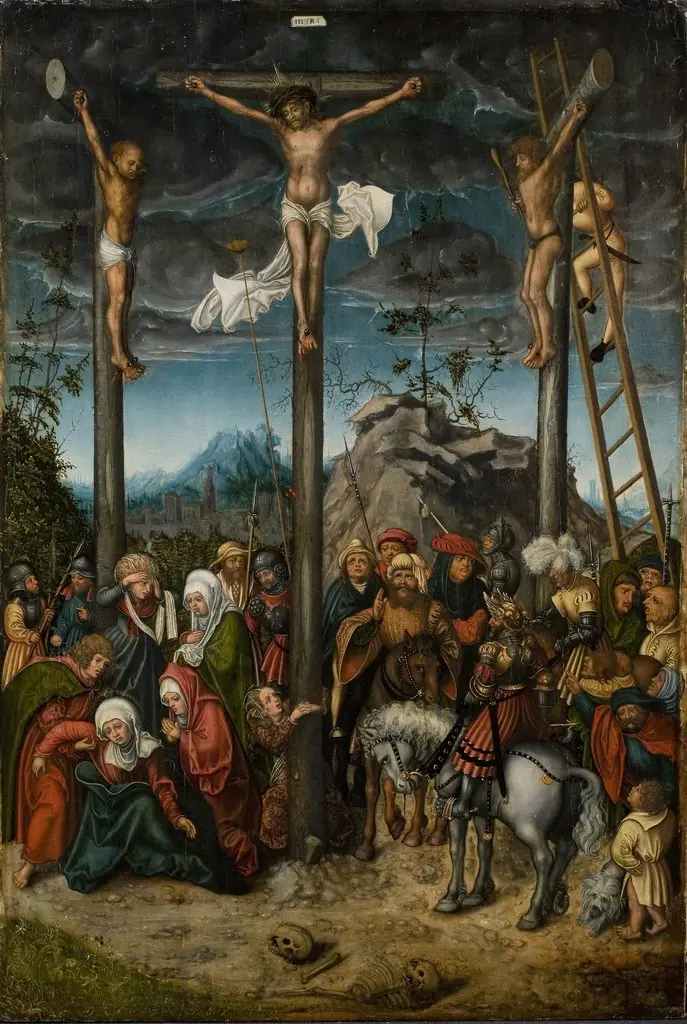
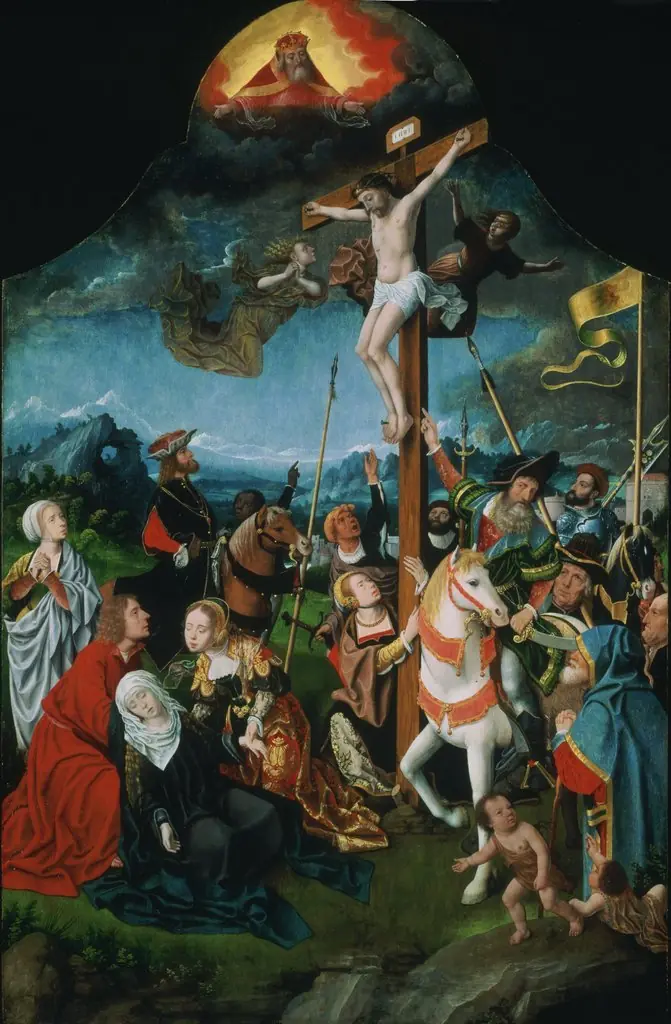
The Crucifixion with the Converted Centurion is an oil painting by the Northern Renaissance artist Lucas Cranach the Elder. It dates from 1536 and is held in the collection of the National Gallery of Art.
- Inscription
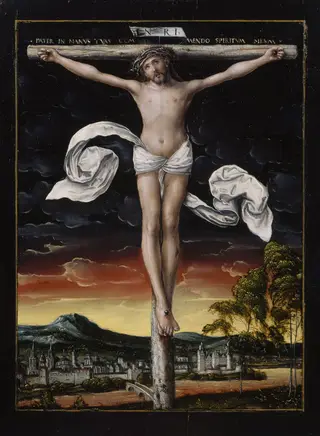
- Inscribed:lower right: 1536; below date, the artist's device, a serpent with folded wings; across top: VATER IN DEIN HET BEFIL ICH MEIN GAIST (Father, into thy hand I commend my spirit); at top of cross: I.N.R.I; center, below Christ's feet: WARLICH DIESER MENSCH IST GOTES SVN GEWEST (Truly, this man was the Son of God)
About this work
Subject & Meaning
Central to the composition is Christ, flanked by two thieves, while traditional Catholic figures such as Saint John or the Marys are conspicuously absent.
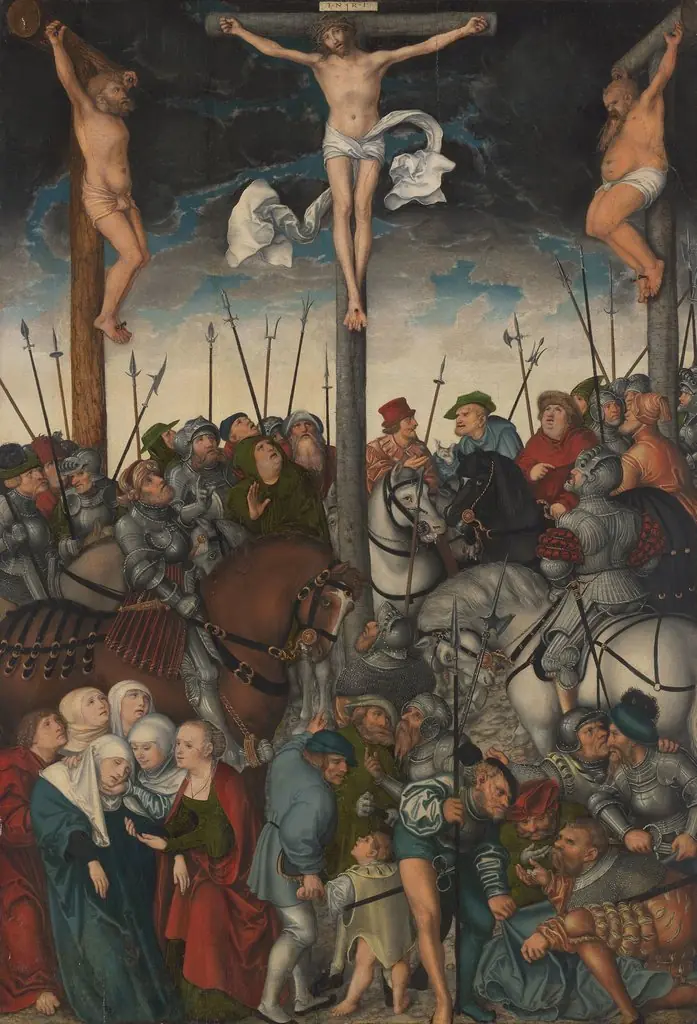
Dating to 1536, this panel depicts the Crucifixion against a dark, stormy sky that lightens at the horizon, symbolizing a new dawn. Central to the composition is Christ, flanked by two thieves, while traditional Catholic figures such as Saint John or the Marys are conspicuously absent. Instead, the sole observer at the foot of the cross is a centurion on horseback, dressed as a contemporary German nobleman.
His startled reaction and the rearing of his horse mark the moment he recognizes Jesus as the Son of God. The work functions as a key example of Reformation iconography, using German inscriptions rather than Latin to quote Mark 15:39 and Luke 23:46 directly. This visual strategy underscores Lutheran doctrines, specifically the translation of scripture into the vernacular and the concept of justification by faith alone, exemplified by the centurion's immediate spiritual conversion.
Technique & Style
The Crucifixion with the Converted Centurion is an oil painting on wooden panel measuring roughly 50.8 × 34.6 cm. Executed in the German Renaissance manner, the work employs a dramatic, scenographic layout and strong chiaroscuro, with a storm-laden sky that brightens toward the horizon to highlight the moment of Christ's death and the centurion's conversion. Cranach places the centurion, mounted and rendered in crisp detail, at the foot of the cross, creating a visual line that links his face to that of Jesus; the figures are illuminated against a dark, cloud-filled background, emphasizing contrast and focus. The composition is further distinguished by German-language inscriptions of the crucifixion dialogue, reflecting Reformation-era iconographic reforms.
History & Provenance
Created in 1536 by Lucas Cranach the Elder, this oil-on-panel painting depicts a Reformation-era interpretation of the Crucifixion. Its documented history begins in Leipzig with Dr. Demiani by 1899, when it was lent to a Cranach exhibition in Dresden. It was subsequently sold at Rudolph Lepke's Berlin auction house on 11 November 1913.
The painting later entered the collection of Mrs. Jenö Hubay, passing to Mathias Salamon after her husband's death in 1937. By 1947 it was held by Aladar Feigel in Budapest before moving to George Biro. In 1952 the Dominion Gallery in Montreal and M. Knoedler & Co. in New York facilitated its acquisition by the Samuel H. Kress Foundation.
Although the Kress Foundation formally gave the piece to the National Gallery of Art in 1961, the painting had been physically present at the museum since June 1953.
Context
Scholars identify this 1536 panel as a quintessential example of Reformed iconography, reflecting Lucas Cranach the Elder's close personal ties to Martin Luther and his circle. Rather than rejecting religious imagery, the early Protestant movement used such works as vehicles for new theological ideas. The painting diverges from traditional Catholic compositions by omitting standard figures like Saint John or the Marys, focusing instead on the centurion whose conversion exemplifies the doctrine of justification by faith alone.
This theological shift is reinforced by the use of German rather than Latin for the inscribed biblical quotes, highlighting the Lutheran emphasis on vernacular scripture. The work shares compositional strategies with another version held in Aschaffenburg, employing a dramatic contrast between the pale bodies of the crucified and a dark, stormy sky to direct attention to the moment of spiritual recognition.
Legacy
The painting is regarded by art historians as a typical example of Cranach's reformed iconography, reflecting his close ties to Martin Luther and the Lutheran emphasis on vernacular scripture and justification by faith. Its early loan to the 1899 Cranach exhibition in Dresden indicates the scholarly interest it attracted, and a further version of the composition housed in Aschaffenburg attests to the enduring reputation of the design.
Overview
This oil on panel painting, titled The Crucifixion with the Converted Centurion, depicts a pivotal moment from the biblical narrative. Lucas Cranach the Elder renders the scene with characteristic intensity, focusing on a Roman soldier's profound spiritual transformation. The artwork combines a dramatic religious subject with a distinctive visual approach, inviting contemplation of faith and conversion amidst the solemnity of the crucifixion.
Own this work as a print
Artist & collection
Artist
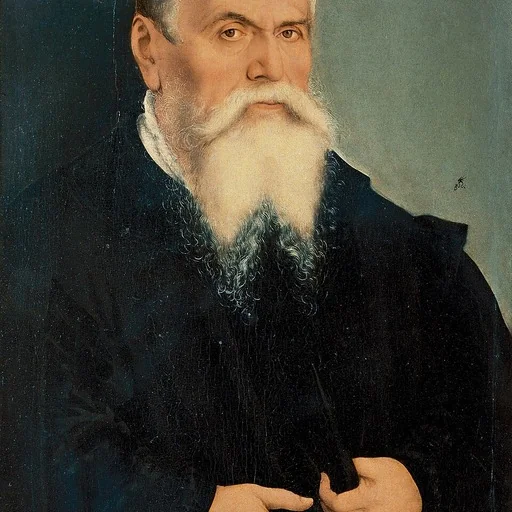
Lucas Cranach the Elder was a German Renaissance painter and printmaker in woodcut and engraving.