Artwork
The Judgment of Paris
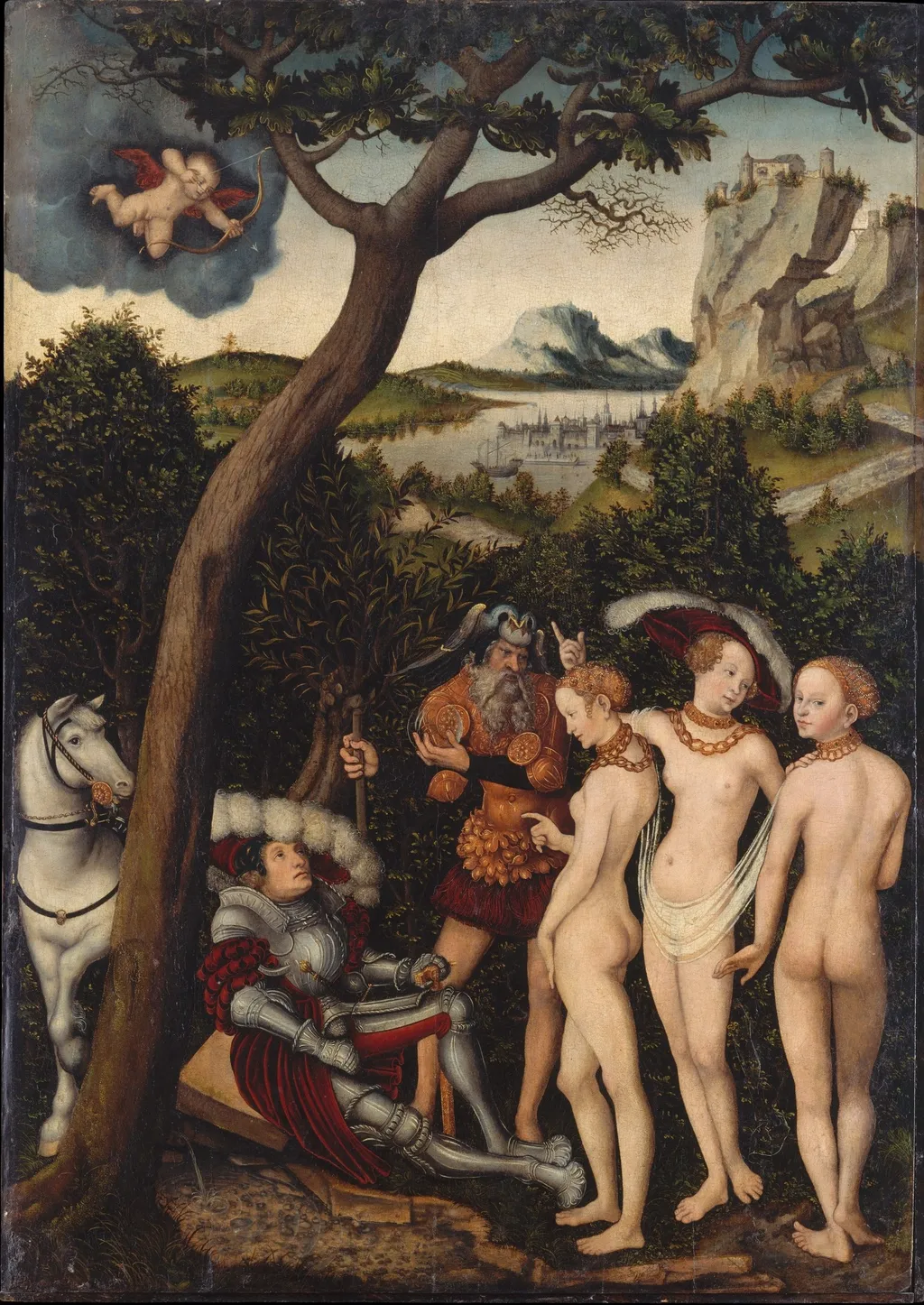
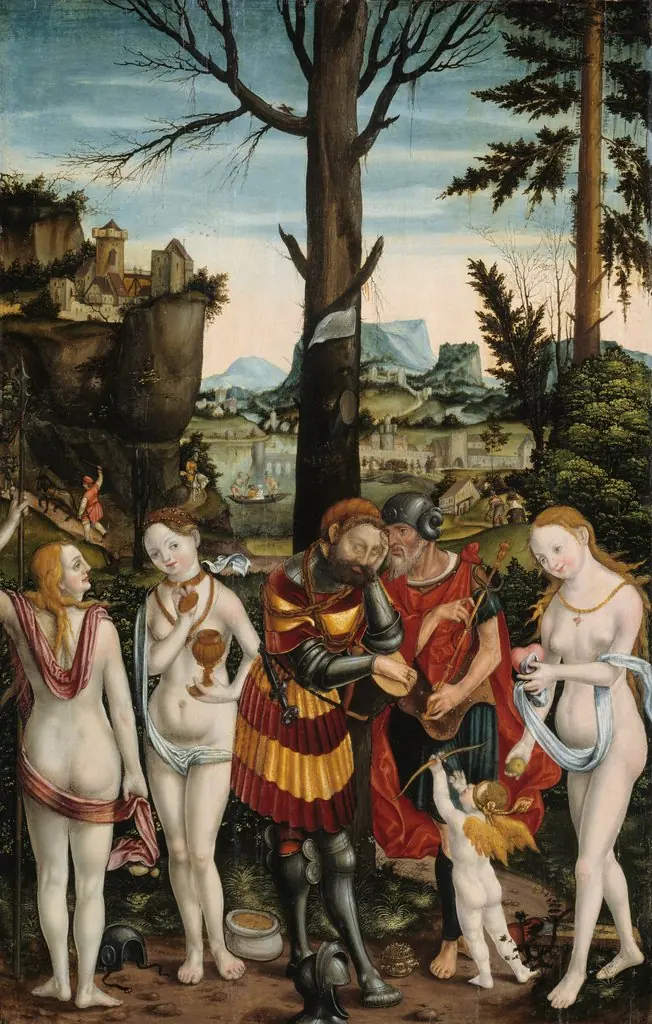
The Judgment of Paris is a paint painting by the Northern Renaissance artist Lucas Cranach the Elder. It dates from 1528 and is held in the collection of the Metropolitan Museum of Art.
About this work
An armored Paris sits on the ground, looking up at Mercury in a red hat and orange armor, who gestures toward three nude goddesses awaiting his choice. A white horse stands behind them, a cupid draws his bow from a tree above, and a castle rises on a distant cliff over water. Lucas Cranach the Elder painted the scene in 1528.
Subject & Meaning
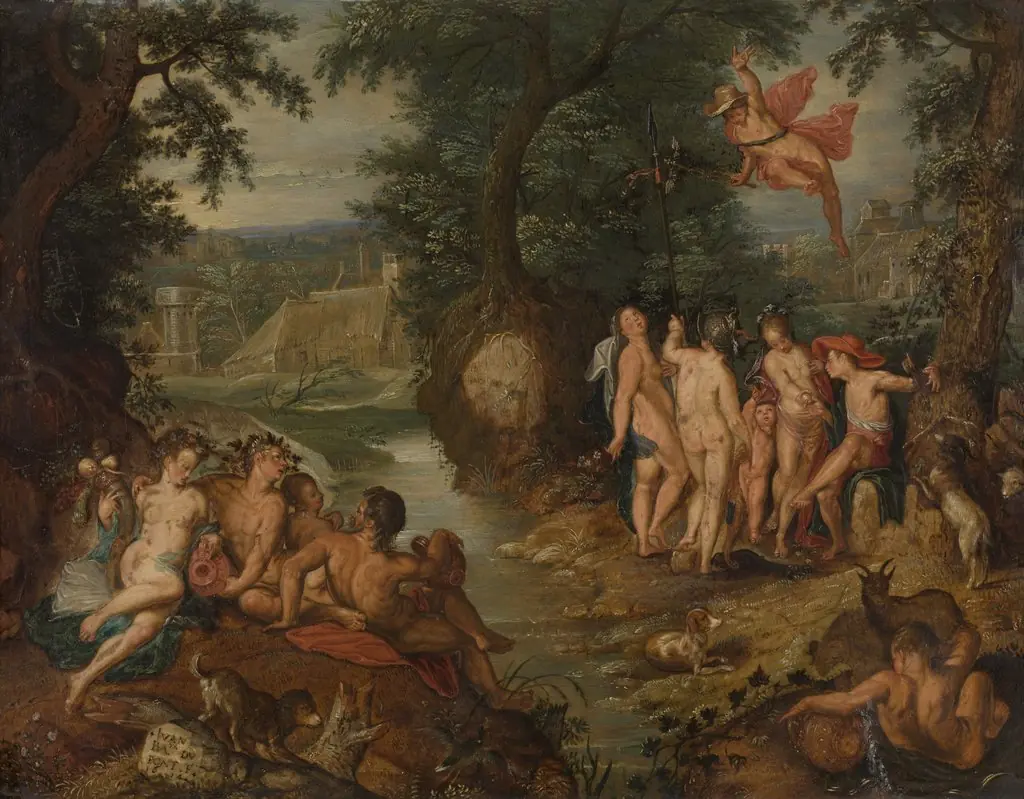
The painting depicts the Judgement of Paris myth, in which the Trojan prince is tasked with awarding a golden apple to the fairest goddess.
The painting depicts the Judgement of Paris myth, in which the Trojan prince is tasked with awarding a golden apple to the fairest goddess. Cranach departs from classical sources, following medieval romances: Paris appears as a warrior in contemporary armor rather than a shepherd, and the encounter occurs in a dreamlike forest setting. A winged Cupid in the sky aims his arrow at Venus, signaling Paris's choice.
Mercury holds a glass sphere instead of the conventional golden apple. The three goddesses, Minerva, Juno, and Venus, are nearly indistinguishable, lacking their usual attributes, which underscores the difficulty of Paris's decision. Symbolically, the composition was interpreted by humanist scholars as an allegory of life choices: the contemplative life (Minerva), the active life (Juno), and the voluptuous life (Venus).
Paris's flawed selection of Venus, representing sensual pleasure, functions as a moral warning against the seduction of physical desires, a theme resonant within the courtly and humanist circles for which Cranach worked.
Technique & Style
The work is executed in paint on a beech wood panel, measuring 101.9 by 71.1 cm. Cranach's distinctive winged serpent signature appears on a rock at the lower right. The support and signature are consistent with the artist's workshop practices of the period.
History & Provenance
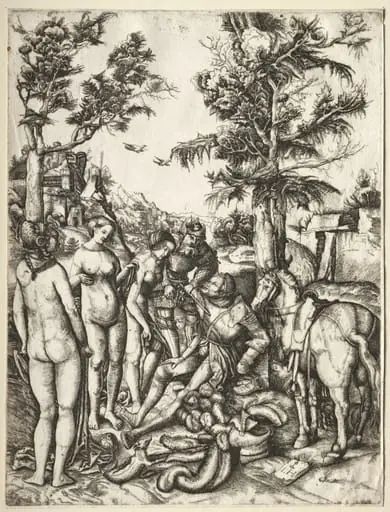
Lucas Cranach the Elder executed this painting in 1528, as confirmed by the inscription and scholarly consensus. While employed as court painter to the Electors of Saxony in Wittenberg, Cranach produced numerous versions of the Judgment of Paris for his patrons; the present work is a later iteration of a composition he first engraved in 1508 and painted around 1510 (a version now at the Kimbell Art Museum). A preparatory drawing dated between 1527 and 1530 likely served as an initial idea for this and other variants.
The painting is signed at lower right with Cranach's winged serpent emblem. It now belongs to the collection of the Metropolitan Museum of Art in New York, where it is housed in Gallery 643. The provided sources do not list an accession number or record an exhibition history.
Context
Scholarship contextualizes Cranach's 1528 Judgment of Paris within a medieval literary tradition, specifically the 12th-century Roman de Troie by Benoît de Sainte-Maure and the 13th-century Historia Destructionis Troiae by Guido delle Colonne. These texts, which Cranach appears to have used, depict Paris as a warrior rather than a shepherd and frame the encounter as a dream vision. Visual precedents include a circa 1460 print by the Master of the Banderoles and a 1502 Wittenberg edition of Dares Phrygius's Bellum Troianum.
Cranach's own 1508 print established the nude goddesses, a motif he repeated in multiple workshop versions, including the Metropolitan's painting. The artist, court painter to the Electors of Saxony, engaged a humanist audience; scholars such as Matsche (1996) interpret the subject as an allegory of life choices, contemplative (Minerva), active (Juno), or voluptuous (Venus), with Paris's flawed decision serving as a moral caution against sensual temptation.
Overview
Lucas Cranach the Elder, a German painter, completed The Judgment of Paris in 1528. This painting depicts a pivotal moment from Greek mythology, illustrating the Prince of Troy's difficult decision. The artwork, executed in paint, is now part of the collection at the Metropolitan Museum of Art in New York. It showcases Cranach's characteristic approach to classical narratives.
Own this work as a print
Artist & collection
Artist
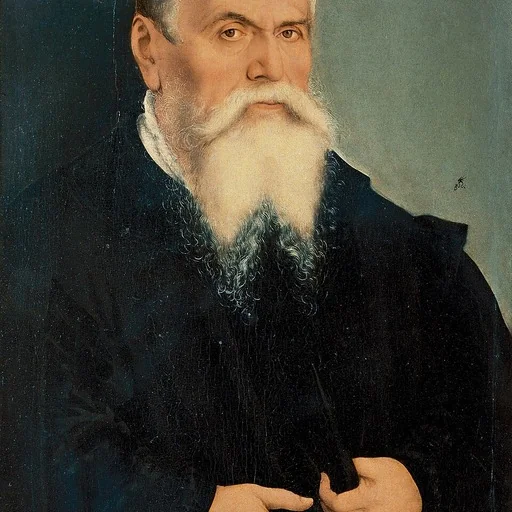
Lucas Cranach the Elder was a German Renaissance painter and printmaker in woodcut and engraving.