Artwork
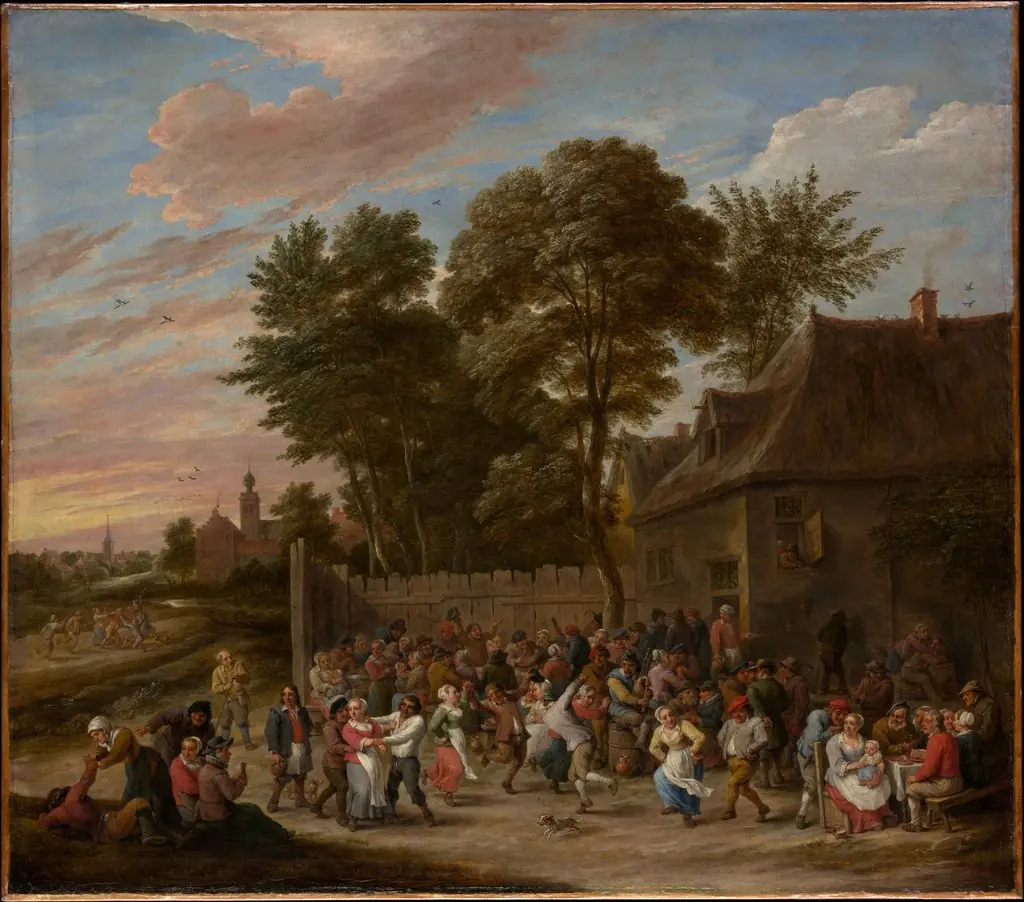
A Village Kermesse near Antwerp
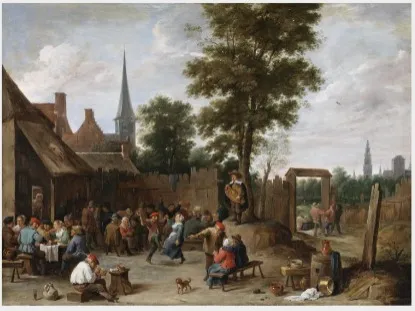
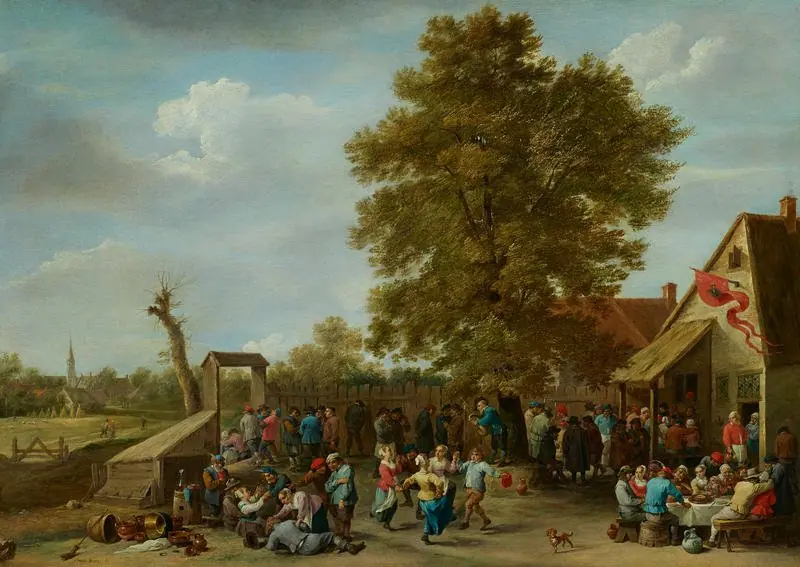
A Village Kermesse near Antwerp is an oil painting by the Flemish Baroque painting artist David Teniers the Younger. It dates from 1640 and is held in the collection of the National Gallery of Ireland.
About this work
Overview
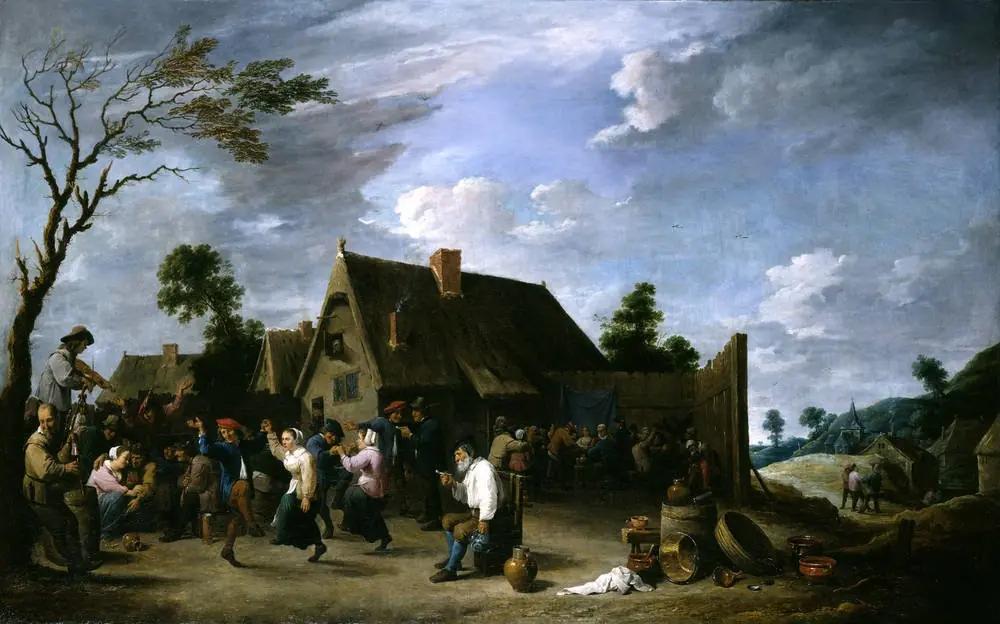
A Village Kermesse near Antwerp is an oil painting on copper by the Flemish artist David Teniers the Younger, dated to 1640.
A Village Kermesse near Antwerp is an oil painting on copper by the Flemish artist David Teniers the Younger, dated to 1640. Measuring 77.5 cm in width and 56.9 cm in height, the work depicts a bustling local festival set outside the gates of Antwerp. It belongs to a small group of monumental kermesse scenes by Teniers from the early 1640s, distinguished as the only one in this elite group executed on a copper support. This material choice gives the paint layer an unparalleled smoothness and lustre. Long heralded as one of the jewels of the Teniers oeuvre, the painting is currently held in the National Gallery of Ireland, part of the Beit Collection at Russborough House.
Subject & Meaning
The painting captures a kermesse, a traditional outdoor fair or village festival originally held to commemorate the anniversary of a local church. The scene presents a continuous narrative of communal celebration, with peasants dancing in pairs, gathered around tables outside a thatched-roof inn, and enjoying music from a hurdy-gurdy and a stringed instrument. A man in a white shirt and red cap eats from a wooden barrel, while a small dog stands alert nearby. The mood is celebratory and orderly, depicting peasants freely enjoying a summer day without coarse or threatening behavior, though one staggering reveller is helped home through a gateway. The setting is specific, staged at the gates of Antwerp with the cathedral's unmistakable spire visible in the distance, anchoring the rural festivities in a municipal frame of reference. Teniers presents an arcadian idyll where rural life is happy and carefree, a positive characterization that aligns with the serene literary tradition of country life rather than mere naturalistic observation.
Technique & Style
Executed in oil on copper, the work features a polished finish with careful blending and minimal visible brushstrokes, indicative of a refined technique aimed at descriptive precision. The copper support allows for an exceptionally smooth and lustrous paint layer, enabling delicate rendering of trees, landscape, and textures of fabric and wood. The composition spreads horizontally, anchored by a large tree in the center that divides the space while connecting the foreground activity to the sky above. Spatial depth is achieved through the gradual diminution of figures and buildings toward the horizon, enhanced by atmospheric perspective. The palette consists of earthy browns, muted greens, soft blues, and warm ochres, reflecting the lighter overall tone and warmer, more radiant colors Teniers developed in the 1640s. Occasional touches of brighter red and blue draw attention to specific individuals. Light falls evenly across the scene, suggesting a cloudy day with diffused illumination and gentle shadows beneath the tree and buildings. The figures are somewhat reduced in scale compared to earlier works, fitting convincingly into the expansive landscape.
History & Provenance
First documented in 1735, the painting passed through some of the greatest French Old Master collections of the 18th and early 19th centuries. It began with Johan van Schuylenburch, Burgomaster of Haarlem, whose posthumous sale in The Hague on September 20, 1735, included the work. Purchased for the Parisian market, it entered the collection of Jean Pâris de Montmartel, Marquis de Brunoy, recorded in his 1766 posthumous inventory. It passed to his son and was sold in 1776 to Antoine Jean Baptiste Dutartre. By 1804 it was owned by Lucien Bonaparte, 1st Prince of Canino, who sold it in 1815. James-Alexandre, Comte de Pourtalès-Gorgier, acquired it in 1826, selling it to Jean-François Boursault, whose 1832 sale led to Edmund Higginson. John Walter III owned it after 1857, and Alfred Beit bought it in 1894 on the recommendation of Wilhelm von Bode. It descended through the Beit family to Sir Alfred Lane Beit at Russborough. The painting has been exhibited widely, including shows in London, Antwerp, Brussels, Cape Town, Bruges, Rye, Karlsruhe, and Dublin, notably at the Royal Academy in 1927 and the National Gallery of Ireland in 2021.
Context
Teniers's fixation on the kermesse theme took on central importance in the 1640s, allowing for the fullest expression of his talents as he reached the pinnacle of his career. His earliest dated kermesse appeared in 1637, the year of his marriage to Anna Brueghel, daughter of Jan Brueghel the Elder. This marriage forged close links to the Brueghel family, bringing Teniers into possession of works by various members, including Pieter Bruegel the Elder, the main progenitor of the large painted kermesse. While Pieter Brueghel the Younger's numerous versions laid a clear precedent, Teniers updated the subject with contemporary protagonists and recognizable settings like Antwerp. He was also influenced by the refined output of his late father-in-law, Jan Brueghel the Elder, whose positive characterization of rural life he adopted, moving away from the coarser style of Adriaen Brouwer. The basic compositional structure established in 1637, with principal action in the left foreground and landscape on the right, was used in varying formats for ensuing famous treatments of the 1640s, including works now in Dresden, St. Petersburg, Karlsruhe, and the Royal Collection. The painting's provenance also reflects a watershed moment in the history of taste, as discerning French collectors championed the goût hollandais, finding the naturalism and technical brilliance of Dutch and Flemish artists like Teniers far more appealing than the grande manière of Italian painting.
Legacy
The painting's remarkable provenance testifies to its enormous and enduring appeal among elite collectors. As it moved through the buoyant Parisian art market of the 18th century, Teniers's works became the most sought after among Dutch and Flemish artists championed by vanguard French collectors. The influential art dealer Gersaint noted in 1744 that Teniers's works were universally beloved, and no worthy collection was complete without one. The artist's popularity was further disseminated by the numerous engravings made after his compositions, which helped establish the kermesse as a defining genre of Flemish art. Today, the work remains a key example within the Teniers oeuvre, representing the pinnacle of his multi-figural compositions and his successful transformation of the Brueghelian tradition into a refined, arcadian vision of peasant life that resonated with collectors for centuries.
Artist & collection
Artist
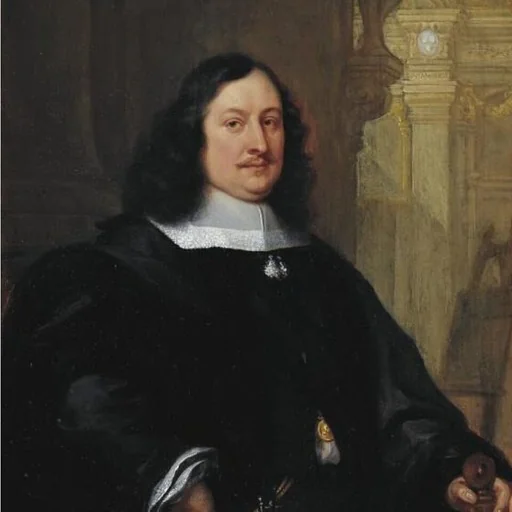
David Teniers the Younger or David Teniers II was a Flemish Baroque painter, printmaker, and artist.