Artwork
The Loge
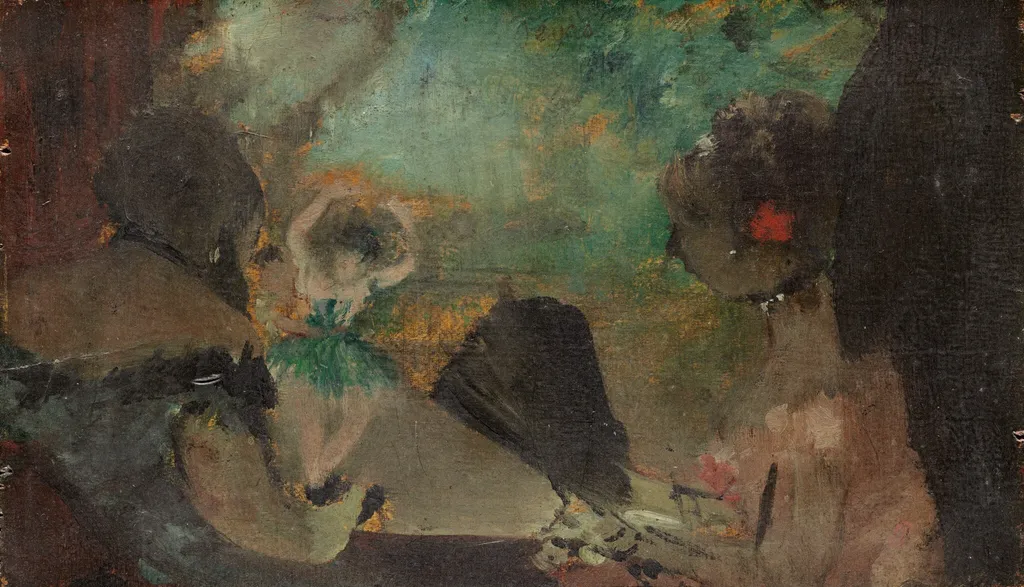
The Loge is an oil painting by the Impressionist artist Edgar Degas. It dates from 1883 and is held in the collection of the National Gallery of Art.
- Inscription
- Inscribed:upper center: Degas
About this work
Technique & Style
Executed in 1883, this portrait by Edgar Degas is rendered in oil on a wood panel support. The work is classified as a painting within the portrait genre. Specific details regarding the artist's handling of the medium or the current physical condition of the surface are not elaborated upon in the available records, though the material composition is established as oil on wood.
History & Provenance
Its earliest documented owner was the Parisian collector George Viau, after which it passed through the dealer M.
The Loge was painted by Edgar Degas in 1883 in oil on wood. Its earliest documented owner was the Parisian collector George Viau, after which it passed through the dealer M. Knoedler & Co. In 1933 it was acquired by Emily M. Wilson of Washington, D.C., who retained it for several decades before giving it in 1980 to the National Gallery of Art, where it remains. A specific accession number is not recorded in the available sources.
Context
Edgar Degas painted The Loge in 1883 in oil on wood panel, a work associated with his mature portraiture and his interest in theatrical interiors. The painting passed from the Paris collector George Viau through the dealer M. Knoedler & Co., was acquired in 1933 by Emily M. Wilson, and was gifted by her to the National Gallery of Art in 1980. Its provenance reflects the movement of Degas's work between European and American collections during the twentieth century.
Overview
Created circa 1883, Edgar Degas’s oil on wood work titled The Loge captures a moment inside a Parisian theatre box. The composition centers on two women, one turned away in a dark dress with a red‑flowered hat, the other facing the viewer, half‑illuminated and holding a fan. The surrounding backdrop suggests a blurred curtain of green and gold, hinting at the stage beyond.
Subject & Meaning
Degas shifts his focus from the ballet dancers that dominate much of his oeuvre to a scene of contemporary leisure. The seated figures embody the social rituals of theatergoing in late‑19th‑century Paris, reflecting both the public spectacle of performance and the private act of observation, as the forward‑facing woman watches the stage while the other remains detached.

Artist & collection
Artist
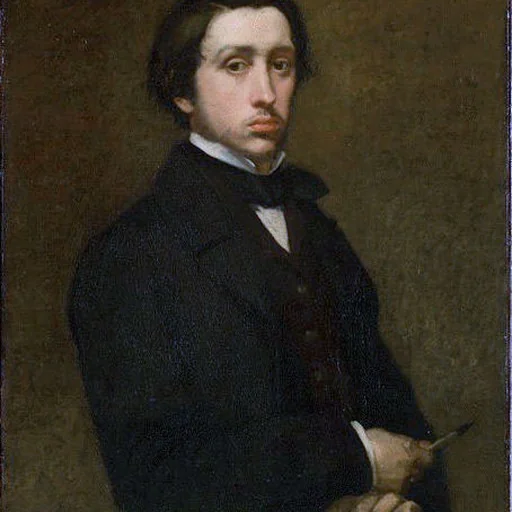
Born Hilaire-Germain-Edgar De Gas on 19 July 1834 in Paris, Edgar Degas came from an affluent banking family with aristocratic roots and spent his childhood among the cultivated circles of the French capital.

![Arearea no Varua Ino (Words of the Devil) [recto], by Paul Gauguin](https://artifactworldgallery.com/img/paul-gauguin--arearea-no-varua-ino-words-of-the-devil-recto--0bfcd29d383e4267-w320.webp)