Artwork
America
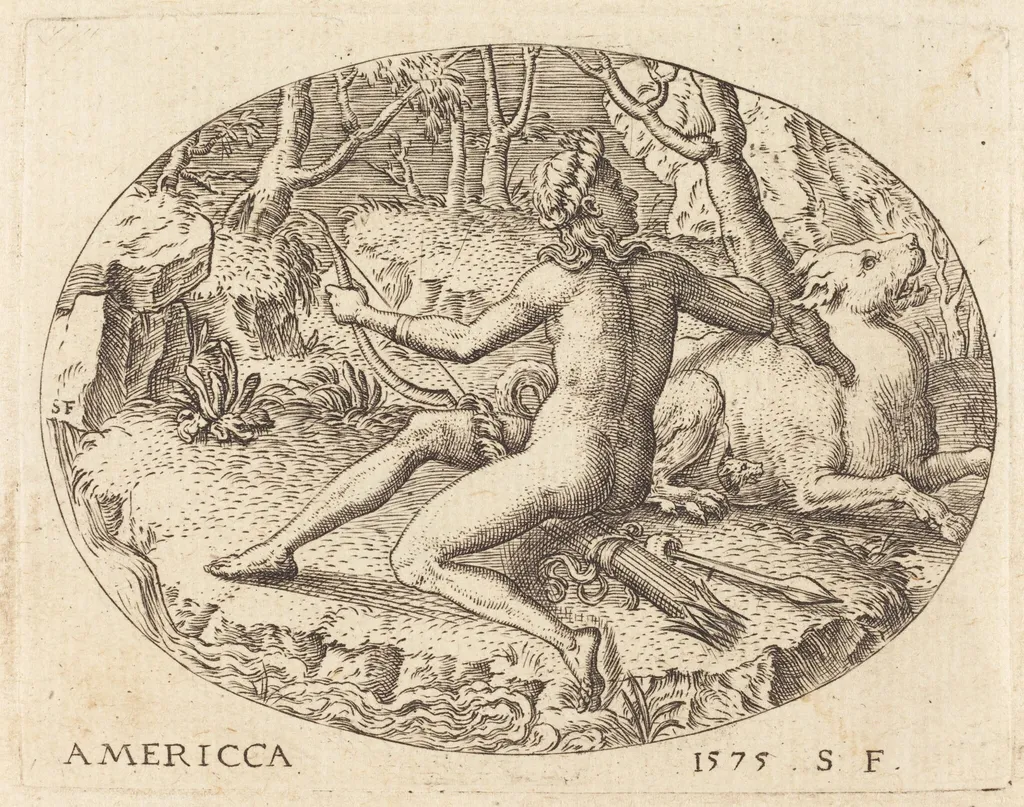
America is an ink print by the Renaissance artist Etienne Delaune. It dates from 1575 and is held in the collection of the National Gallery of Art.
About this work
Overview
Created in 1575 by Étienne Delaune, this engraving is a single-plate print depicting a symbolic scene tied to early European perceptions of the New World.
Created in 1575 by Étienne Delaune, this engraving is a single-plate print depicting a symbolic scene tied to early European perceptions of the New World. Rendered in fine linear detail, the composition centers on a kneeling female figure amid turbulent seas, with shipwrecked figures and distant observers framing the narrative. The inscription 'AMERICA' anchors the image as an allegorical representation rather than a literal depiction.
Subject & Meaning
The central figure, holding a cross and a book, suggests Christian faith as a stabilizing force amid chaos. The shipwrecked man clinging to rocks evokes peril and survival, while the small boat and onlookers imply rescue or observation. Together, these elements convey a moral or spiritual narrative: the New World as a place of trial, where faith endures against nature’s violence and isolation.
Technique & Style
Delaune employed the burin to carve precise, controlled lines into a metal plate, using varying densities of hatching and cross-hatching to model form and depth. The waves and rocks are rendered with intricate, rhythmic strokes, while the figures retain a sculptural clarity despite their small scale. The monochrome ink medium relies entirely on line and tone to suggest texture, movement, and atmosphere.
History & Provenance
The engraving emerged during a period of intense European exploration and colonial expansion. Delaune, active in France and known for his work in royal workshops, likely produced this piece for a learned or aristocratic audience. Its survival in private and institutional collections reflects its status as a rare example of 16th-century allegorical printmaking outside religious or mythological themes.
Context
In the late 1500s, visual representations of America were often allegorical, blending geography with moral or religious ideals. This engraving aligns with contemporary emblem books and cartographic imagery that personified continents as figures embodying virtues or perils. The inclusion of faith as a survival mechanism mirrors prevailing narratives justifying colonization through divine providence.
Legacy
Though not widely reproduced, the engraving contributes to a broader visual lexicon of early modern European responses to the Americas. Its focus on individual endurance and spiritual resilience influenced later allegorical depictions in print culture. Delaune’s technical precision helped elevate engraving as a medium for complex narrative expression beyond portraiture or heraldry.
Own this work as a print
Artist & collection