Artwork
Asia
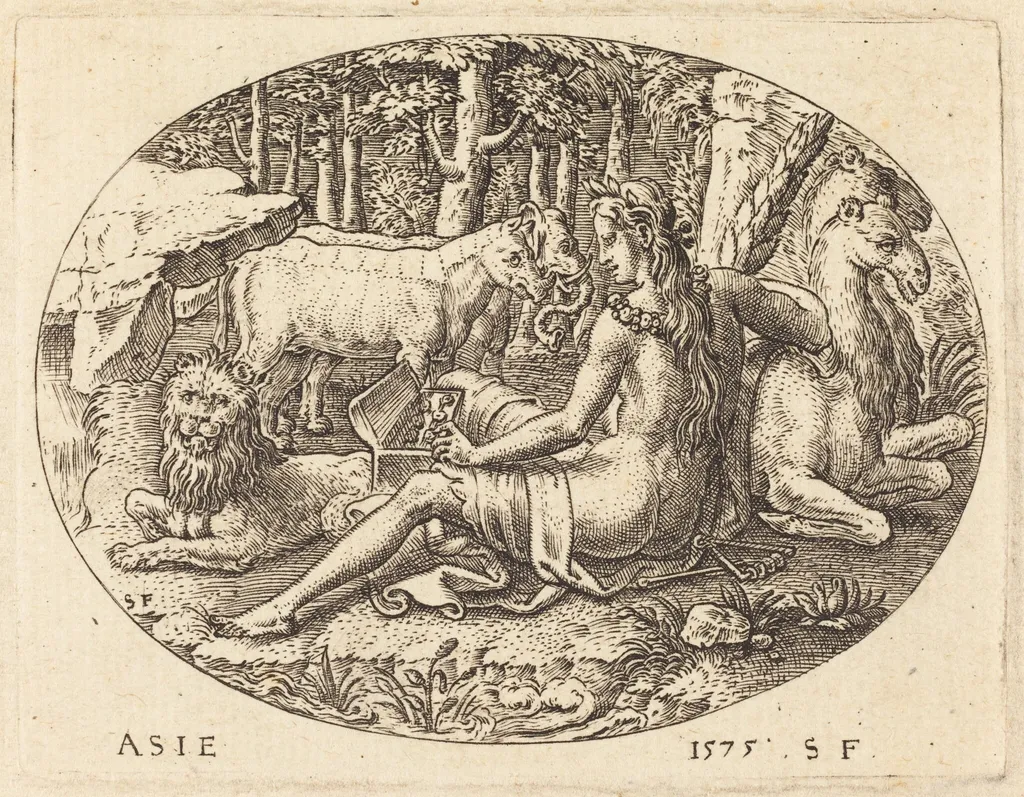
Asia is an ink print by the Renaissance artist Etienne Delaune. It dates from 1575 and is held in the collection of the National Gallery of Art. Created in 1575 by Étienne Delaune, this engraving depicts a surreal landscape labeled 'ASIE.
About this work
Overview
Delaune’s precise line work and intricate shading evoke a dreamlike atmosphere, characteristic of Mannerist printmaking traditions in late 16th-century France.
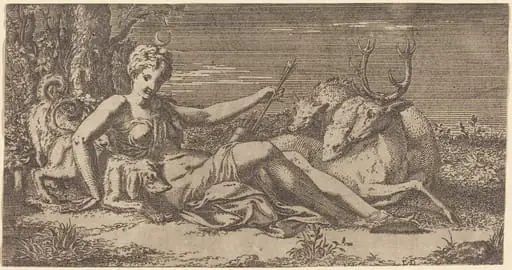
Created in 1575 by Étienne Delaune, this engraving depicts a surreal landscape labeled 'ASIE.' The composition centers on a reclining female figure on a rocky shore, surrounded by hybrid creatures and ethereal beings. Though the title references the continent, the imagery draws from allegory and fantasy rather than geographic realism.
Delaune’s precise line work and intricate shading evoke a dreamlike atmosphere, characteristic of Mannerist printmaking traditions in late 16th-century France.
Subject & Meaning
The central figure, possibly an allegory of Asia, lies amid a constellation of symbolic forms: a winged male figure, a crowned female, and a crouching lion. These elements do not correspond to known cultural or historical representations of Asia but instead reflect Renaissance allegorical conventions. The scene suggests a personification of the continent through mythic imagery, blending classical, Christian, and exoticized motifs to convey abstract ideas of power, mystery, and otherness.
Technique & Style
Delaune employed fine, controlled engraving lines to model form and depth, using cross-hatching and delicate stippling to suggest texture and shadow. The composition is densely packed, with overlapping figures and intricate details in foliage and anatomy. The dark, looming trees frame the scene, enhancing its enigmatic tone.
This technical precision reflects the artist’s training in goldsmithing and his mastery of the burin, typical of French Mannerist printmakers of the period.
History & Provenance
The engraving was produced during Delaune’s time in Paris, where he worked for royal patrons and produced prints for elite collectors. It likely circulated as part of a series of continental allegories, though no complete set survives. Its survival in museum collections today indicates its early recognition as a refined example of Northern European printmaking, valued for its craftsmanship rather than its narrative clarity.
Context
In the late 16th century, European artists frequently depicted continents as allegorical women, often accompanied by symbolic animals and objects. These images reflected expanding global knowledge and colonial ambitions, yet remained filtered through myth and imagination. Delaune’s work aligns with this trend, but diverges by rejecting literal representation in favor of a poetic, almost hallucinatory vision that prioritizes aesthetic complexity over geographic accuracy.
Legacy
Though not widely reproduced or celebrated in its time, the engraving exemplifies the intellectual and technical ambitions of French Mannerist printmaking. It influenced later artists interested in allegory and the expressive potential of line. Today, it is studied for its fusion of craftsmanship and symbolism, offering insight into how early modern Europe imagined distant lands through the lens of fantasy and artistic convention.
Own this work as a print
Artist & collection