Artwork
After the Bath (Woman Drying Herself)
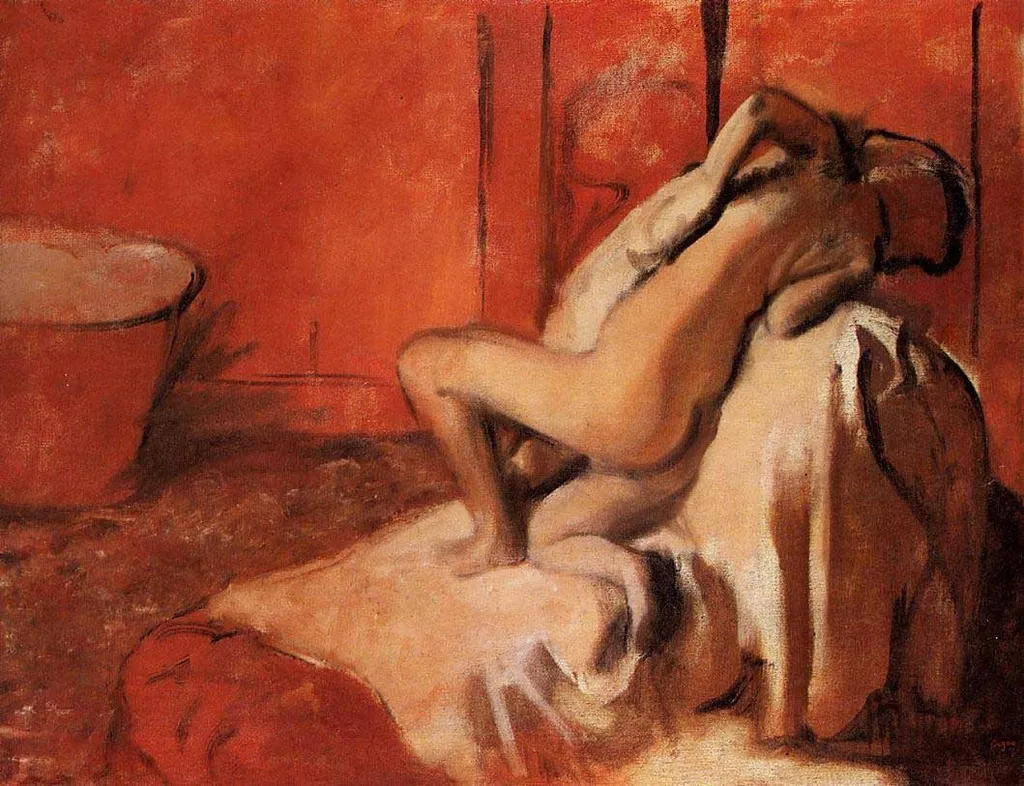
After the Bath (Woman Drying Herself) is an oil painting by the Impressionist artist Edgar Degas. It dates from 1898 and is held in the collection of the Philadelphia Museum of Art.
About this work
Overview
This work belongs to Degas's extensive and radical late series of bathing nudes, a subject that dominated his output during his final decades.
After the Bath (Woman Drying Herself) is a nude genre painting created by the French artist Edgar Degas around 1896. Executed in oil paint on canvas, the work measures 89.5 by 116.8 centimeters. It is currently held in the collection of the Philadelphia Museum of Art. The composition captures a woman seated beside a bathtub, twisting her body as she dries herself with a white cloth. This work belongs to Degas's extensive and radical late series of bathing nudes, a subject that dominated his output during his final decades.
Subject & Meaning
The painting depicts a nude woman seated on draped white fabric, turned away from the viewer as she reaches a white cloth to her neck to dry herself. Her body is twisted into an unstable, daring pose, with her face obscured by shadow and her posture emphasizing physical awkwardness and authentic movement over idealized beauty. Degas deliberately rejected the classical tradition of the nude, which historically presented figures in poses meant for an audience. Instead, he portrayed women engaged in the everyday, private activity of washing, seeking to capture a fleeting, unguarded moment rather than a narrative identity. He described this approach as looking through a keyhole at honest, simple folk unaware of being observed.
Technique & Style
Degas employed oil paint on canvas but manipulated the medium to achieve a dry, pastel-like aesthetic. To accomplish this, some of the oil was leached out of the paint before application. The surface features thin, fluid paint without heavy impasto, utilizing loose, visible brushwork and soft edges that leave certain passages sketchy and unfinished. Light falls from the upper left, illuminating the woman's back and the drapery while casting her face in shadow. The palette is dominated by warm reds, oranges, and creamy whites, with brown shadows defining the form. The background consists of flat red-orange panels with vertical dark lines, and the wallpaper pattern was created by applying spots of gray and orange paint with the artist's fingers, leaving visible fingerprints under magnification. Degas's late style is characterized by heavy, directional strokes that model the figure with tactile urgency, treating the body as pure sculptural form.
History & Provenance
Created circa 1896, the painting remained in Degas's possession until his death. It was sold from the Estate of Edgar Degas at an auction held at Galerie Georges Petit in Paris on May 6 through 8, 1918, listed as lot 98. The work was sold to the dealer Ambroise Vollard. It subsequently passed through the de Galéa heirs in Paris and the dealer or agent Robert de Bolli. On May 30, 1959, Henry Pearlman acquired the painting, facilitated by a 1958 letter from Galerie Rene Drouet encouraging the purchase. The work then entered the Henry and Rose Pearlman Foundation after 1974, ultimately joining the collection of the Philadelphia Museum of Art.
Context
The work emerges from Degas's final, most radical phase of nude studies, which began in the late 1880s and intensified through the 1890s. During this period, his deteriorating eyesight paradoxically pushed him toward bolder simplification of form and more emphatic modeling, making his late bathing women highly sculptural in quality. Although Degas occasionally used live models, he usually based his figures on preliminary drawings, and the generalized body in this painting suggests it was created from memory or a sketch rather than direct observation. The subject had become almost abstract for Degas by this time, functioning as a series of formal problems regarding mass, movement, and light. His experimental angles and cropping reflect the influence of photography and Japanese prints on his working method.
Artist & collection
Artist
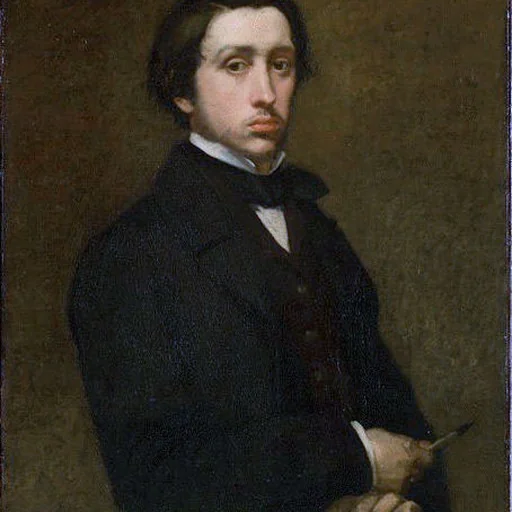
Born Hilaire-Germain-Edgar De Gas on 19 July 1834 in Paris, Edgar Degas came from an affluent banking family with aristocratic roots and spent his childhood among the cultivated circles of the French capital.