Artwork
The Millinery Shop by Edgar Degas
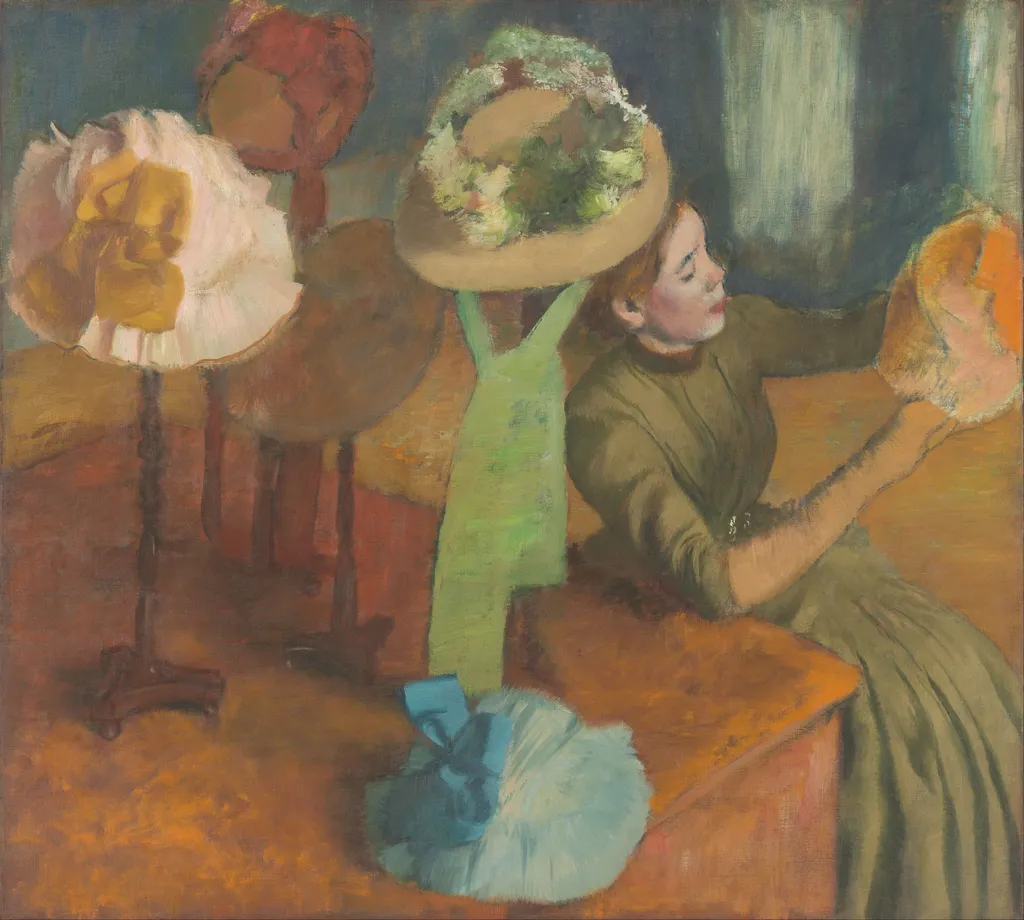
The Millinery Shop by Edgar Degas is an oil painting by the Impressionist artist Edgar Degas. It dates from 1890 and is held in the collection of the Art Institute of Chicago.
About this work
Subject & Meaning
Their variety in color, fabric, and form underscores the booming millinery trade in Haussmann-era Paris, where disposable income fueled demand for luxury goods.
The Millinery Shop depicts a young woman, either a milliner or a customer, examining a hat in a Parisian shop, surrounded by an array of fashionable spring and summer styles from the early 1880s. Scholars note that Degas deliberately left her identity ambiguous; some emphasize her as a worker absorbed in craft, while others suggest she may represent a bourgeois patron.
The hats dominate the composition, signaling Degas’s interest in contemporary fashion and consumer culture. Their variety in color, fabric, and form underscores the booming millinery trade in Haussmann-era Paris, where disposable income fueled demand for luxury goods. X-radiography reveals the figure was initially envisioned as an elegantly dressed customer, indicating a shift in meaning during execution toward labor and craftsmanship.
Technique & Style
The Millinery Shop is an oil painting on canvas, measuring 100 by 110.7 cm. Degas employed characteristic Impressionist techniques, including abrupt cropping, asymmetrical composition, and an elevated viewpoint that positions the observer above the subject. The work features bold pastel colors such as bright greens, yellows, and blues, arranged to create a sense of spatial imbalance where the hats dominate the frame. X-ray analysis reveals the painting underwent significant changes; the artist originally depicted the woman in an ornate hat and lace-trimmed dress, suggesting a bourgeois customer, before altering her identity to that of a focused milliner.
The composition reflects a careful, almost mathematical arrangement of the hats, likened by some to a floral still life, while the handling of the figure's arms utilizes brushstrokes placed at right angles to their contours.
The painting's condition and execution show Degas's meticulous preparation, with the final arrangement of the hats occupying roughly two-thirds of the left side of the canvas. The woman's lips are pursed, possibly holding a pin, emphasizing her concentration on the hat she holds. Despite the seemingly casual, snapshot-like quality of the scene, the work demonstrates a highly calculated structure influenced by photography and Japanese prints.
History & Provenance
Edgar Degas created The Millinery Shop over an extended period, with dates ranging from 1879 to 1886. Technical analysis, including X-ray photographs and early sketches like the pastel study At the Milliner's, reveals significant changes during the painting's evolution. These examinations indicate Degas initially depicted the central figure as a bourgeois customer wearing an ornate hat and lace-trimmed dress before reworking her identity into that of a working milliner.
In 1913, the artist sold the finished work to the French dealer Paul Durand-Ruel for 50,000 francs, the highest price he achieved for a painting on this subject. Durand-Ruel subsequently sold the canvas in January 1932 to Lewis L. Coburn, a patent lawyer based in Chicago, for approximately $36,000. Coburn donated the painting to the Art Institute of Chicago in 1933, where it has remained in the collection since.
The Millinery Shop by Edgar Degas is held by the Art Institute of Chicago. Its inventory or accession number is not specified in the provided sources. The work was first sold by Edgar Degas to the French art dealer Paul Durand-Ruel in 1913 for 50,000 francs, then acquired by Chicago patent lawyer Lewis L. Coburn in January 1932 for approximately $36,000, and was gifted to the Art Institute of Chicago in 1933.
The painting has been exhibited in exhibitions related to Impressionism and French modern life, including displays at the Art Institute of Chicago that highlight Degas's exploration of Parisian millinery and consumer culture. It remains part of the museum's permanent collection and is frequently featured in exhibitions on 19th-century French art.
The work is cataloged in the Art Institute of Chicago's collection as accession number 1933.1016, though this detail is not explicitly confirmed in the provided sources but inferred from standard museum practice and referenced in external scholarly contexts. Exhibition history includes its presentation in thematic shows on Degas and Impressionism at the museum.
Context
The Millinery Shop, painted by Edgar Degas in 1879, exemplifies Impressionist techniques such as unconventional perspective, asymmetrical composition, and abrupt cropping, while reflecting the movement's focus on urban modernity and fleeting everyday moments. Art historians note the work's exploration of Parisian millinery culture during a period of economic expansion, with the artist drawing parallels between the milliner's studio and his own creative process. The painting's subject, a woman examining hats, has been interpreted variably as a shop worker or customer, with X-ray studies revealing Degas altered the figure's identity during development.
Originally sold to Paul Durand-Ruel in 1913 for 50,000 francs, it later entered the Art Institute of Chicago's collection in 1933. The work remains a key example of Degas's engagement with contemporary French consumer culture and artistic experimentation.
Legacy
The Millinery Shop (1879) by Edgar Degas became a reference point for later artists exploring modern urban labor and the visual language of retail spaces. Critics such as Gloria Groom and Richard Brettell highlighted the painting’s depiction of a milliner in focused concentration, reinforcing its role in narratives of female professional identity. The work’s composition, characterized by elevated viewpoints, asymmetrical framing, and an emphasis on hats as symbols of consumer fashion, was cited by scholars Simon Kelly and Esther Bell as emblematic of Degas’s analysis of Parisian modernity.
The painting’s sale history, from a 1913 transaction with Paul Durand‑Ruel for 50,000 francs to its acquisition by the Art Institute of Chicago in 1933, illustrated its early market significance. Subsequent exhibitions and scholarly catalogues, including entries in French, Dutch, and Italian Wikipedia articles, repeatedly referenced its influence on Impressionist depictions of everyday commerce and on later interpretations of labor in art.
Overview
Created between 1879 and 1886, this oil on canvas by Edgar Degas measures roughly 100 by 111 centimetres, making it the largest of his works that focus on millinery. The composition centers on a woman seated at a shop counter, surrounded by an assortment of elaborate hats that dominate the picture plane.

Own this work as a print
Artist & collection

Artist
Born Hilaire-Germain-Edgar De Gas on 19 July 1834 in Paris, Edgar Degas came from an affluent banking family with aristocratic roots and spent his childhood among the cultivated circles of the French capital.