Artwork
Un soir de grève
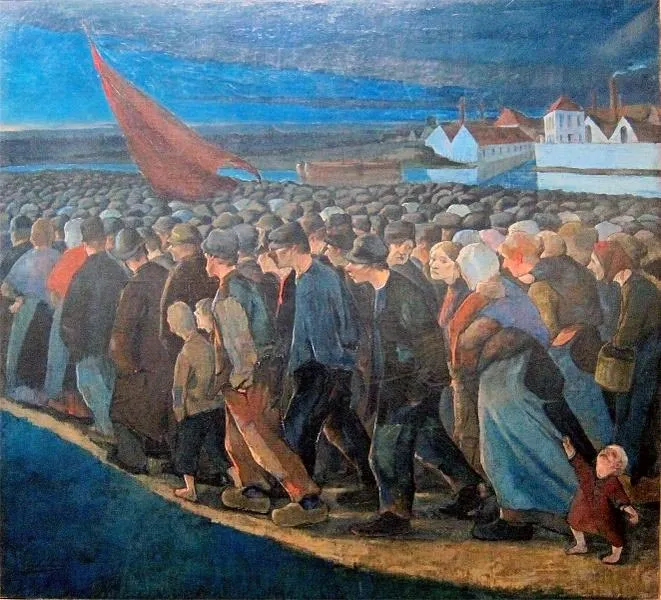
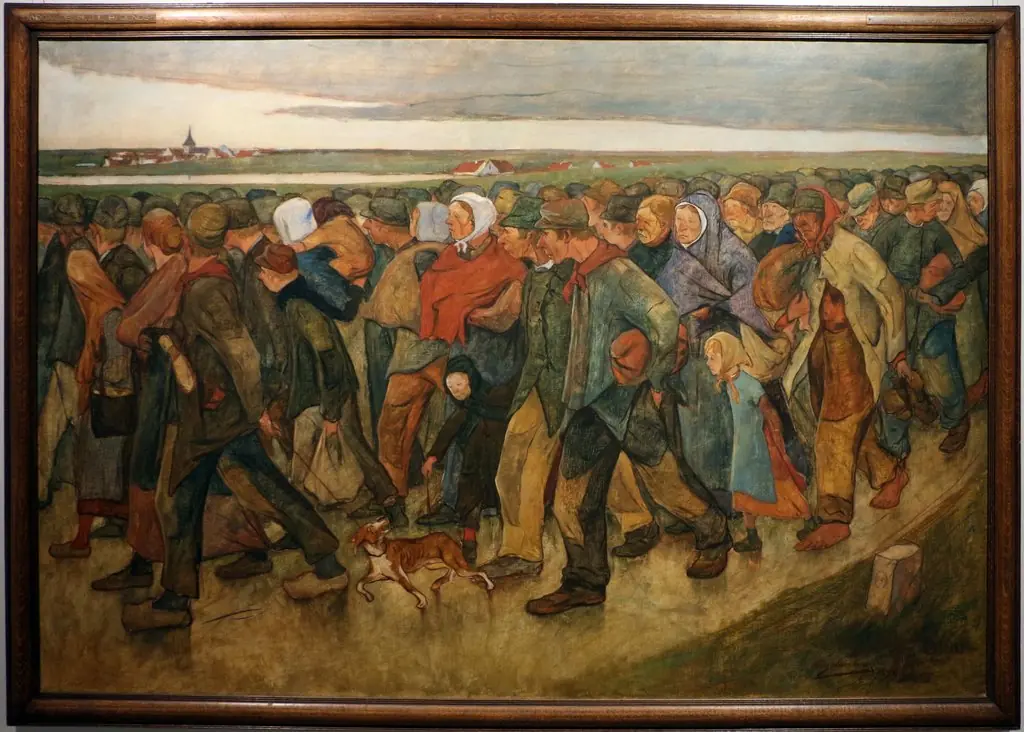
Un soir de grève is an oil painting by the Realist artist Eugène Laermans. It dates from 1897 and is held in the collection of the Royal Museums of Fine Arts of Belgium.
About this work
Subject & Meaning
Through this scene, Eugène Laermans visualizes the collective struggle of the proletariat, whom he viewed as victims of social injustice.
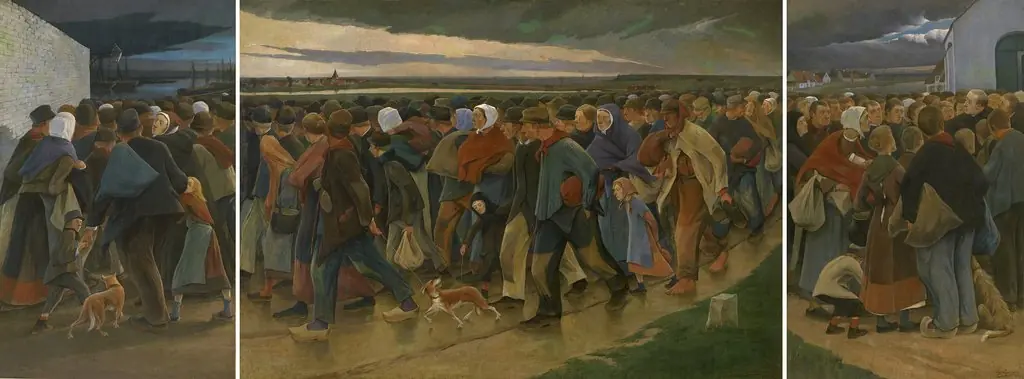
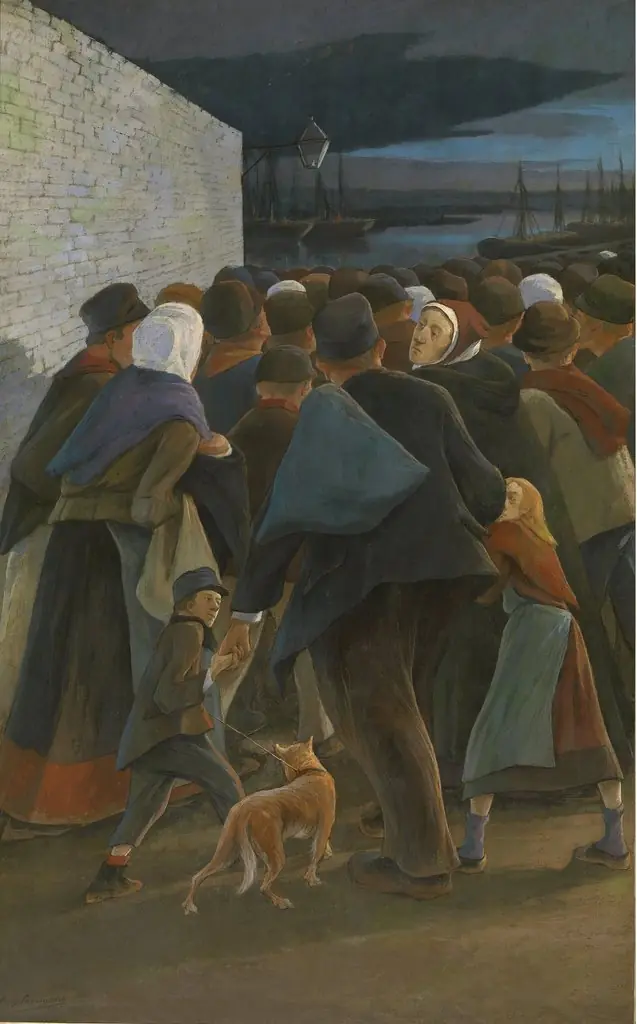
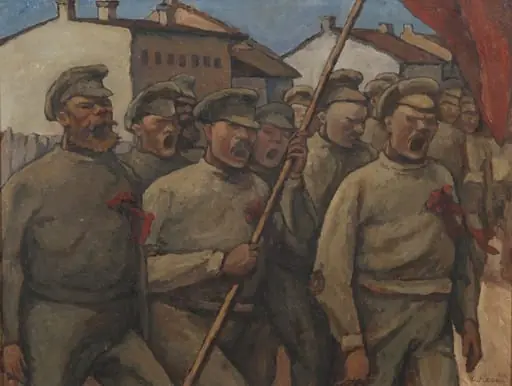
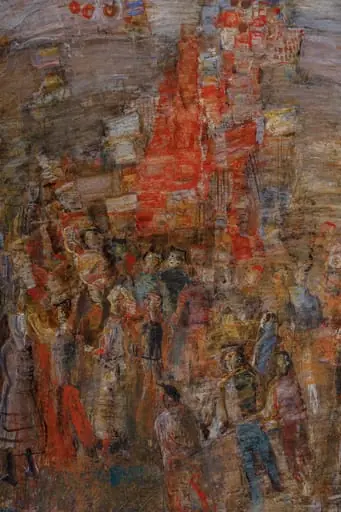
Un soir de grève, also known as Le drapeau rouge, depicts the Belgian general strike of 1893, capturing a moment when the industrial working class mobilized against factory owners. The painting portrays a dense, indistinct crowd moving in a somber procession before white factory buildings, led by a red flag that serves as the work's central symbol of proletarian solidarity and revolt. The composition features men in dark caps at the forefront, followed by women with uncovered or veiled heads, all traversing a narrow strip of land beside stagnant water under a cold, threatening sky.
Through this scene, Eugène Laermans visualizes the collective struggle of the proletariat, whom he viewed as victims of social injustice. The work stands as a significant example of social realism, emphasizing the unity and grim determination of the workers during a period marked by tragic repression and agitation.
Technique & Style
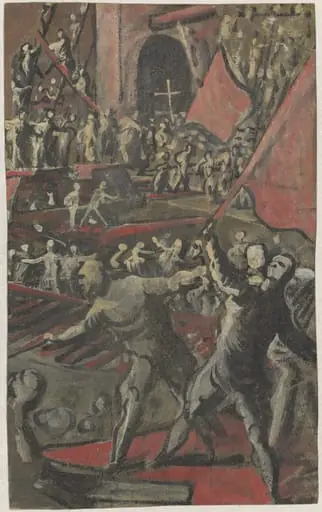
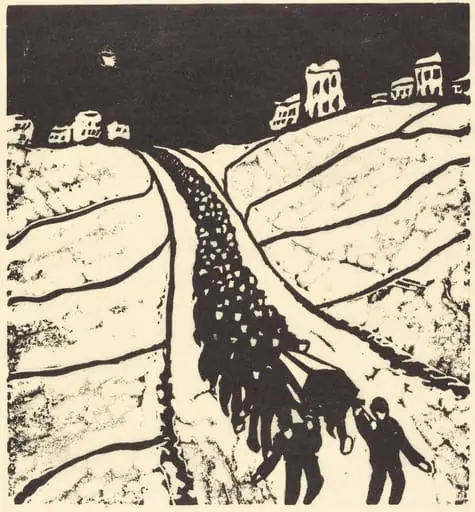
Un soir de grève is an oil painting on canvas, measuring 106 by 115 cm. The work belongs to the tradition of social realism, depicting a tightly packed crowd advancing in a single, broad diagonal mass behind a red flag and before the white sheds of a factory. The procession is rendered as an undifferentiated cluster of heads: men lead the march, uniform and capped in dark berets, while women bring up the rear, distinguished by uncovered or veiled heads and the occasional face turning outward. The figures press along a narrow strip of land bordering stagnant water, beneath a bleak, cold sky heavy with the threat of rain. Laermans also translated the same subject into a print, extending his exploration of the theme across media.
History & Provenance
Un soir de grève was painted by Eugène Laermans in 1893 as an oil on canvas work. The painting entered the collection of the Royal Museums of Fine Arts of Belgium, where it remains on display in the Fin-de-Siècle Museum. It was first shown publicly at the La Libre Esthetique exhibition in Brussels in 1894 before later appearing at the Venice Biennale in 1924 and in a retrospective of Laermans' oeuvre in Brussels in 1925.
The work has been part of several subsequent exhibitions, including shows in Antwerp (1952), Belgrade (1956-1957), Charleroi (1958), and Brooklyn (1980). The painting's subject references the 1893 Belgian general strike, depicting a crowd marching under a red flag before factory gates.
Un soir de grève is held in the collection of the Royal Museums of Fine Arts of Belgium, specifically at the Fin-de-Siècle Museum within that institution. Its accession number is not specified in the sources. The work was first exhibited in 1894 at La Libre Esthetique in Brussels, later shown at the Venice Biennale in 1924, and featured in retrospectives at venues including Antwerp, Belgrade, Charleroi, and Brooklyn through 1980-1981.
It has been included in exhibitions focusing on social themes such as Le drame social dans l'art; de Goya à Picasso in 1960 and Belgian Art: 1880-1914 in 1980. No additional exhibition records are confirmed by the sources.
Context
Un soir de grève (1893) is situated within the social realism movement, reflecting Eugène Laermans's dedicated focus on the proletariat and social injustices. The work emerged during a period of intense industrial unrest in Belgium, specifically responding to the tragic general strike of 1893 and earlier violent labor conflicts in the Hainaut coal region. Laermans visually articulated the collective consciousness of the working class through this depiction of a somber crowd marching behind a red flag before factory buildings.
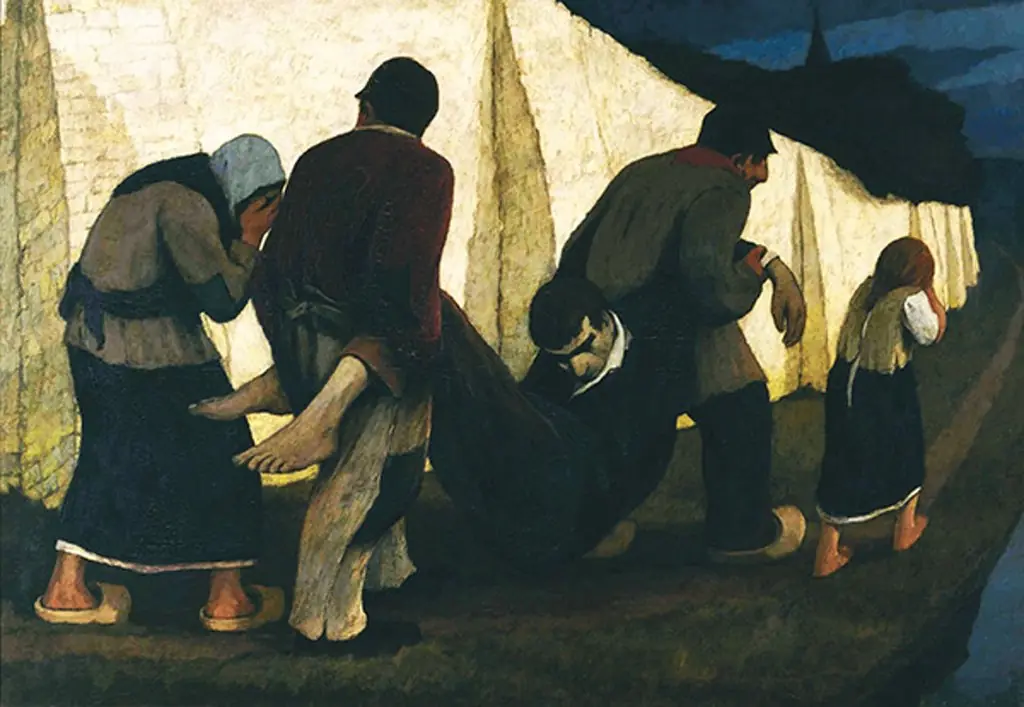
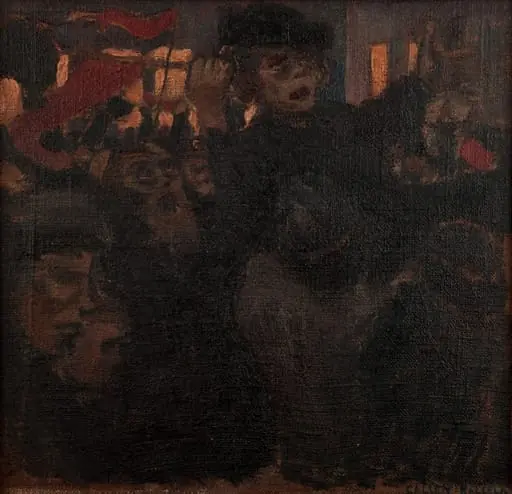
The painting is thematically linked to Laermans's subsequent social critiques, including Une foule (1894), Les emigrants (1894), and the triptych Les Deuillants (1896). Its historical significance has been reinforced through extensive exhibition history, ranging from its 1894 debut at La Libre Esthétique in Brussels to international surveys such as the 1960 exhibition Le drame social dans l'art and the 1980 Brooklyn Museum showcase Belgian Art: 1880-1914.
Legacy
Un soir de grève has been recognized as a pivotal image of social protest in modern European art, shaping later depictions of collective labor movements. Its visual language, crowds advancing under a red flag before industrial backdrops, was echoed in Laermans' other realist works such as Une foule (1894) and Les emigrants (1894), and influenced subsequent social realist painters who adopted similar compositions of proletarian solidarity. The painting's inclusion in major exhibitions, from the 1924 Venice Biennale to the 1980 Brooklyn Museum survey 'Belgian Art: 1880-1914', cemented its reputation as a canonical representation of the 1893 Belgian general strike and the broader realist tradition.
Overview
Un soir de grève is an 1897 oil painting by Eugène Laermans, capturing a pivotal moment in Belgian history through a somber, dusk-lit street scene.
Artist & collection

Museum
Royal Museums of Fine Arts of Belgium
Continue through works from the same source collection.