Artwork
The Beach at Deauville
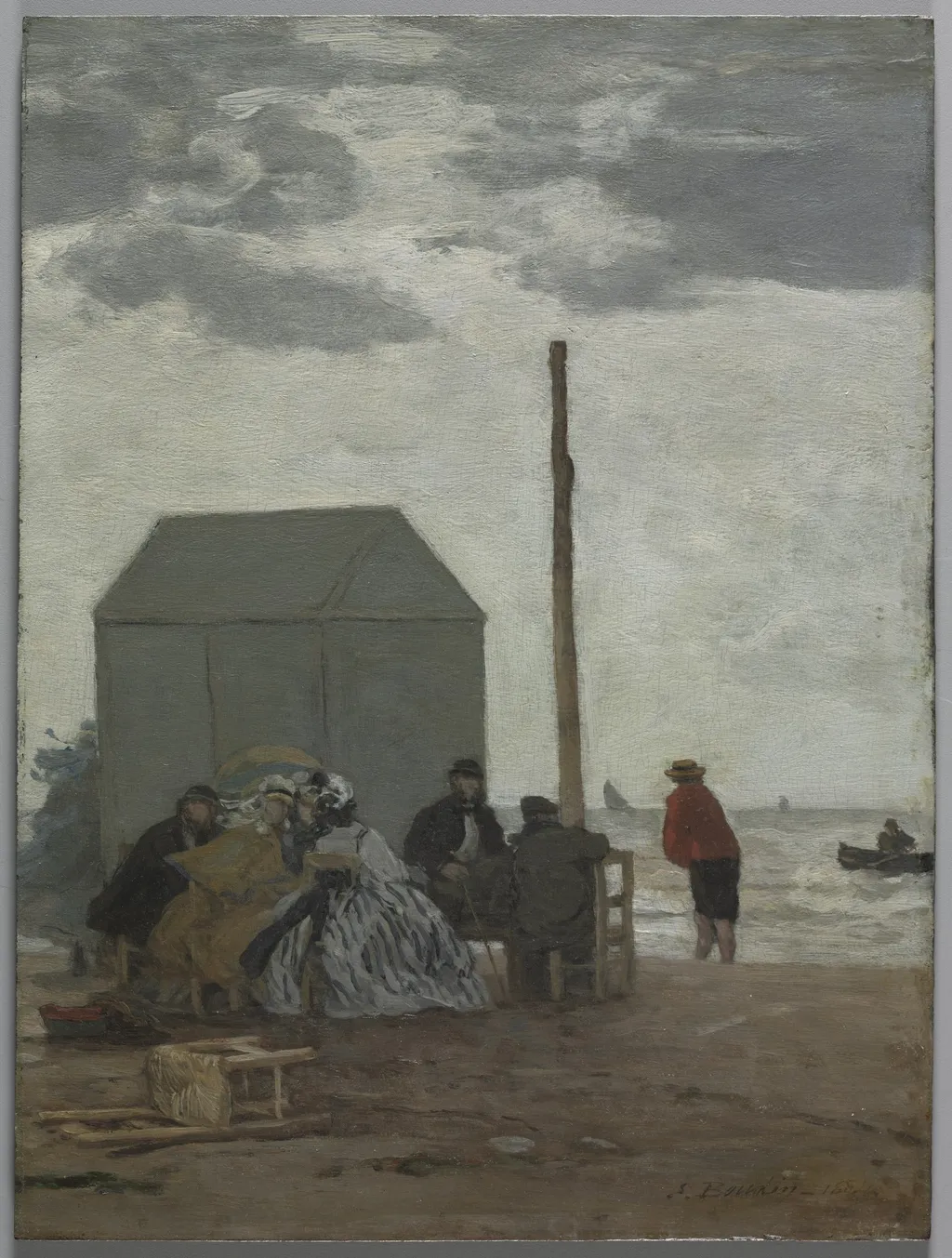
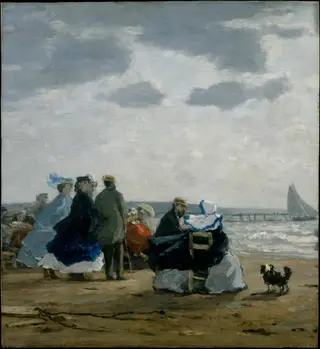
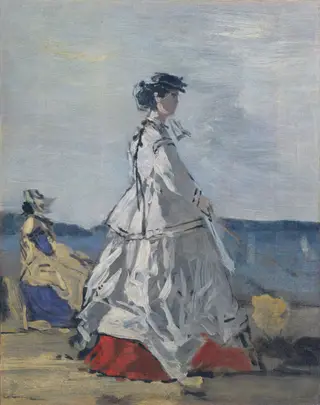
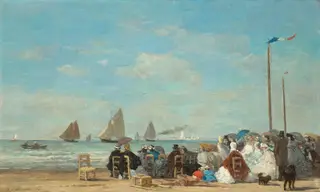
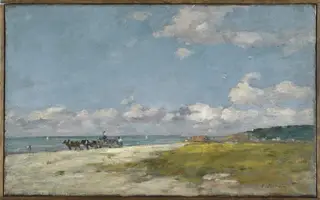
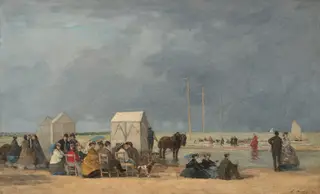
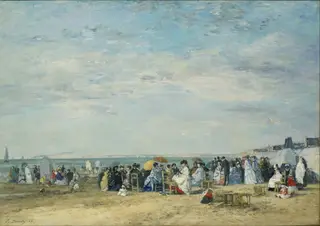
The Beach at Deauville is an oil painting by the Realist artist Eugène Louis Boudin. It dates from 1864 and is held in the collection of the Cleveland Museum of Art.
About this work
Subject & Meaning
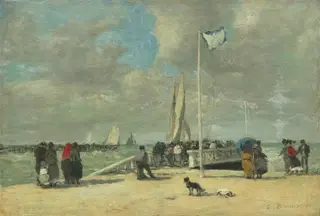
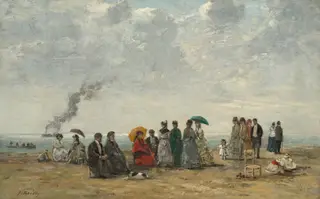
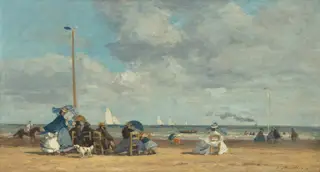
The painting depicts a sunlit shoreline at Deauville, featuring figures in contemporary seaside attire strolling along the promenade and children playing near the water's edge. The subject reflects the leisure activities of the French bourgeoisie during the mid-19th century, emphasizing themes of recreation and the burgeoning popularity of coastal resorts. Boudin's focus on light and atmospheric effects captures the transient quality of the beach scene, aligning with Impressionist interests in modern life and natural observation.
Technique & Style
As a painting classified within the artist's oeuvre, it exemplifies his handling of oil on a rigid surface, a common choice for his beach scenes of the period.
Eugène Boudin executed The Beach at Deauville in 1864 using oil paint applied to a panel support. The work measures 34.7 cm in height and 26.0 cm in width. As a painting classified within the artist's oeuvre, it exemplifies his handling of oil on a rigid surface, a common choice for his beach scenes of the period. The specific material combination of oil and panel defines its physical construction.
History & Provenance
The Beach at Deauville, painted by Eugène Louis Boudin in 1864, is an oil on panel work measuring 34.7 by 26.0 centimeters. It entered the collection of the Cleveland Museum of Art in 1946 as accession number 1946.71 and remains on view there. The painting was created in France and is classified as a work of painting.
The Beach at Deauville is held in the collection of the Cleveland Museum of Art. It was acquired by the museum in 1946 and is cataloged under the accession number 1946.71. The work has been part of exhibitions at the Cleveland Museum of Art, including a presentation in 1950 of French paintings from the museum's collection.
Legacy
The painting's bold treatment of light and shoreline influenced subsequent Impressionist approaches to plein-air depiction of coastal scenes, establishing a precedent for atmospheric rendering in later French modernism. Its inclusion in the Cleveland Museum's collection facilitated scholarly reassessment of Boudin's role in bridging Realist and Impressionist practices, reinforcing his reputation as a precursor to Monet and Renoir in the study of modern optics.
Overview
Eugène Louis Boudin’s 1864 oil painting The Beach at Deauville presents a quiet stretch of Normandy shoreline. A modest gathering of figures occupies the sand near a low wooden structure, while a solitary figure in a red coat stands close to the water’s edge. The composition balances sky, sea, and shore, emphasizing the muted palette of earth tones and cool blues that characterize Boudin’s treatment of light.
Context
Boudin’s focus on coastal life aligns with the broader Realist movement’s concern for contemporary, everyday subjects. His contemporaries, including Charles Baudelaire and Jean‑Baptiste‑Camille Corot, praised his ability to capture atmospheric effects, a quality evident in this depiction of Deauville’s beach.
Own this work as a print
Artist & collection

Artist
Eugène Louis Boudin (French: ; 12 July 1824 – 8 August 1898) was one of the first French landscape painters to paint outdoors.