Artwork
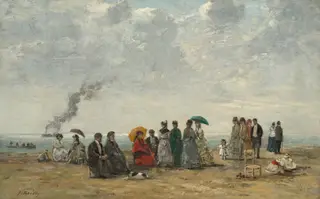
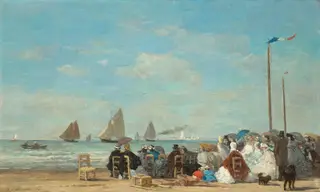
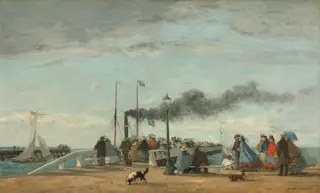
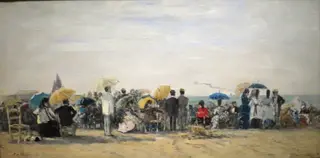
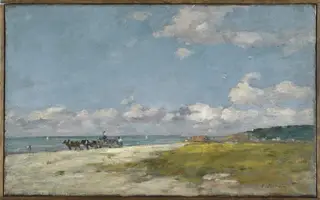
Beach at Trouville
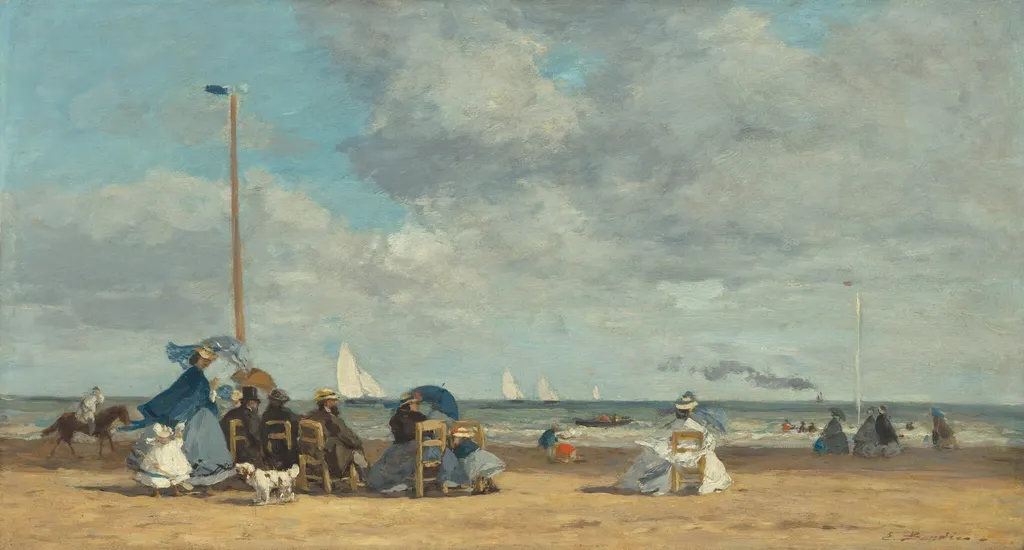
Beach at Trouville is an oil painting by the Impressionist artist Eugène Louis Boudin. It dates from 1864 and is held in the collection of the National Gallery of Art.
- Inscription
- Inscribed:lower right: E. Boudin.
About this work
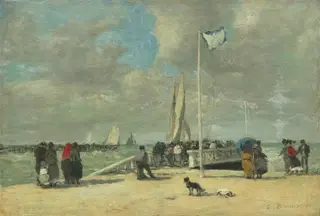
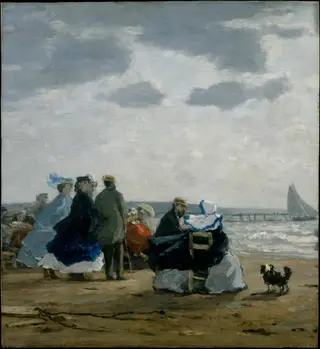
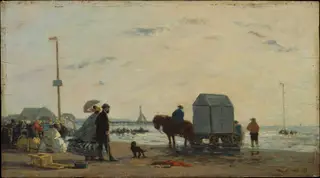
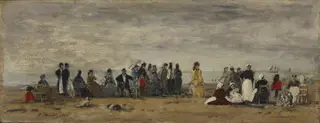
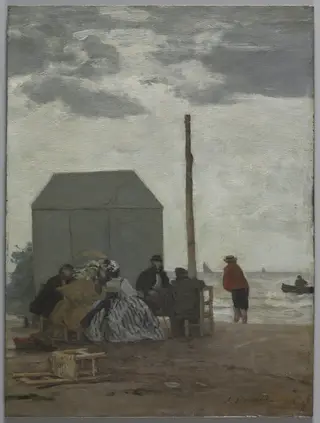
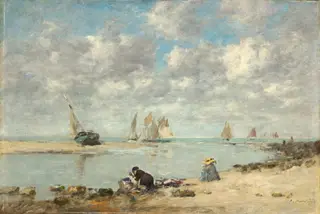
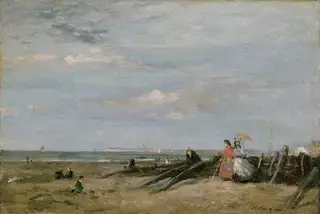
The painting shows a beach scene with people sitting on chairs and a child standing next to a woman in a blue dress. A horse and rider are on the left, and sailboats are in the background.
The people are dressed in clothing typical of the 19th century. A small white dog is by the woman's side.
If you like this painting, you might also want to look into Impressionism, Realism.
Subject & Meaning
Its subject therefore embodies contemporary bourgeois recreation while emphasizing the transitory quality of light and weather.
The painting shows a shoreline scene at Trouville-sur-Mer on the Normandy coast. Boudin places a group of elegantly dressed figures strolling along the beach beneath billowing clouds that dominate the sky. The work captures a fleeting leisure moment of the Second Empire era, reflecting both the social habit of seaside promenading and the artist’s interest in atmospheric effects. Its subject therefore embodies contemporary bourgeois recreation while emphasizing the transitory quality of light and weather.
The composition also conveys a sense of fleeting modernity through its loose brushwork and open-air approach, linking the scene to emerging Impressionist concerns with immediacy and perception.
Technique & Style
The work is executed in oil on a wooden panel, a support commonly used by Boudin in the 1860s for its portability during plein-air campaigns. Handling is fluid and sketch-like, with quick, broken brushstrokes that register light and atmosphere rather than detailed form. The palette is muted, anchored by cool grays and whites modulated by atmospheric haze, while the horizon is loosely defined to emphasize the expansive sky and shifting weather.
Stylistically, the composition privileges the fleeting effects of light and movement, aligning with the emerging naturalist tendencies of the mid-1860s rather than the tighter finish of academic practice.
History & Provenance
Painted in 1864, the work is recorded under the title "At Deauville" in Arthur Tooth and Sons’ London stock inventory before its transfer to Capt. Edward H. Molyneux in 1952.
Its ownership chain begins with the Paris dealer Dieterle, followed by Paul Gerson in New York. It was later held by Harold Sidney Harmsworth, 1st Viscount Rothermere, whose estate sold it at Christie’s, London, on 19 December 1941 (lot 34). Arthur Tooth and Sons acquired it for Molyneux the same day, and it was sold in 1955 to Ailsa Mellon Bruce. She bequeathed it to the National Gallery of Art, Washington, D.C., in 1970.
Eugène Boudin's Beach at Trouville is held in the collection of the National Gallery of Art in Washington, D.C. The work entered the museum's holdings through the 1970 bequest of Ailsa Mellon Bruce, who had purchased it from Captain Edward H. Molyneux in August 1955. Prior to its acquisition by Bruce, the painting was sold at Christie's in London on December 19, 1941, as part of the estate of Harold Sidney Harmsworth, 1st Viscount Rothermere, where it was listed as catalogue number 34. The artwork subsequently passed through the London and Paris dealers Arthur Tooth and Sons before reaching Molyneux.
Context
Eugène Boudin painted Beach at Trouville in 1864, an early example of his beach scenes that prefigure Impressionist interest in fleeting light and atmosphere.
The work entered private collections in Paris and New York before being acquired by Arthur Tooth and Sons, which sold it to Ailsa Mellon Bruce in 1955; Bruce later bequeathed it to the National Gallery of Art in Washington, D.C., where it remains in the collection.
Scholarship on the painting emphasizes its role in Boudin’s development of plein‑air techniques and its influence on younger Impressionists such as Monet, who admired Boudin’s treatment of coastal subjects.
Overview
Eugène Boudin’s 1864 work Beach at Trouville is an oil painting executed on a wooden panel. The composition presents a seaside promenade populated with figures, a horse and rider, and distant sailboats, all rendered in a light-filled atmosphere characteristic of Boudin’s coastal subjects.
Artist & collection

Artist
Eugène Louis Boudin (French: ; 12 July 1824 – 8 August 1898) was one of the first French landscape painters to paint outdoors.