Artwork
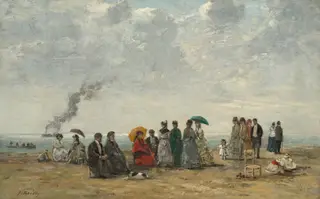
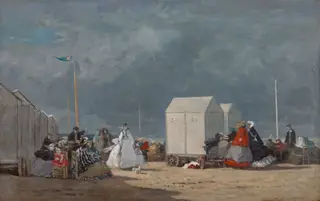
Bathing Time at Deauville
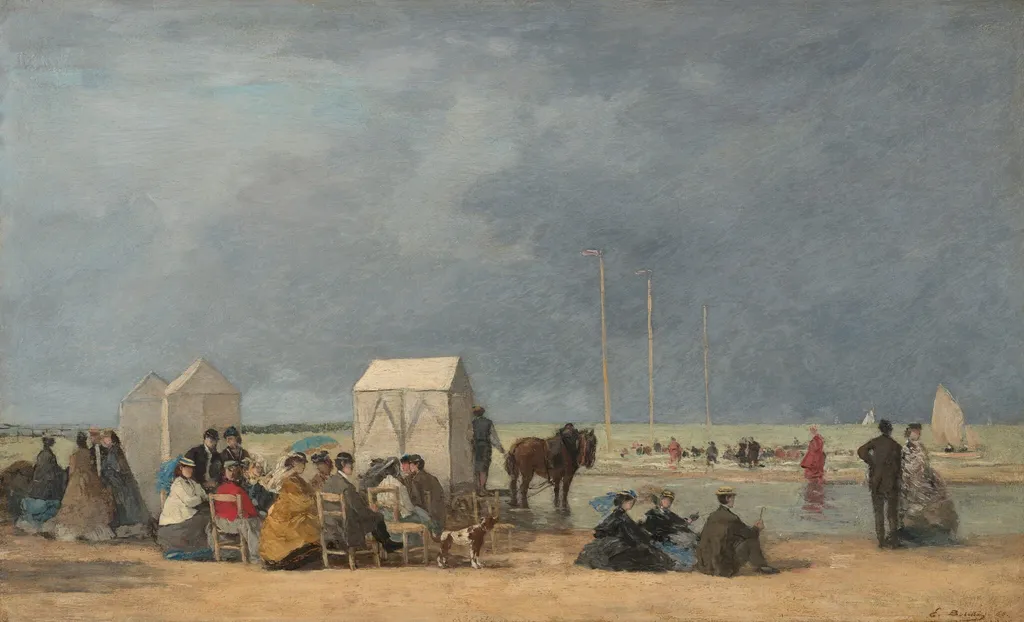
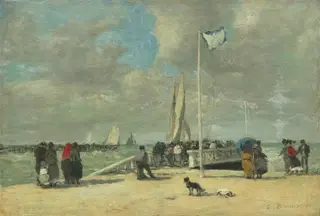
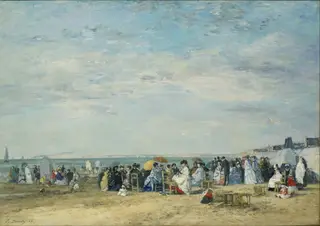
Bathing Time at Deauville is an oil painting by the Impressionist artist Eugène Louis Boudin. It dates from 1865 and is held in the collection of the National Gallery of Art.
- Inscription
- Inscribed:lower right: E. Boudin - 65
About this work
Technique & Style
Bathing Time at Deauville is executed in oil on wood, a relatively modest support that suited Boudin's rapid, plein-air manner of the mid-1860s.
Bathing Time at Deauville is executed in oil on wood, a relatively modest support that suited Boudin's rapid, plein-air manner of the mid-1860s. The horizontal panel measures 34.7 by 57.5 cm, a small, cabinet-scale format that encouraged the loose, sketch-like handling typical of his beach scenes. The work is classified as a painting and falls within the genre of nude, depicting figures on the Normandy coast in a manner consistent with Boudin's broader coastal oeuvre of the period.
The oil medium on a rigid wooden ground allowed for the fluid, abbreviated brushwork that characterizes Boudin's approach to light and atmosphere, while the compact dimensions suited an intimate, observational treatment of the subject.
History & Provenance
Painted in 1865, the oil-on-panel work first appeared at the Cabruja sale at Galerie Georges Petit, Paris, on 20 May 1921, where it was acquired by Durand-Ruel. It reappeared at Christie's, London, on 23 April 1937 as 'Property of a Lady', then passed through Arthur Tooth & Sons, London. In January 1943 it was sold to Mrs. Peter Pleydell-Bouverie, London, who retained it until at least 1954.
After ownership by N. Beecham, it was handled by Marlborough-Gerson Gallery, New York, and sold in December 1963 to Mr. Paul Mellon of Upperville, Virginia. Mellon gave the painting to the National Gallery of Art in 1983.
Bathing Time at Deauville entered the collection of the National Gallery of Art in Washington, D.C., in 1983 as a gift from Paul Mellon, who had acquired the work in December 1963. Prior to Mellon's ownership, the painting passed through several private and commercial hands, including Mrs. Peter Pleydell-Bouverie, who held it from January 1943 until at least 1954, and the Marlborough-Gerson Gallery in New York. Earlier provenance includes sales at Galerie Georges Petit in Paris in 1921 and Christie's in London in 1937, as well as dealings by Arthur Tooth & Sons.
The work was featured in the 1954 exhibition The Pleydell-Bouverie Collection of Impressionist and Other Paintings at the Tate Gallery in London. It also appeared in A Selection of Important 19th Century French Masters, organized by Marlborough Fine Art Ltd in London in October 1960.
Overview
Eugène Boudin’s Bathing Time at Deauville (1865) is an oil painting on wood that captures a coastal scene on the Normandy shore. The composition presents a dock crowded with small boats, choppy water, and figures in mid‑19th‑century attire. Executed en plein air, the work conveys the immediacy of natural light and atmosphere, hallmarks of Boudin’s marine oeuvre.
Subject & Meaning
The canvas depicts a bustling seaside moment: vessels moored to a pier, a few onlookers, and a nude figure positioned within the lively environment. By placing the human form amid the maritime setting, Boudin underscores the interaction between people and the sea, suggesting leisure and the everyday rhythms of a coastal town.
Context
At the time of its execution, painting directly from nature was still a relatively novel practice in French art. Boudi n’s dedication to plein‑air methods placed him among the forerunners of the later Impressionist movement, influencing peers who sought to capture the transient effects of light and weather in their work.
Own this work as a print
Artist & collection

Artist
Eugène Louis Boudin (French: ; 12 July 1824 – 8 August 1898) was one of the first French landscape painters to paint outdoors.