Artwork
Judith Goes to the Camp of Holofernes
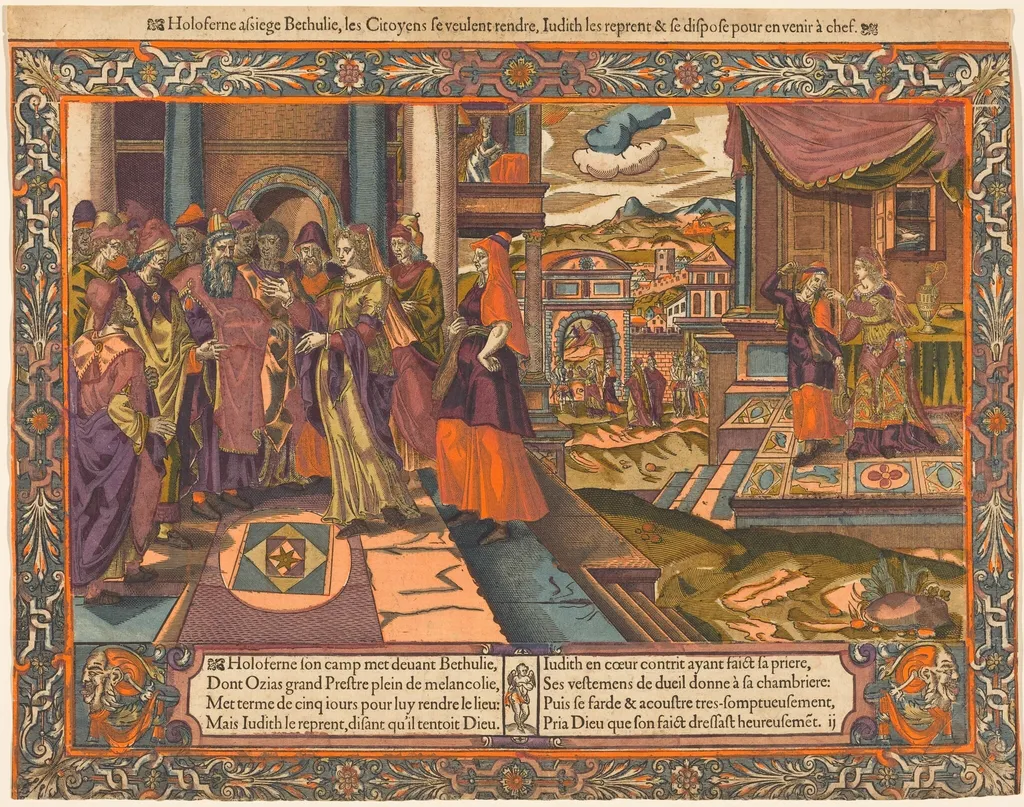
Judith Goes to the Camp of Holofernes is an ink print by the Renaissance artist French 16th Century. It dates from 1575 and is held in the collection of the National Gallery of Art. This hand-colored woodcut depicts Judith approaching the encampment of Holofernes, a moment from the biblical Book of Judith.
- Inscription
- Inscribed:ATin plate: Holoferne afsiege Bethulie, les Citoyens fe veulent rendre, Iudith les reprent & fe difpofe pour en venir a chef.; across bottom in plate: Holoferne ... ij
About this work
Overview
This hand-colored woodcut depicts Judith approaching the encampment of Holofernes, a moment from the biblical Book of Judith. Rendered on laid paper, the image combines printed lines with manual color application to enhance narrative clarity. The composition centers on Judith’s solitary figure, framed by attentive soldiers and a distant landscape, suggesting both tension and impending action.
Subject & Meaning
Judith, portrayed as a poised yet resolute woman, enters the enemy camp with quiet determination. Her presence contrasts with the curious, armed men surrounding her, underscoring her role as a cunning liberator. The scene captures the moment before her decisive act, her infiltration of Holofernes’ tent, emphasizing courage through restraint rather than violence.
Technique & Style
The image is produced via woodcut, a relief printing method where carved blocks transfer inked lines to paper. Subtle hand-coloring in red, blue, and yellow adds emotional nuance without obscuring the crisp, linear quality of the print. The texture of the laid paper and the precision of the carving contribute to a tactile, almost sculptural effect.
History & Provenance
Though the artist remains unidentified, the work aligns with early 16th-century Northern European printmaking traditions. Similar woodcuts circulated as devotional or moral imagery, often distributed widely due to the medium’s reproducibility. Its survival in good condition suggests it was carefully preserved, possibly in a private or ecclesiastical collection.
Context
The architectural backdrop reflects contemporary European ideals of monumental design, grounding the sacred narrative in a recognizable world.
Created during a period of religious upheaval, images of Judith resonated as symbols of divine justice and female agency. Her story was frequently invoked to illustrate faith overcoming tyranny, making it popular among Protestant and Catholic audiences alike. The architectural backdrop reflects contemporary European ideals of monumental design, grounding the sacred narrative in a recognizable world.
Legacy
This print contributes to a broader visual tradition of Judith’s story in print culture, influencing later depictions in both religious and secular art. Its combination of narrative clarity and technical craftsmanship exemplifies how woodcuts served as accessible vehicles for complex moral tales, bridging literacy gaps through visual storytelling.
Artist & collection

Artist
A French artist of the 1500s made metal sculptures and prints. One is a bronze portrait of François de Mandelot, governor of Lyon, dated 1572; another a bronze Virgil dangling in a basket, cast in the early 1500s. The…

![Allegory of the Life of a Scholar in a Rich Household [fol. 3 verso / 4 recto], by French 16th Century](https://artifactworldgallery.com/img/french-16th-century--allegory-of-the-life-of-a-scholar-in-a-rich-household-fol-3--52df746155b443e5-w320.webp)
- Saint Stephen before the Council
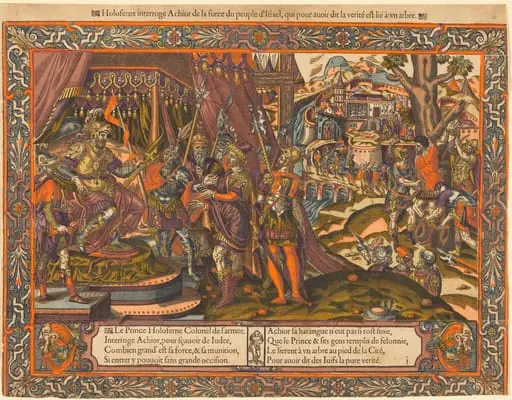 Holofernes Interrogating Achior
 The Old King on His Throne
 Josiah Celebrating Passover
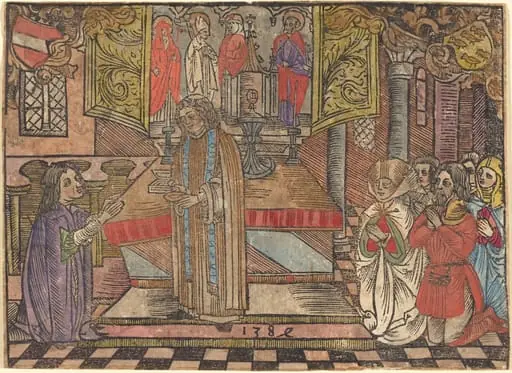 Miracle at Seefeld
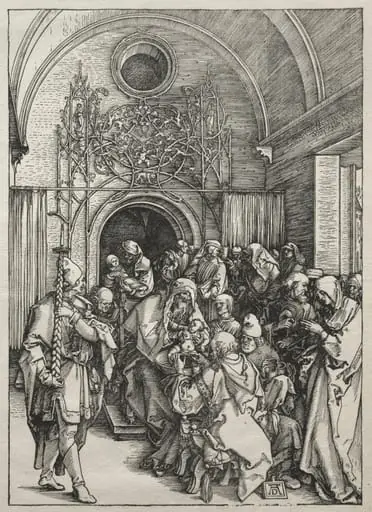 Life of the Virgin: The Circumcision
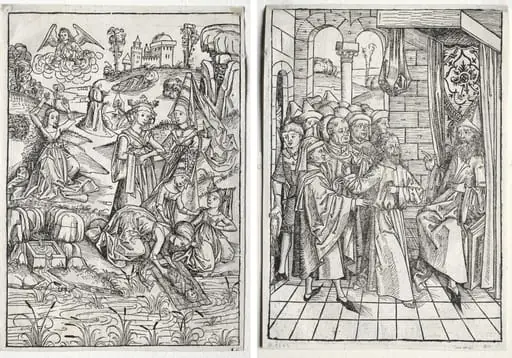 Der Schatzbehalter: Moses Found by Pharaoh's Daughter (recto); Der Schatzbehalter: Christ before Caiaphas (verso)
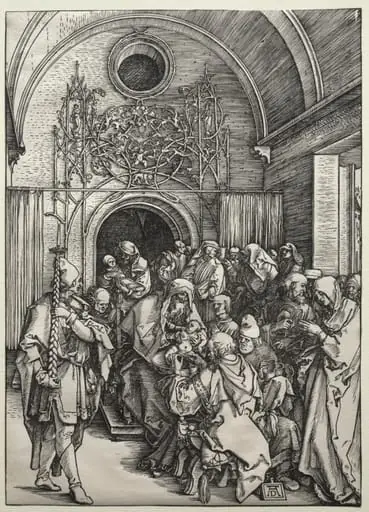 The Circumcision
 The Adoration of the Magi
 Jupiter
 Christ among the Doctors
 The Old White King Sending His Messengers to Portugal