Artwork
"Do Not Turn Back When You Arrive at the End" [fol. 26 verso / 27 recto]
!["Do Not Turn Back When You Arrive at the End" [fol. 26 verso / 27 recto], by French early 16th Century, ink, 1513](https://artifactworldgallery.com/img/french-early-16th-century--do-not-turn-back-when-you-arrive-at-the-end-fol-26-verso-27--e11e5d3478112a7e-w1024.webp)
"Do Not Turn Back When You Arrive at the End" [fol. 26 verso / 27 recto] is an ink drawing by the Renaissance artist French early 16th Century. It dates from 1513 and is held in the collection of the National Gallery of Art.
- Inscription
- Inscribed:Inscribed in pen and brown ink on the house at upper left: Domus Hominis Prudentis..; the figures standing at left labeled: Cupiditas Vite, Medicus, and Pharmacopehela; the woman with a spear at center labeled: Ratio; inscribed in the wheels on the cart on which she stands; Vir and Prudens; on the chariot at upper right: Saturnus; on the coffin-shaped cart at right center: Finis Vite; and on the chariot at lower right: Mars
About this work
Overview
"Do Not Turn Back When You Arrive at the End" is a symbolic drawing executed on two joined sheets of laid paper, rendered in pen and brown ink with watercolor. The work presents a narrative across two sides, juxtaposing contrasting scenes that explore themes of life, wisdom, and mortality.
Subject & Meaning
The left side depicts three men outside a house labeled with concepts like Ratio (Reason) and Medicus (Healer), suggesting a realm of wisdom or intellectual pursuit. In contrast, the right side shows a dark, monster-drawn chariot approaching a skeleton marked Finis Vitae (End of Life), observed by a crow. These elements symbolize the inevitability of death and the journey through life.
Technique & Style
The drawing combines pen and brown ink for detailed linework with watercolor, achieving a balance between precision and expressive color. The use of symbolism and the narrative split across two pages reflect a style reminiscent of Renaissance illustrative traditions, where visual elements conveyed deeper moral or philosophical messages.
Context
This work aligns with Renaissance artistic practices that employed symbolism to convey moral and philosophical lessons. The strategic placement of words and figures as 'clues' for interpretation further situates it within a tradition of visually rich, intellectually engaging art.
Legacy
While specific legacy details of this piece are not provided, its themes and stylistic elements contribute to a broader understanding of how Renaissance and Renaissance-inspired art used symbolism to engage viewers with universal themes of life, death, and the pursuit of wisdom.
!["Obliterate the Trace of the Pot in the Ashes" [fol. 32 verso / 33 recto]](https://artifactworldgallery.com/img/french-early-16th-century--obliterate-the-trace-of-the-pot-in-the-ashes-fol-32-verso-33--e808688d684304b0-w320.webp)
Artist & collection

Artist
A French draftsman from the early 1500s filled sheets of laid paper with tiny, sharp-tongued instructions, ink sketches paired with warnings like “Do Not Eat Your Heart Out” or “Feed Not Things That Have Sharp Claws.”…

!["Do Not Eat Your Heart Out" [fol. 22 recto], by French early 16th Century](https://artifactworldgallery.com/img/french-early-16th-century--do-not-eat-your-heart-out-fol-22-recto--003887c9850175b9-w320.webp) "Do Not Eat Your Heart Out" [fol. 22 recto]
"Do Not Eat Your Heart Out" [fol. 22 recto]![The Calumny of Apelles [fol. 6 recto], by French early 16th Century](https://artifactworldgallery.com/img/french-early-16th-century--the-calumny-of-apelles-fol-6-recto--037fde9ac8dbd27b-w320.webp) The Calumny of Apelles [fol. 6 recto]
The Calumny of Apelles [fol. 6 recto]!["Do Not Make Water on Clippings from Nails or Hair" [fol. 30 recto], by French early 16th Century](https://artifactworldgallery.com/img/french-early-16th-century--do-not-make-water-on-clippings-from-nails-or-hair-fol-30-rec--03ca31c36e5a66b9-w320.webp) "Do Not Make Water on Clippings from Nails or Hair" [fol. 30 recto]
"Do Not Make Water on Clippings from Nails or Hair" [fol. 30 recto]!["You Are Tying a Dolphin by the Tail" [fol. 17 recto], by French early 16th Century](https://artifactworldgallery.com/img/french-early-16th-century--you-are-tying-a-dolphin-by-the-tail-fol-17-recto--0abe83abfb5ccd1d-w320.webp) "You Are Tying a Dolphin by the Tail" [fol. 17 recto]
"You Are Tying a Dolphin by the Tail" [fol. 17 recto]!["Feed Not Things That Have Sharp Claws" [fol. 38 recto], by French early 16th Century](https://artifactworldgallery.com/img/french-early-16th-century--feed-not-things-that-have-sharp-claws-fol-38-recto--1f28115410528631-w320.webp) "Feed Not Things That Have Sharp Claws" [fol. 38 recto]
"Feed Not Things That Have Sharp Claws" [fol. 38 recto]![A Courtier Standing Between Covetousness and Dissimulation [fol. 14 recto], by French early 16th Century](https://artifactworldgallery.com/img/french-early-16th-century--a-courtier-standing-between-covetousness-and-dissimulation-f--2578f4fe9846edc2-w320.webp) A Courtier Standing Between Covetousness and Dissimulation [fol. 14 recto]
A Courtier Standing Between Covetousness and Dissimulation [fol. 14 recto]![A Fool Feeding Flowers to Swine [fol. 42 recto], by French early 16th Century](https://artifactworldgallery.com/img/french-early-16th-century--a-fool-feeding-flowers-to-swine-fol-42-recto--27579a7c495e1682-w320.webp) A Fool Feeding Flowers to Swine [fol. 42 recto]
A Fool Feeding Flowers to Swine [fol. 42 recto]!["You Are Shooting at Heaven" [fol. 9 recto], by French early 16th Century](https://artifactworldgallery.com/img/french-early-16th-century--you-are-shooting-at-heaven-fol-9-recto--28e4ef6e8d8a696d-w320.webp) "You Are Shooting at Heaven" [fol. 9 recto]
"You Are Shooting at Heaven" [fol. 9 recto]
- "Obliterate the Trace of the Pot in the Ashes" [fol. 32 verso / 33 recto]
![Allegory of the Life of a Scholar in a Rich Household [fol. 3 verso / 4 recto], by French 16th Century](https://artifactworldgallery.com/img/french-16th-century--allegory-of-the-life-of-a-scholar-in-a-rich-household-fol-3--52df746155b443e5-w320.webp) Allegory of the Life of a Scholar in a Rich Household [fol. 3 verso / 4 recto]
Allegory of the Life of a Scholar in a Rich Household [fol. 3 verso / 4 recto]![A Dialogue on Human Favor (recto) [fol. 15 verso / 16 recto], by French early 16th Century](https://artifactworldgallery.com/img/french-early-16th-century--a-dialogue-on-human-favor-recto-fol-15-verso-16-recto--a4f1453e0385d8d6-w320.webp) A Dialogue on Human Favor (recto) [fol. 15 verso / 16 recto]
A Dialogue on Human Favor (recto) [fol. 15 verso / 16 recto]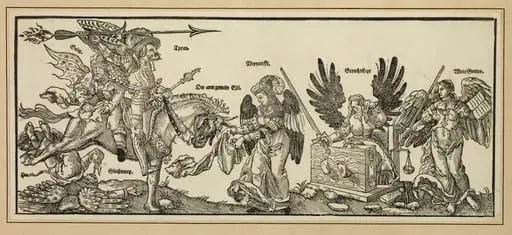 The poor common donkey
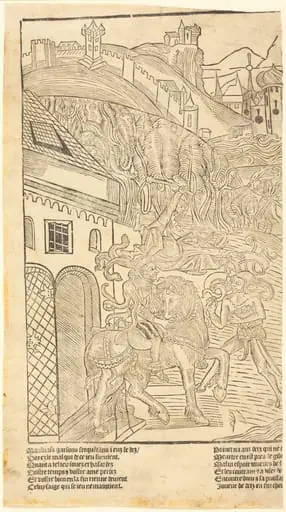 A Warning Against Playing Dice
![The Triumphal Chariot of Maximilian I (The Great Triumphal Car) [plate 1 of 8], by Albrecht Dürer](https://artifactworldgallery.com/img/albrecht-durer--the-triumphal-chariot-of-maximilian-i-the-great-triumphal-ca--4840429519ebb12d-w320.webp) The Triumphal Chariot of Maximilian I (The Great Triumphal Car) [plate 1 of 8]
The Triumphal Chariot of Maximilian I (The Great Triumphal Car) [plate 1 of 8]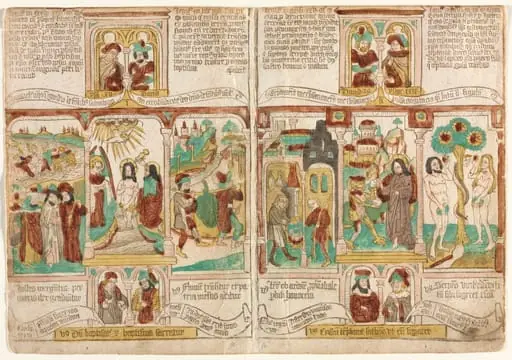 The Bible of the Poor (Biblia Pauperum),
Pharaoh's Army Drowned in the Red Sea; Baptism of Christ; and Moses' Spies Returning with Grapes from Canaan
Esau Selling Jacob his Birthright; Temptation of Christ; and Temptation of Adam and Eve
The Bible of the Poor (Biblia Pauperum),
Pharaoh's Army Drowned in the Red Sea; Baptism of Christ; and Moses' Spies Returning with Grapes from Canaan
Esau Selling Jacob his Birthright; Temptation of Christ; and Temptation of Adam and Eve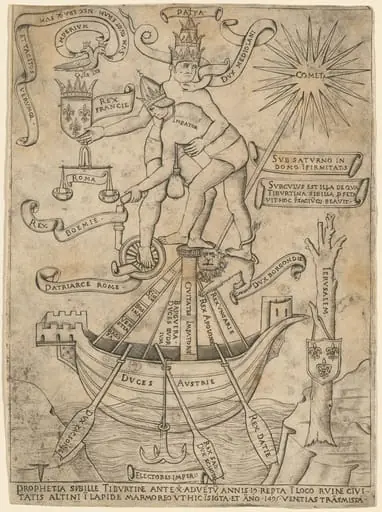 Allegory of the Emperor and the Pope
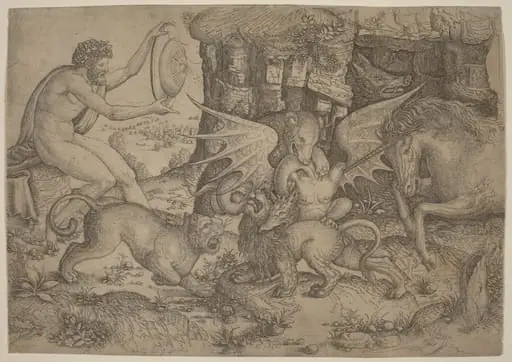 Allegorical Theme: Combat of Animals
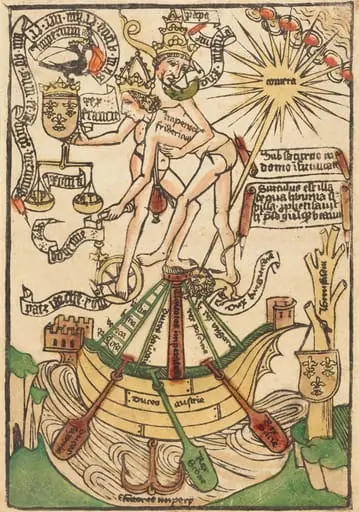 Allegory of the Meeting of Pope Paul II and Emperor Frederick III
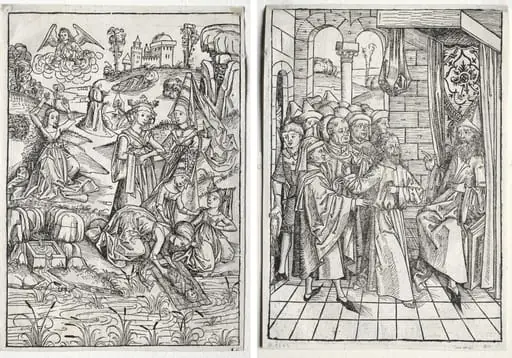 Der Schatzbehalter: Moses Found by Pharaoh's Daughter (recto); Der Schatzbehalter: Christ before Caiaphas (verso)
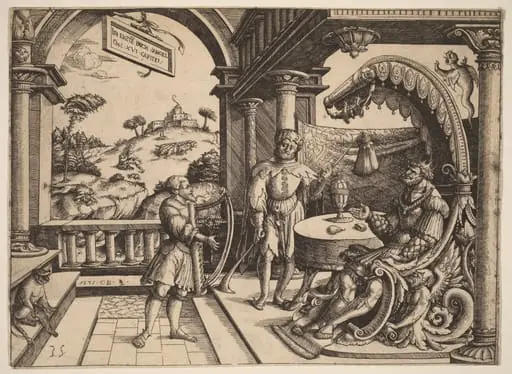 David Playing the Harp before Saul