Artwork
Man Writing a Letter
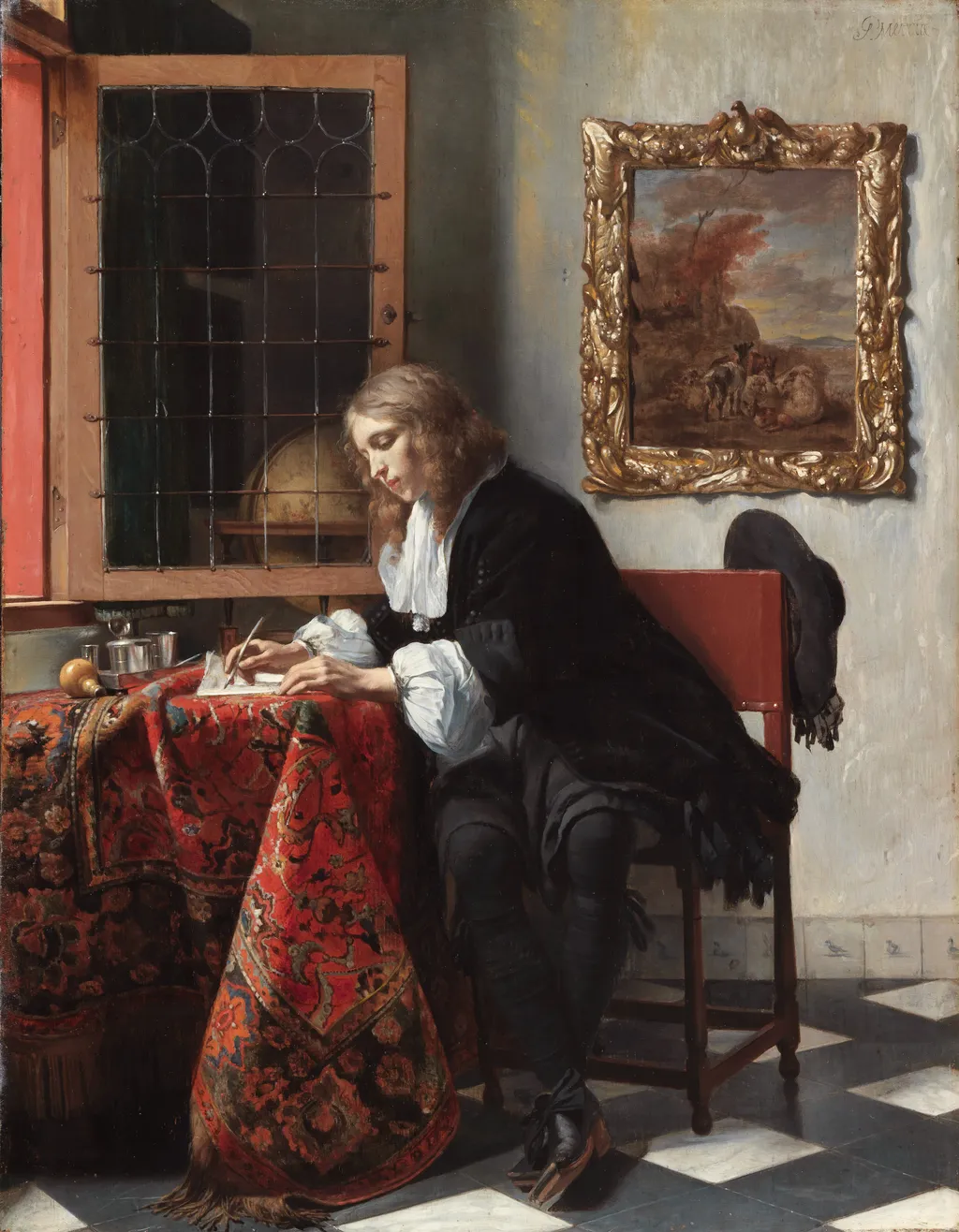
Man Writing a Letter is an oil painting by the Dutch Golden Age artist Gabriel Metsu. It dates from 1665 and is held in the collection of the National Gallery of Ireland.
About this work
Subject & Meaning
The Persian rug and silver writing set on the table indicate his wealth, and a globe in the corner suggests his interest in mercantile or scholarly pursuits.
The painting depicts a young man seated before an open window, writing a letter with a quill pen while dressed in a black silk suit and white linen shirt. The Persian rug and silver writing set on the table indicate his wealth, and a globe in the corner suggests his interest in mercantile or scholarly pursuits. A pastoral landscape by Jacob van der Does hangs on the wall, crowned by a carved dove, and Delftware tiles on the baseboard display birds.
The work serves as the companion piece to Woman Reading a Letter, together representing the exchange of a love letter; the man writes while the woman later reads. The composition, lighting, and detailed rendering reflect Metsu's mastery of Dutch genre painting, emphasizing realism and intimate domesticity.
Technique & Style
The painting is executed in oil paint on a wood panel, measuring 52.5 cm in height and 40.2 cm in width. It depicts a young man seated before an open window, writing a letter with a quill pen while dressed in a black silk suit and white linen shirt. A Persian rug and silver writing set on the table indicate his affluent status, and a globe in the corner suggests scholarly or mercantile interests.
The composition is carefully balanced, with natural light entering from the left that creates a warm, intimate atmosphere. The detailed rendering of textures, such as the fabric folds, the grain of the wood, and the glaze on the tiles, demonstrates Metsu's technical mastery and his focus on everyday realism. The work functions as a pendant to Woman Reading a Letter, together forming a thematic pair that reflects the practice of letter writing in 17th‑century Dutch society.
History & Provenance
The painting was created by Gabriel Metsu around 1665 as an oil on panel work. It was first owned by Hendrick Sorgh, an Amsterdam art collector, who sold the piece with its pendant, Woman Reading a Letter, to George Bruyn on 28 March 1720 for 560 guilders. The work changed hands several times, passing to Johannes Coop in 1724, then to Gerrit Braamcamp circa 1744, and later to Jan Hope in 1771.
It remained in the Hope family until sold in 1898 to art dealers A. Wertheimer and P. & D. Colnaghi, eventually reaching Alfred Beit, who inherited it through his family. The painting was stolen during burglaries at Russborough House in 1974 and again in 1986, recovered, and donated to the National Gallery of Ireland in 1987 before being fully recovered in 1993.
Man Writing a Letter has been held by the National Gallery of Ireland in Dublin since 1987, when the painting and its pendant Woman Reading a Letter were donated to the institution, though both works remained missing until their recovery in 1993 following earlier thefts from Russborough House in 1974 and 1986.
The work has been documented as part of the exhibition "Vermeer and the Masters of Genre Painting. Inspiration and Rivalry."
Provenance traces through a succession of owners: Hendrick Sorgh in Amsterdam (sold 28 March 1720 for 560 guilders), George Bruyn (sold 16 March 1724 for 785 guilders), Johannes Coop, and circa 1744 Gerrit Braamcamp (purchased for 500 guilders). On 31 July 1771 Jan Hope acquired the pair for 5,205 guilders; they descended to Lord Francis Pelham Clinton Hope, who sold them in 1898 to dealers A. Wertheimer and P. & D. Colnaghi. Alfred Beit purchased them in 1900, with inheritance passing to Otto Beit (1906) and Sir Alfred Beit, 2nd Baronet (1930), before the 1987 donation to the National Gallery of Ireland.
Context
Created near the end of Gabriel Metsu's life, Man Writing a Letter (1665) is widely considered part of his artistic climax, standing alongside Woman Reading a Letter and The Sick Child. The work exemplifies the Dutch Golden Age's focus on domestic realism and meticulous detail. Scholars note that Metsu likely derived the concept of thematic pendant paintings from Gerard ter Borch, while the composition's lighting and marble floor reflect the influence of Johannes Vermeer.
During his lifetime, Metsu was a more renowned figure than Vermeer. Modern critics have praised the pair as some of the artist's finest achievements; a 2011 review in The New York Times described them as "stunning," while NPR highlighted their "gorgeously painted" technique and "meticulously rendered details." These works remain central to understanding Metsu's mastery of genre scenes and his ability to capture intimate human moments.
Legacy
Man Writing a Letter is widely regarded as one of Gabriel Metsu's finest achievements, often cited alongside its companion piece, Woman Reading a Letter, as representing the artistic climax of his career. Modern critics have praised the work for its meticulous technique and status as a significant crowd-pleaser; a 2011 review in The New York Times described the pair as "stunning," while NPR highlighted their fabulous execution. The painting's reputation is further cemented by its inclusion in major exhibitions such as Vermeer and the Masters of Genre Painting: Inspiration and Rivalry.
Although the work suffered a turbulent modern history involving two thefts from Russborough House in 1974 and 1986, its eventual recovery and donation to the National Gallery of Ireland in 1987 secured its place as a cornerstone of the museum's collection.
Overview
Gabriël Metsu’s oil on wood panel, titled Man Writing a Letter, dates from the peak of his artistic output in the mid‑17th century. The composition shows a solitary figure at a modest desk, engaged in the act of composing a missive. The work is traditionally paired with a companion piece, Woman Reading a Letter, together representing a narrative pair within Metsu’s genre oeuvre.
Own this work as a print
Artist & collection
Artist
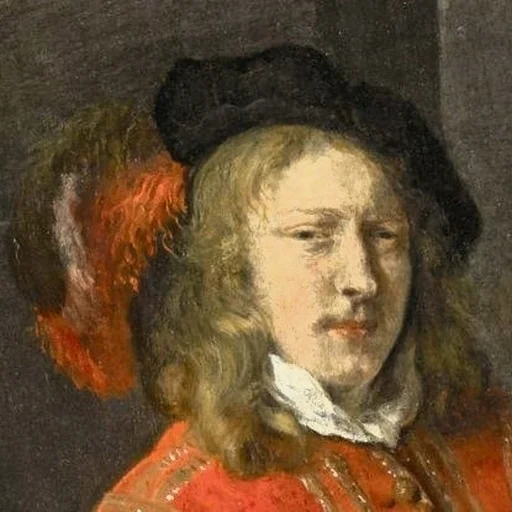
Gabriël Metsu (1629–1667) was a Dutch painter of history paintings, still lifes, portraits, and genre works.