Artwork
Mars
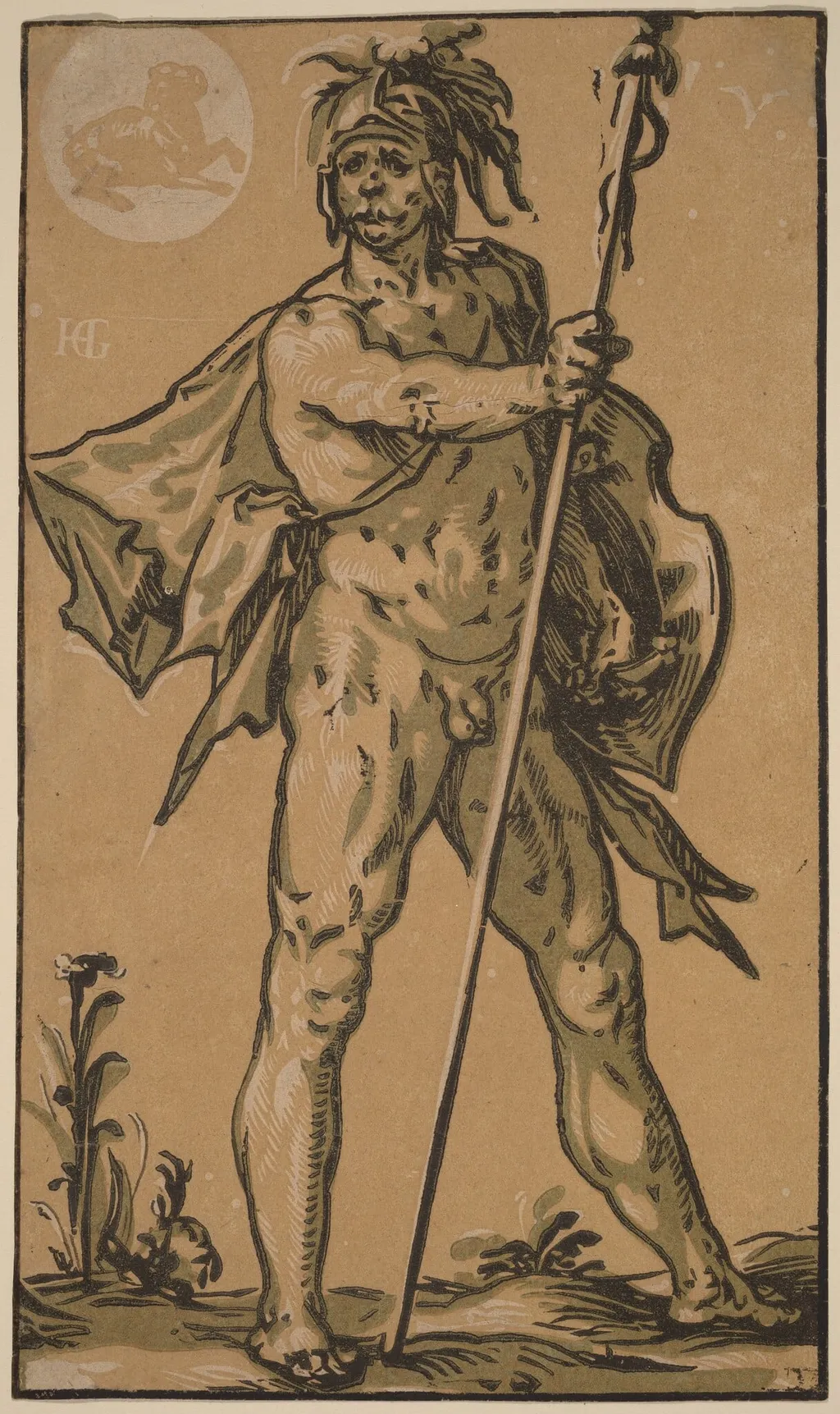
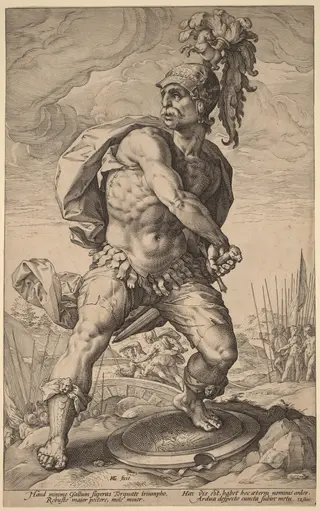
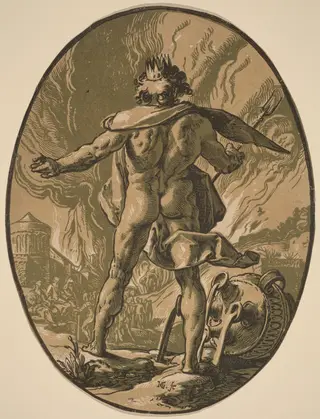
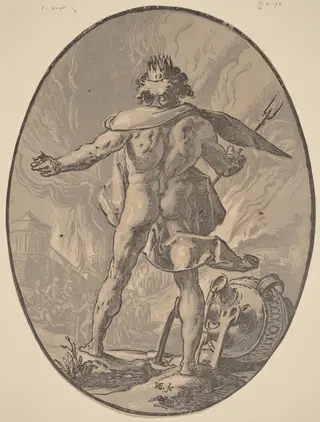
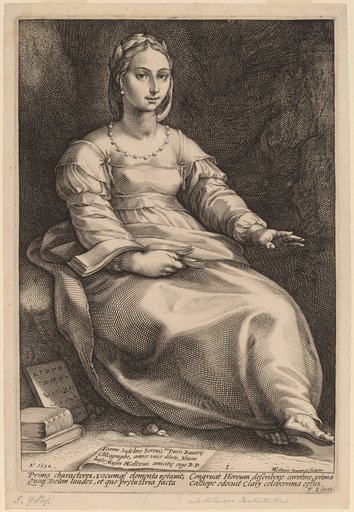
Mars is an ink print by the Renaissance artist Hendrick Goltzius. It dates from 1594 and is held in the collection of the National Gallery of Art.
About this work
Overview
Hendrick Goltzius produced Mars circa 1594 as a chiaroscuro woodcut, employing three blocks to layer sepia-ochre, olive, and black inks.
Hendrick Goltzius produced Mars circa 1594 as a chiaroscuro woodcut, employing three blocks to layer sepia-ochre, olive, and black inks. The print reflects his mastery of the technique, which was still emerging in Northern Europe at the time. Unlike traditional engravings, this method used tone to model form, allowing for a sculptural quality in a printed medium.
Goltzius, active in the Netherlands, was among the first to elevate woodcut beyond reproductive work into a vehicle for expressive art.
Subject & Meaning
The figure of Mars, Roman god of war, is depicted not in battle but in contemplative stillness, armored yet relaxed. His posture suggests authority tempered by introspection, diverging from typical martial iconography. Goltzius avoids overt violence, instead emphasizing the god’s physical presence and psychological weight.
The choice of subject aligns with Renaissance humanist interests in classical mythology as a lens for exploring power, identity, and the human condition.
Technique & Style
Goltzius employed multiple woodblocks to build tonal gradations, using subtle shifts in ink density to create volume and shadow. His linework is precise yet fluid, defining musculature and armor with rhythmic precision. The sepia-ochre base establishes warmth, while olive and black deepen the contrasts without harshness.
This layered approach allowed him to mimic the chiaroscuro effects of painting in a print, pushing the technical limits of woodcut as a fine art medium.
History & Provenance
Created during Goltzius’s mature period in Haarlem, Mars was part of a series of mythological prints that solidified his reputation across Europe. The work circulated among collectors and artists, influencing later printmakers in both the Netherlands and Italy. Early impressions are rare; surviving examples reside in major institutional collections, including the Rijksmuseum and the British Museum, attesting to its early and sustained scholarly interest.
Context
In the late 16th century, Dutch printmakers were redefining the medium’s artistic potential. Goltzius’s work emerged alongside the rise of Northern Mannerism, which favored complex compositions and virtuosic technique. Chiaroscuro woodcuts, inspired by Italian models like Giulio Bonasone, were adapted with greater structural clarity and emotional restraint. Mars reflects this synthesis, classical subject, Italian technique, Northern precision.
Legacy
Goltzius’s Mars demonstrated that woodcut could rival engraving in nuance and expressive range. It influenced generations of printmakers who sought to merge tonal depth with linear control. The print’s technical innovation helped legitimize chiaroscuro woodcut as a serious artistic form, moving it beyond decorative use.
Its legacy endures in the way later artists approached light, form, and the materiality of the printed image.
Own this work as a print
Artist & collection
Artist
Hendrick Goltzius (German: , Dutch: ; né Goltz; January or February 1558 – 1 January 1617) was a German-born Dutch printmaker, draftsman, and painter.