Artwork
Marcelle la Brune
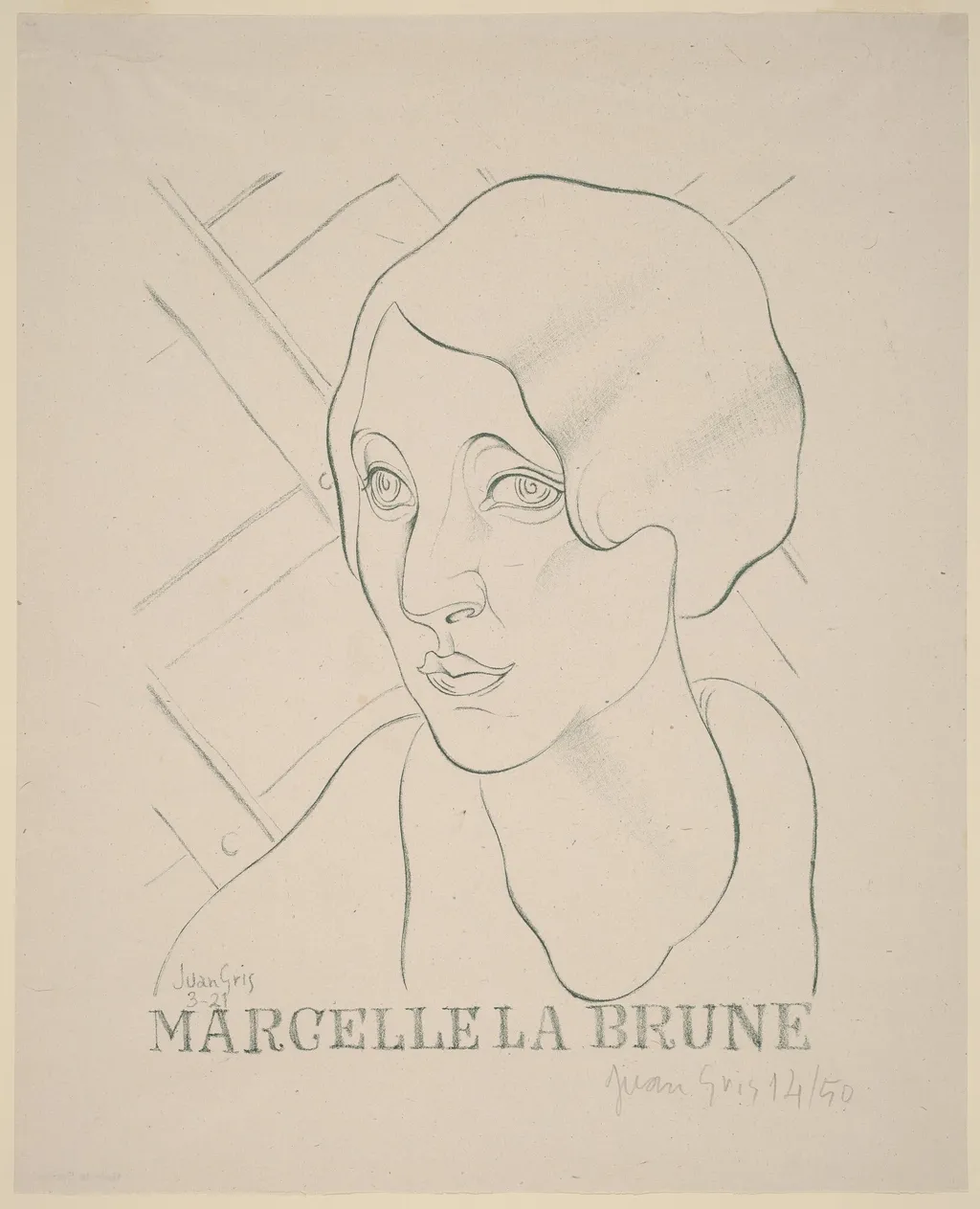
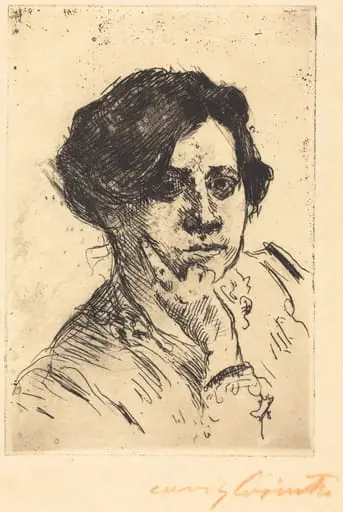
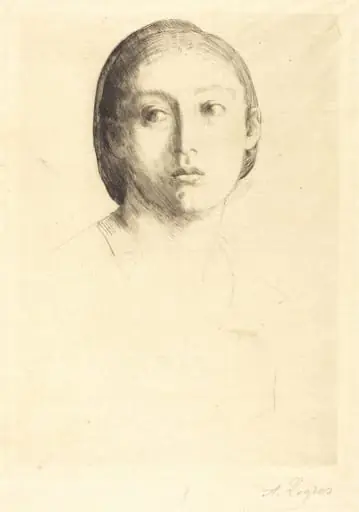
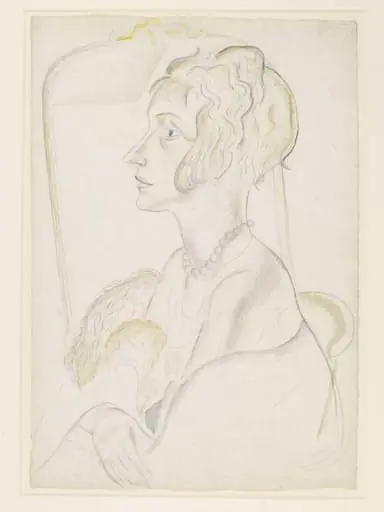
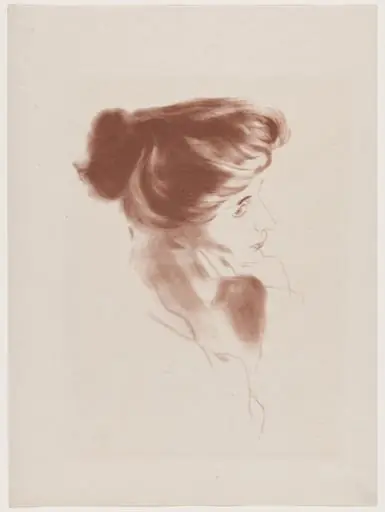
Marcelle la Brune is an ink print by Juan Gris. It dates from 1921 and is held in the collection of the National Gallery of Art.
About this work
Overview
Its monochromatic palette and restrained composition reflect Gris’s interest in structural clarity, characteristic of his mature style during this period.
Created in 1921, Marcelle la Brune is a lithograph in dark green by Juan Gris, a Spanish-born artist who settled in France and became a key contributor to Cubism. The work is a portrait rendered with minimal yet deliberate lines, emphasizing form over detail. Its monochromatic palette and restrained composition reflect Gris’s interest in structural clarity, characteristic of his mature style during this period.
Subject & Meaning
The subject is a woman identified as Marcelle, likely a figure from Gris’s personal circle, depicted in profile with a slight forward tilt. The title, meaning 'Marcelle the Brunette,' suggests a personal or intimate connection, though no narrative is overtly conveyed. The simplicity of the features invites focus on the quiet dignity of the sitter rather than emotional expression or symbolic content.
Technique & Style
Executed in lithography, the image uses a single dark green ink to define contours and subtle planes. Gris employed loose, economical strokes to suggest hair, neck, and facial structure, avoiding shading or modeling. Faint diagonal lines in the background imply texture or spatial depth without disrupting the flatness central to Cubist aesthetics. The contrast between the bold lines and pale paper enhances the figure’s presence.
History & Provenance
The work was produced during Gris’s most active years in Paris, when he was refining his synthetic Cubist approach. While its early ownership is undocumented, it has been consistently attributed to Gris since its creation. As a lithograph, it exists in multiple impressions, and this version remains among the more restrained examples of his graphic output from the early 1920s.
Context
In 1921, Gris was moving beyond the fragmented forms of early Cubism toward more ordered compositions, often integrating still-life elements and portraiture with geometric precision. Marcelle la Brune aligns with this shift, reflecting his interest in balancing structure with human presence. Lithography allowed him to explore these ideas with immediacy, distinct from his more labor-intensive paintings.
Legacy
Though less known than his paintings, Gris’s graphic works like this lithograph demonstrate his mastery of line and composition. Marcelle la Brune exemplifies how Cubist principles could be adapted to intimate, portable formats. It remains a quiet but significant contribution to the broader understanding of his graphic practice and the versatility of Cubist expression beyond canvas.
Own this work as a print
Artist & collection

Artist
José Victoriano González-Pérez, better known as Juan Gris, was a Spanish painter born in Madrid who lived and worked in France for most of his active period.