Artwork
The Artist's Letter Rack
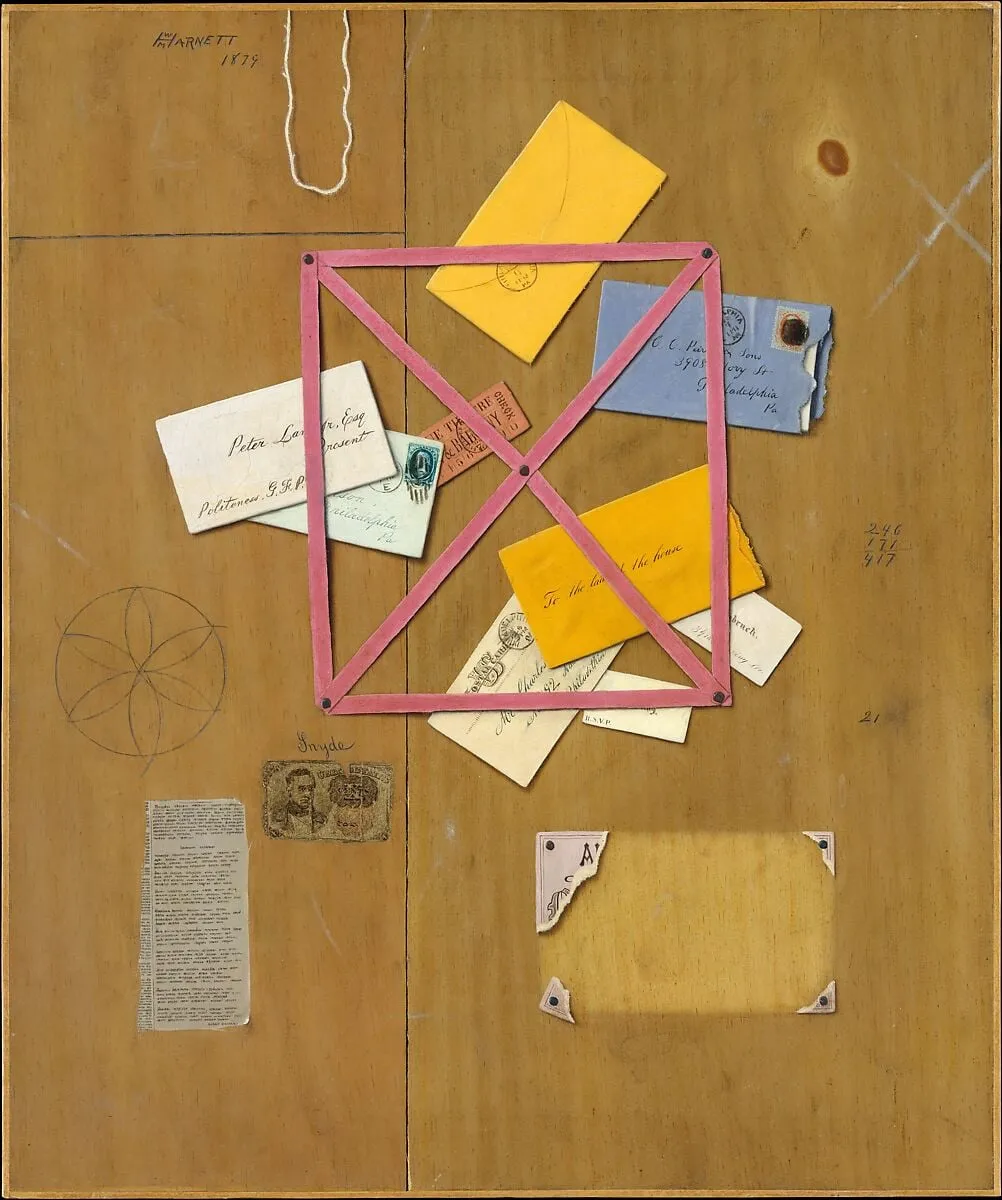
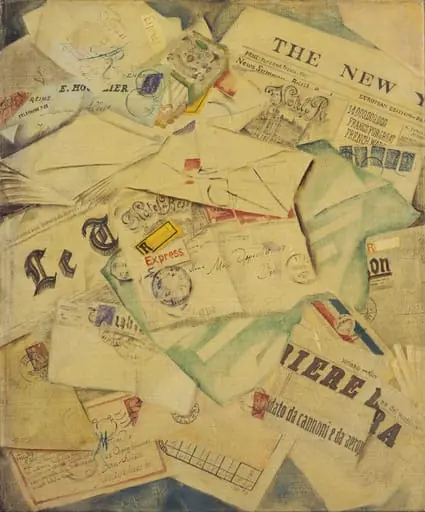
The Artist's Letter Rack is an oil painting by the Impressionist artist William Harnett. It dates from 1879 and is held in the collection of the Metropolitan Museum of Art.
- Accession no.
- 66.13
- Credit line
- Morris K. Jesup Fund, 1966
About this work
Technique & Style
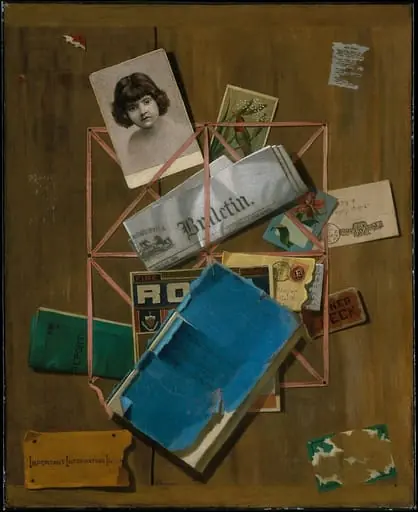
Formal qualities emphasize spatial illusion: overlapping letters, a curling newspaper edge, and a dangling ticket create a shallow but convincing recession.
The work is an oil painting on canvas executed in 1879, measuring 76.2 cm in height and 63.5 cm in width.
Harnett’s handling is meticulous, employing a refined realism that renders each object with sharp focus and precise gradations of light and shadow. The composition is built through layered glazing to achieve the luminous quality of metallic surfaces and the subtle translucency of paper. Brushwork remains largely invisible, supporting the trompe-l’oeil effect.
Formal qualities emphasize spatial illusion: overlapping letters, a curling newspaper edge, and a dangling ticket create a shallow but convincing recession. The subdued palette, dominated by ochres, blacks, and metallic reflections, anchors the scene in a quiet, domestic stillness.
History & Provenance
The Artist's Letter Rack was created by William Michael Harnett in 1879, executed in oil on canvas. The work measures 76.2 cm in height by 63.5 cm in width. It is held in the collection of the Metropolitan Museum of Art, classified within The American Wing.
The available sources do not document a prior ownership chain, a commissioning party, or a specific creation history beyond the 1879 dating and its present placement at the Metropolitan Museum of Art.
William Michael Harnett's The Artist's Letter Rack, created in 1879, is held in the collection of the Metropolitan Museum of Art in New York. The work is classified within the museum's American Wing and is executed in oil on canvas. Specific inventory numbers or accession details are not provided in the available sources, though the painting's dimensions are recorded as 76.2 cm in height and 63.5 cm in width. The provided documentation does not contain information regarding a specific exhibition history for this piece.
Legacy
William Michael Harnett's The Artist's Letter Rack, painted in 1879, has been recognized for pioneering trompe l'oeil realism within American still life, influencing later artists who explored illusionistic detail and object-based symbolism. Its inclusion in The American Wing at the Metropolitan Museum of Art has cemented its status as a benchmark of 19th-century American painting, frequently referenced in scholarly discussions of visual deception and material authenticity.
Overview
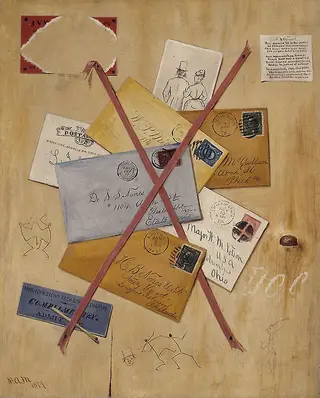
William Michael Harnett’s 1879 oil on canvas, titled The Artist’s Letter Rack, presents a meticulously rendered still life that mimics a wall-mounted correspondence holder. The composition features a wooden surface punctuated by a pink‑framed X‑shaped metal rack holding letters, envelopes, and a stamp, while additional paper scraps and a postage stamp are affixed to the surrounding wall.
Subject & Meaning
The work centers on ordinary epistolary objects, letters bearing names and addresses, envelopes, and postal markings, arranged as if in a private studio. By foregrounding these mundane items, Harnett draws attention to the everyday rituals of communication and the tactile qualities of paper, suggesting a quiet intimacy within the act of writing.
Context
The Artist’s Letter Rack aligns with the broader 19th‑century interest in depicting the banal with meticulous accuracy, a hallmark of the Realist movement. Harnett’s focus on letters and writing implements echoes contemporary concerns about the proliferation of printed material and the personal nature of correspondence in an increasingly industrialized society.
Artist & collection

Artist
William Michael Harnett (August 10, 1848 – October 29, 1892) was an American painter known for his trompe-l'œil still lifes of ordinary objects.