Artwork
The three ages and death
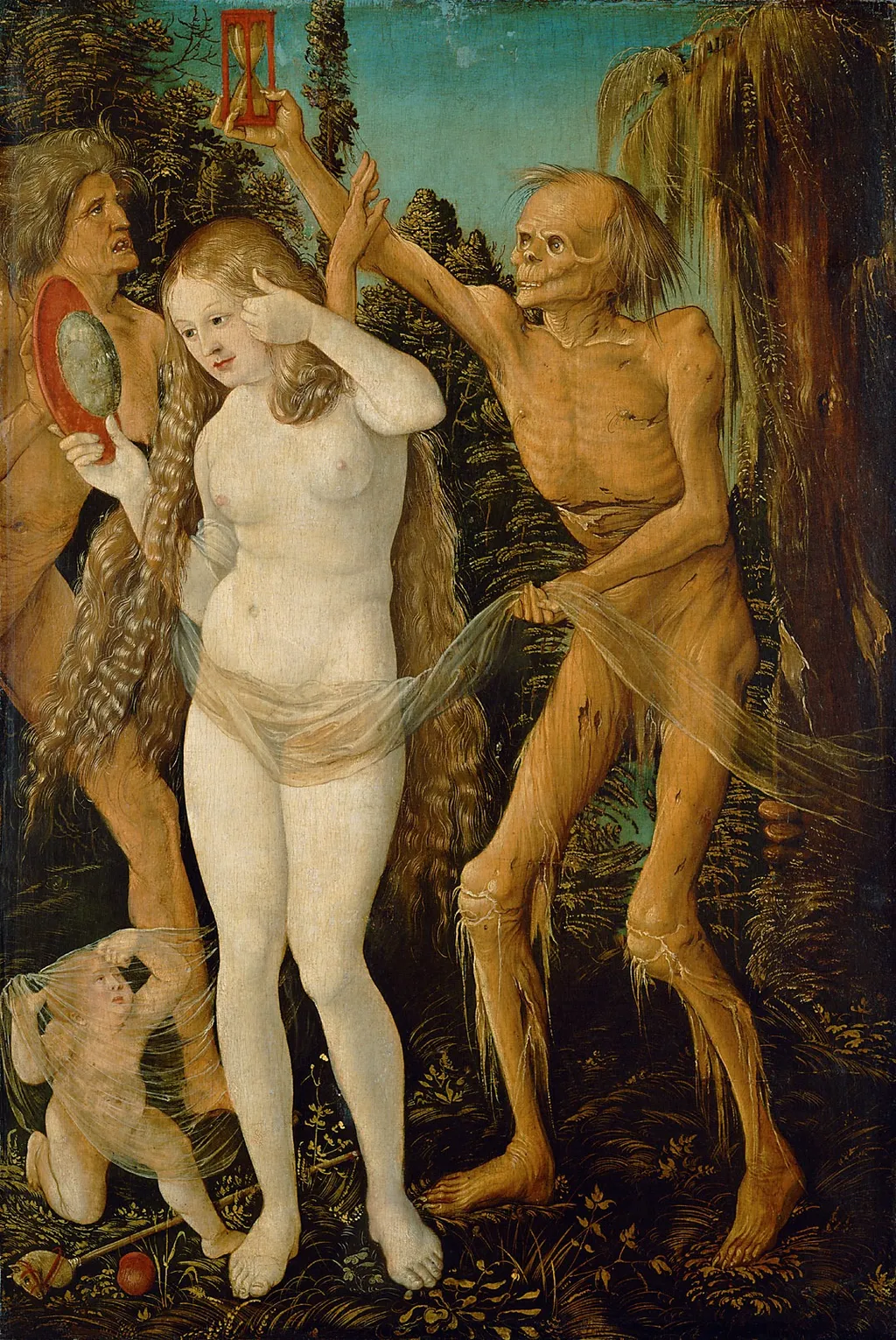
The three ages and death is an oil painting by the Northern Renaissance artist Hans Baldung Grien. It dates from 1509 and is held in the collection of the Kunsthistorisches Museum.
About this work
Subject & Meaning
Together the composition conveys an allegory of mortality that cautions against worldly vanity and the illusion of eternal youth.
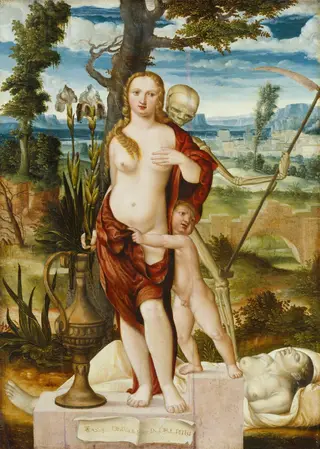
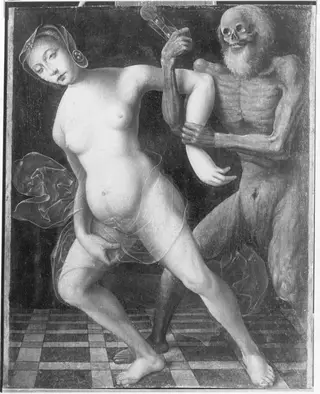
The painting shows three stages of life: a child with a stick-horse at the lower edge, a nude young woman examining herself in a mirror, and an elderly woman confronting a decaying corpse that holds an hourglass. The mirror functions as a vanitas symbol, emphasizing the fleeting nature of beauty, while the skeletal figure, rendered with hair and skin remnants rather than a traditional skeleton, makes death immediate and unavoidable. Together the composition conveys an allegory of mortality that cautions against worldly vanity and the illusion of eternal youth.
Technique & Style
The three ages and death is an oil painting executed on a wooden panel in 1509. The work measures 48.2 cm in height and 32.8 cm in width and is classified as an allegorical piece. Its surface is built up with traditional oil pigments applied in thin layers, allowing subtle chiaroscuro to model the figures, a young woman, an elderly woman, a child, and a decaying corpse, against a faint landscape of foliage.
The composition balances linear rhythm with soft modeling, emphasizing the vanitas theme through the mirror, veil and sandglass. The painting is housed in the Kunsthistorisches Museum in Vienna, where it has been preserved since 1806.
History & Provenance
Hans Baldung Grien executed this oil painting on panel around 1509, with some sources extending the creation period to 1510. The work originated in the collection of Guidobald, Count Thun, Prince-Archbishop of Salzburg, and was recorded in 1803 at the Prince-Archbishop's Residence in Salzburg. In 1806 it was transferred to the Kunsthistorisches Museum in Vienna, where it remains part of the permanent collection. No exhibition history beyond its arrival at the museum is documented in the available sources.
Context
The three ages and death (1509) is an allegorical oil panel in the Kunsthistorisches Museum, Vienna, that embodies Renaissance vanitas through its juxtaposition of youth, maturity and old age with an allegorical figure of Death. Scholars connect the work to Baldung's early training in the workshop of Albrecht Dürer, whose influence informs the figures' modeling and the detailed foliage background. The painting's provenance traces from the Salzburg archbishopric collection to the museum in 1806.
Critical discourse emphasizes its symbolic focus on transience and the fleeting nature of beauty, positioning it within broader early-sixteenth-century treatments of mortality and vanity.
Overview
Hans Baldung Grien's The Three Ages and Death, an oil painting from 1509, explores human mortality and the relentless progression of time. This allegorical work, housed in the Kunsthistorisches Museum, exemplifies the artist's distinctive approach to themes prevalent in the German Renaissance. It showcases his command of oil paint to render complex narratives, reflecting on the transient nature of existence through its symbolic figures.
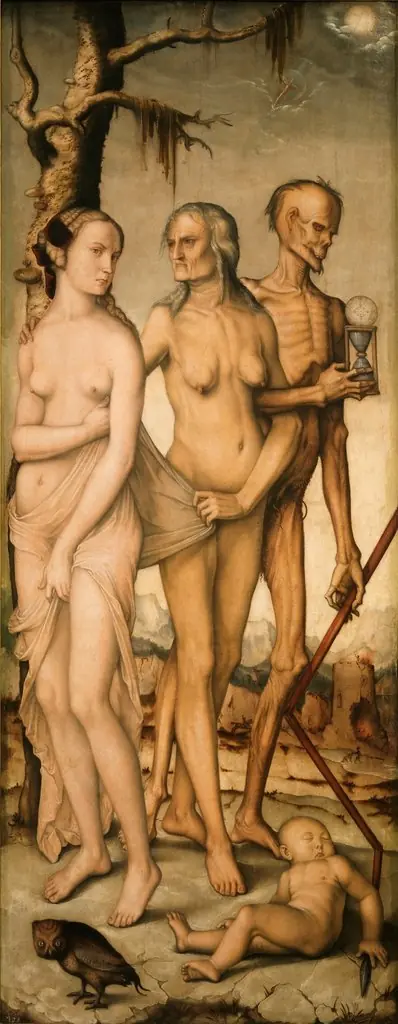
Artist & collection
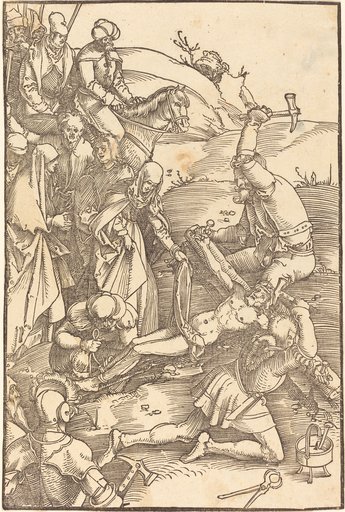
Artist
Hans Baldung (1484 or 1485 – September 1545), called Hans Baldung Grien, (being an early nickname, because of his predilection for the colour green), was a painter, printer, engraver, draftsman, and stained glass…