Artwork
The Ages and Death
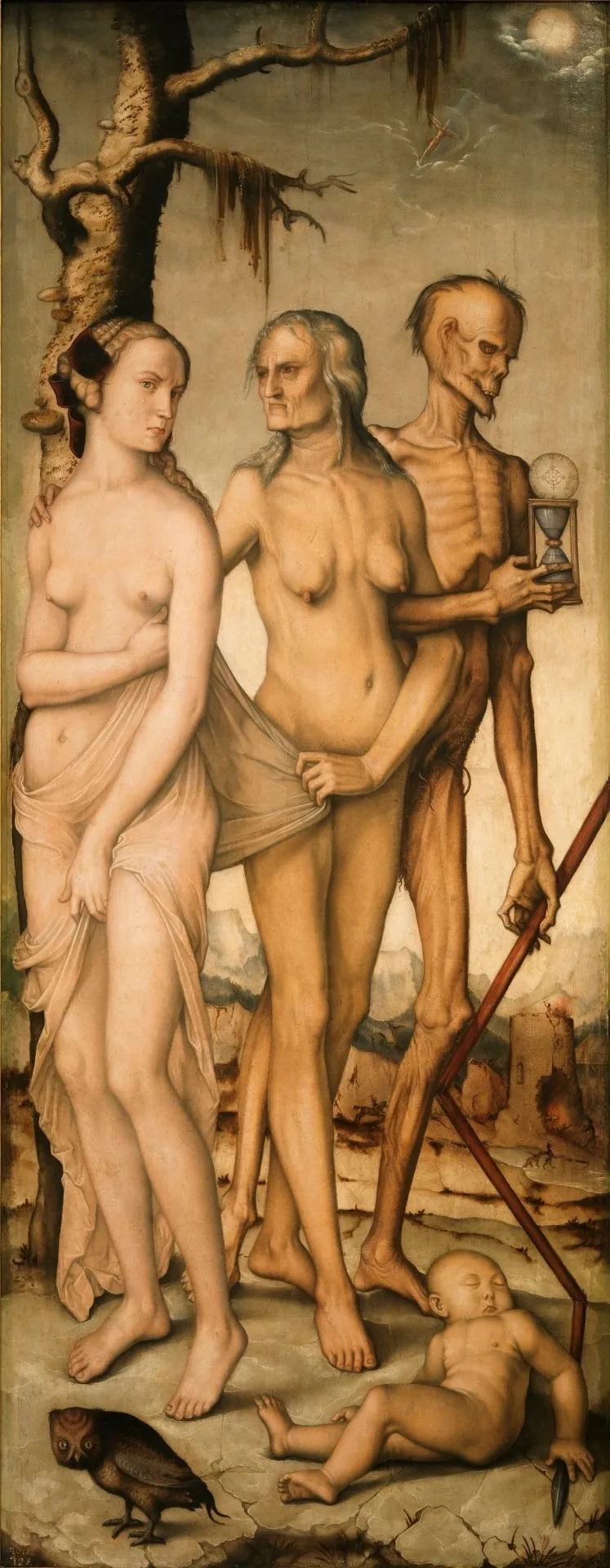
The Ages and Death is an oil painting by the Northern Renaissance artist Hans Baldung Grien. It dates from 1541 and is held in the collection of the Museo del Prado.
About this work
A skeletal Death grips an hourglass and a broken spear in Hans Baldung Grien's panel of 1541 to 1544 at the Prado.
A skeletal Death grips an hourglass and a broken spear in Hans Baldung Grien's panel of 1541 to 1544 at the Prado. It drags an old woman, who in turn clutches a nude youth, while a dead infant lies at their feet. Demons torment souls by an infernal tower, and only a crucified Christ rises toward the light. Commissioned for Frederick of Solms-Laubach, it passed through Philip II's collection to Madrid.
Subject & Meaning
The painting depicts the Ages of Man, personified by a sleeping infant, a young woman, and an elderly woman, confronted by Death. It is an allegory of the transience of beauty and the fragility of human life. Death holds an hourglass and a broken lance, symbolizing the inevitable passage of time and life cut short.
He grasps the old woman, who in turn clings to the younger woman, who recoils. In the background, a depiction of Hell contrasts with a crucified Christ bathed in heavenly light, representing opposing visions of the afterlife. An owl at lower left, a symbol of wisdom, warns against sin.
The cold, muted palette of whites, grays, and browns reinforces the theme of mortality, typical of a vanitas work.
Technique & Style
Executed in oil paint, the work's support is recorded inconsistently, with sources indicating both panel and canvas. It measures 151 × 61 cm. The palette is predominantly cool, whites, grays, and muted browns, reinforcing a sense of lifelessness. A cleaning of darkened varnishes in 2022 restored vivacity to the color.
The vertical, nearly life-size format organizes four figures in a shallow foreground against a landscape with aerial perspective. Death’s gaunt, skeletal form contrasts with the smooth, pale flesh of the young woman, whose three-quarter pose and cold gaze mirror Death’s own. The handling blends meticulous detail for drapery, hair, and wrinkles with broader rendering in the background, emphasizing the allegory of transience.
History & Provenance
The painting was created by the German artist Hans Baldung Grien and is dated 1541. It was formerly owned by King Ferdinand VII of Spain, and later entered the collection of the Museo del Prado in Madrid, where it remains. No details of the original commission or earlier provenance have been recorded.
The sources consulted confirm this location but do not provide an inventory or accession number for the work, and no exhibition history is recorded in the available sources.
Context
Often categorized as a vanitas allegory, The Ages and Death exemplifies Hans Baldung Grien's recurring exploration of mortality and the transience of beauty. Scholarly interpretations emphasize the work's cold palette and symbolic elements, such as the hourglass, broken lance, and owl, as visual meditations on human fragility. The painting belongs to a group of similarly themed works by Baldung that engage the memento mori tradition.
Considered one of the artist's most renowned pieces, it underwent conservation cleaning in 2022 that restored vibrancy to its original palette. It remains a key Northern Renaissance example of the vanitas genre, housed in the Museo del Prado.
Overview
Hans Baldung Grien completed The Ages and Death, an oil-on-canvas painting, between 1541 and 1544. Housed in Madrid's Prado Museum, this work, also known as The Ages of Woman and Death, functions as an allegory. It explores themes of human mortality and the ephemeral nature of beauty, presenting a stark meditation on the passage of time and the inevitability of demise.
Artist & collection
Artist
Hans Baldung (1484 or 1485 – September 1545), called Hans Baldung Grien, (being an early nickname, because of his predilection for the colour green), was a painter, printer, engraver, draftsman, and stained glass…