Artwork
Mississippi Kite
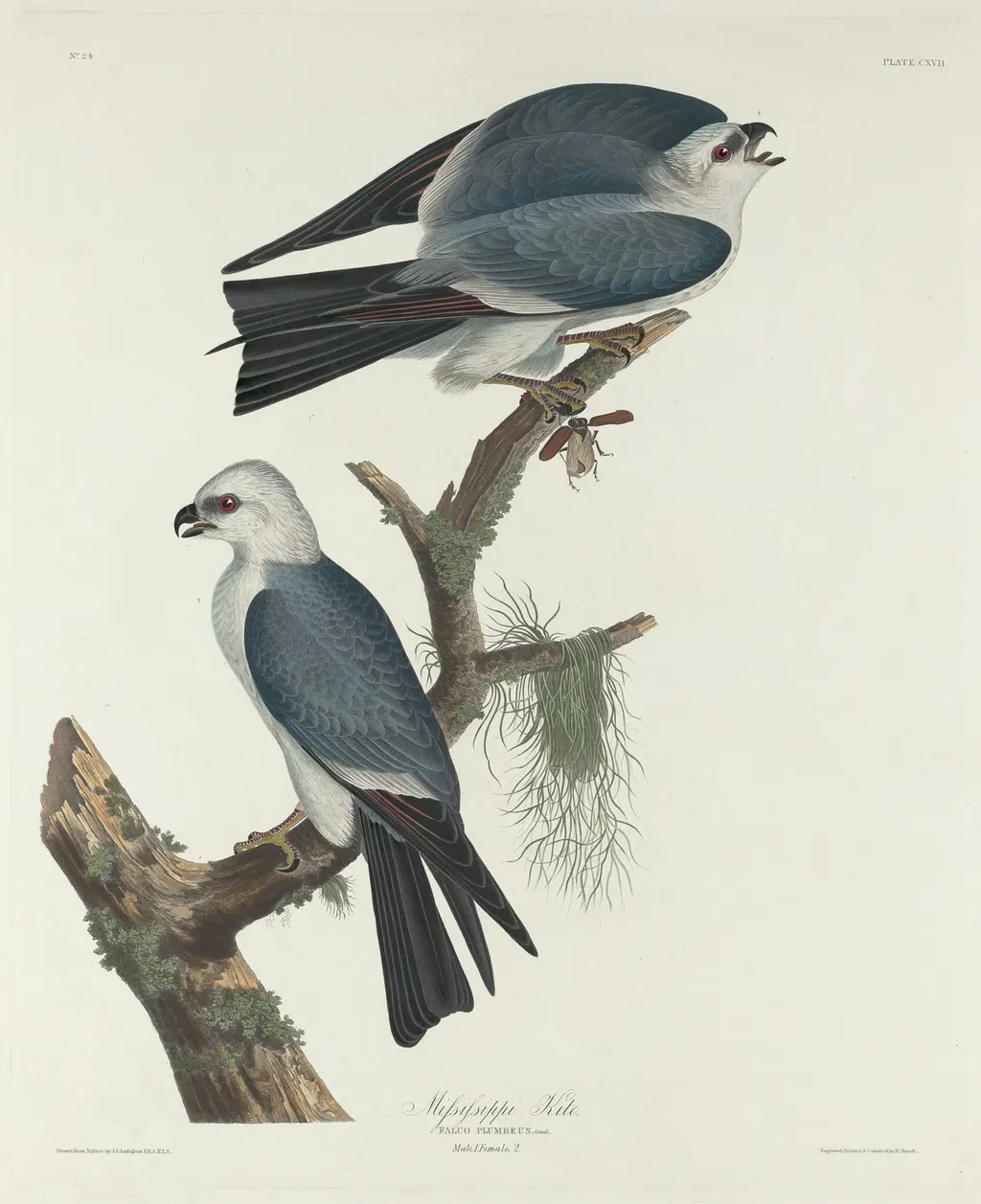
Mississippi Kite is an ink print by the Romanticist artist Havell, Jr., Robert. It dates from 1831 and is held in the collection of the National Gallery of Art.
About this work
Overview
Created in 1831, Mississippi Kite is a hand‑colored engraving combined with aquatint, printed on fine Whatman wove paper. The image presents two birds perched on a moss‑laden branch, their contrasting plumage and vivid red eyes set against a muted background, conveying a quiet natural scene.
Subject & Meaning
The composition focuses on a pair of Mississippi kites, one oriented to the right and the other to the left, each rendered with white heads, dark gray wings and lighter gray bodies. The subtle inclusion of moss and sparse leaves hints at the birds’ woodland habitat, inviting contemplation of avian grace and the serenity of a quiet perch.
Technique & Style
Robert Havell Jr. employed a combination of engraving and aquatint, a method his family had refined for tonal variation. Hand‑coloring adds delicate hues to the printed tones, enhancing depth and three‑dimensionality. The precise line work of the birds contrasts with the softer, mottled washes of the background, exemplifying early‑19th‑century printmaking skill.
History & Provenance
The print emerges from the Havell workshop, a lineage that began with Robert Havell the Elder and continued through Daniel Havell, known for their contributions to natural history illustration and publishing. Mississippi Kite reflects this familial tradition of combining scientific observation with artistic execution, and it remains part of the Havell family’s broader legacy in print media.
Own this work as a print
Artist & collection
Artist
The Havell family of Reading, Berkshire, England, included a number of notable engravers, etchers and painters, as well as writers, publishers, educators, and musicians.