Artwork
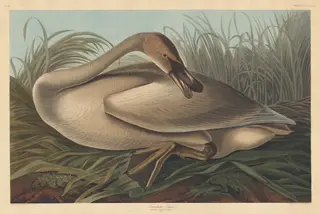
Trumpeter Swan
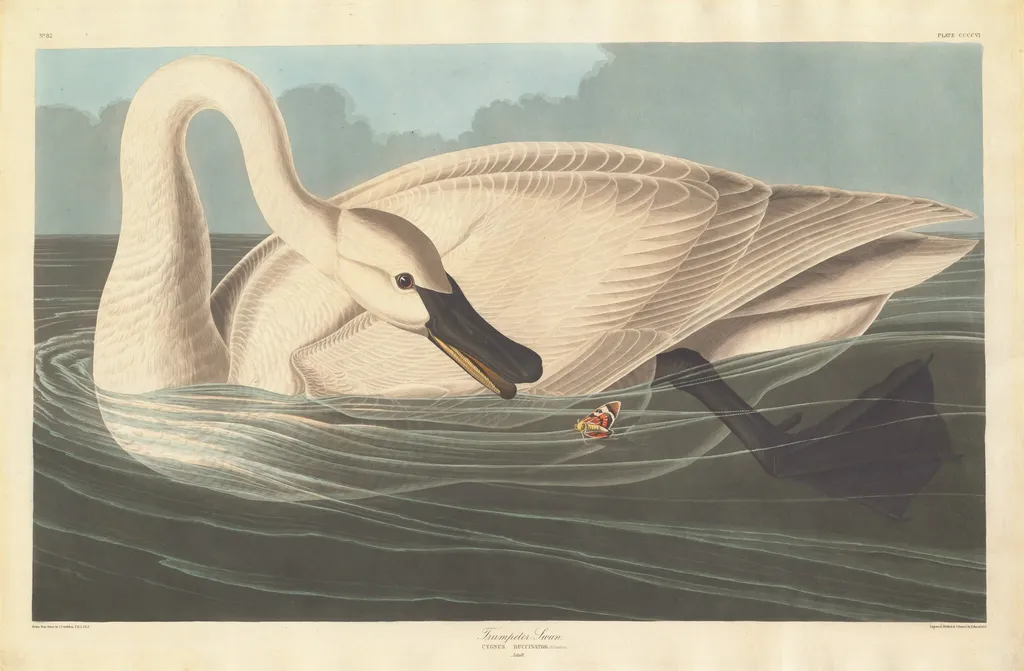
Trumpeter Swan is an ink print by the Romanticist artist Havell, Jr., Robert. It dates from 1838 and is held in the collection of the National Gallery of Art.
About this work
He used engraving and cross-hatching to create texture in the feathers and ripples in the water.
This hand-colored engraving shows a trumpeter swan floating on calm water. Its black bill and white feathers stand out against soft greens and blues. The bird’s body takes up most of the page. Tiny details like its webbed feet and curved neck look almost real.
Robert Havell Jr. made this in 1838. He used engraving and cross-hatching to create texture in the feathers and ripples in the water. The colors were added by hand later, giving it extra life.
Try looking up the National Gallery of Art, Washington for more like this.
Overview
The 1838 print titled Trumpeter Swan is a hand‑colored engraving combined with aquatint, executed on smooth Whatman wove paper. The image presents a single trumpeter swan gliding on tranquil water, its stark white plumage and dark bill contrasting with muted greens and blues that suggest a natural setting.
Subject & Meaning
The work focuses on the trumpeter swan, a large North American waterfowl, rendered with meticulous attention to anatomical detail. By isolating the bird against a calm surface, the image emphasizes the creature’s elegance and the subtle interplay of light on feathers and water.
Technique & Style
Robert Havell Jr. employed traditional line engraving to define the bird’s form, using fine cross‑hatching to suggest texture in the plumage and ripples in the water. Aquatint was applied to achieve tonal washes, while the final coloration was added by hand, enhancing depth and realism without obscuring the underlying print.
History & Provenance
Created by Robert Havell Jr., a member of a distinguished English family of engravers, the print reflects the Havell workshop’s reputation for high‑quality natural history illustration in the early nineteenth century. The piece has been catalogued in several public collections, including the National Gallery of Art in Washington, D.C.
Context
The image belongs to a period when British printmakers were producing detailed studies of exotic wildlife for scientific and decorative purposes. The Havell family’s connections to aquatint and Indian art informed their approach to rendering natural subjects with both accuracy and aesthetic appeal.
Own this work as a print
Artist & collection
Artist
The Havell family of Reading, Berkshire, England, included a number of notable engravers, etchers and painters, as well as writers, publishers, educators, and musicians.