Artwork
Forum Vulcani: The Hot Springs at Pozzuoli
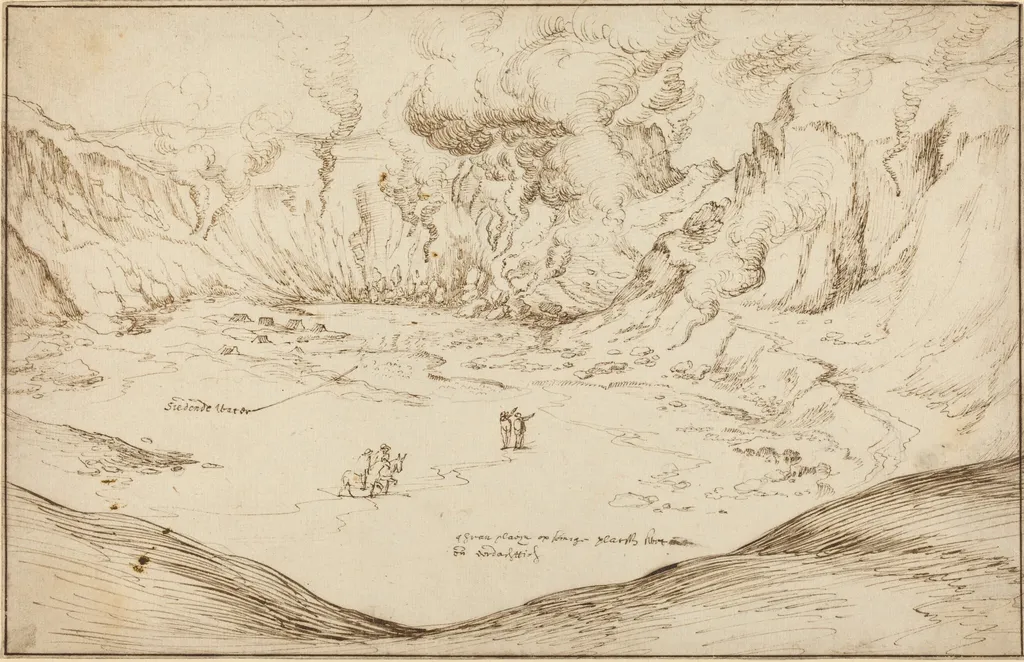
Forum Vulcani: The Hot Springs at Pozzuoli is an ink drawing by the Renaissance artist Joris Hoefnagel. It dates from 1578 and is held in the collection of the National Gallery of Art.
- Inscription
- Inscribed:Inscription at left and lower center partly illegible
About this work
Overview
The drawing is notable for its synthesis of topographic observation and the era's emerging scientific curiosity, capturing the dynamic geothermal landscape.
Forum Vulcani: The Hot Springs at Pozzuoli is a 1577 drawing by Joris Hoefnagel depicting the volcanic Solfatara crater near Pozzuoli, Italy. Executed in pen and brown ink over traces of black chalk on laid paper, the work measures 18.8 by 29.3 centimeters. The drawing is notable for its synthesis of topographic observation and the era's emerging scientific curiosity, capturing the dynamic geothermal landscape. It is currently held in the National Gallery of Art in Washington, D.C., under accession number 1974.21.1.
Subject & Meaning
The drawing portrays the Solfatara, a shallow volcanic crater characterized by steaming vents and rugged terrain. The composition is organized around a central valley flanked by steep rocky cliffs. Dense, swirling masses of steam erupt upward into the middle distance, partially obscuring the geological formations behind them. In the foreground, two small standing figures gesture toward the steaming vents, while two figures on horseback traverse the uneven, mineral-stained earth. Small rectangular structures appear in the left middle distance. Handwritten inscriptions, now partly illegible, appear at the left and lower center. The image presents an objective topographic view that simultaneously reflects a broader cultural impulse to document, classify, and understand the natural world during an age of exploration and colonization.
Technique & Style
Hoefnagel employed a limited palette of warm brown ink on an off-white laid paper ground, utilizing underlying traces of black chalk for initial layout. Tonal variation is achieved through meticulous hatching and cross-hatching. The artist relied on energetic, curving pen strokes to define both the solid geological forms and the atmospheric effects of the billowing steam. The overall finish is sketch-like and exploratory rather than highly finished, emphasizing the spontaneous and dynamic qualities of the geothermal landscape over strict formal rigidity. The drawing is unsigned.
History & Provenance
Created in 1577, the drawing passed through several hands before entering a public collection. It was once in the possession of Lord Treowen at Llanover House in Monmouthshire. It entered the market via a sale conducted by Burton, Knowles & Co. in Gloucester between June 20 and 28, 1934, subsequently belonging to Alfred Jowett of Killinghall. The work was later acquired by David Carritt, Ltd. The National Gallery of Art purchased the drawing in 1974, assigning it the accession number 1974.21.1. It was exhibited the same year in the NGA Recent Acquisitions 1974 show, listed as number 41.
Context
Joris Hoefnagel created the drawing during a period of expanding European interest in documenting and classifying the natural world. The work fits within his broader oeuvre, which frequently bridged art and empirical science. Scholars have situated the drawing within the context of Hoefnagel's contributions to the Civitates Orbis Terrarum, as explored by A. E. Popham in 1936 and Lucia Nuti in 1988, who examined the merchant and humanist perspectives in his mapped views. Thea Vignau-Wilberg catalogued the drawing in her 2017 monograph on Joris and Jacob Hoefnagel, and Marisa Ann Bass discussed it in 2019 within the framework of nature and art during the Dutch Revolt.
Legacy
The drawing remains a key reference for scholars studying the intersection of art, science, and observation in the late sixteenth century. Its inclusion in major catalogues by Eduard Chmelarz, Thomas Dacosta Kaufmann, Thea Vignau-Wilberg, and Marisa Ann Bass underscores its enduring relevance to the study of Habsburg court art and early modern naturalism. The work continues to be analyzed as a visual document that merges topographic record with the political and economic ambitions of an era increasingly focused on the control and comprehension of nature.
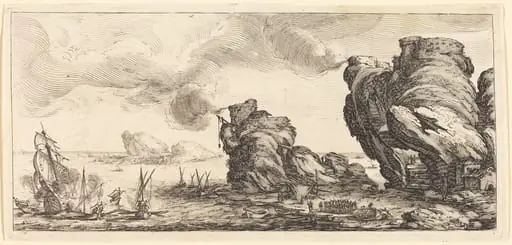
Own this work as a print
Artist & collection

Artist
Joris Hoefnagel or Georg Hoefnagel (1542 – 24 July 1601) was a Flemish painter, printmaker, miniaturist, draftsman and merchant.

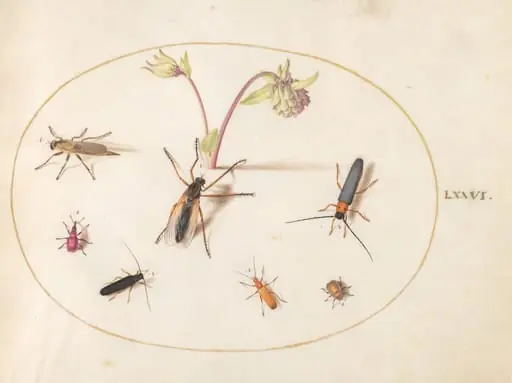 Plate 76: Insects with a Pink and Cream Columbine
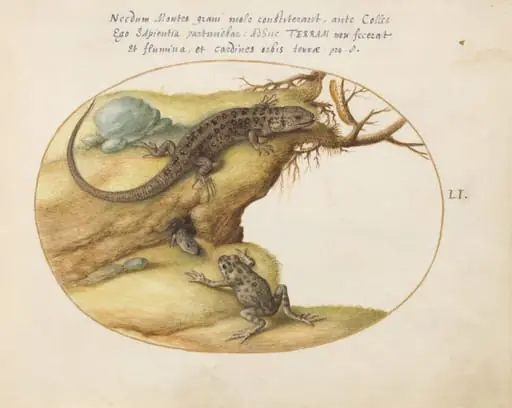 Plate 51: Two Sand Lizards, a Common Parsley Frog(?), and a Caterpillar
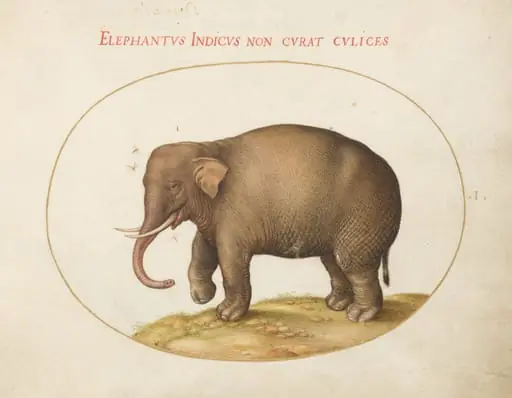 Plate 1: Elephant with Insects
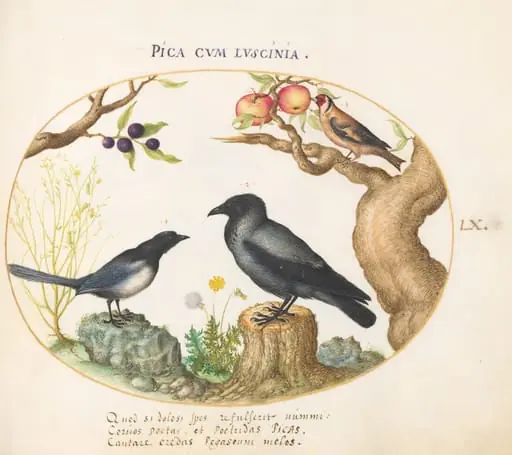 Plate 60: Magpie, Crow, and Goldfinch
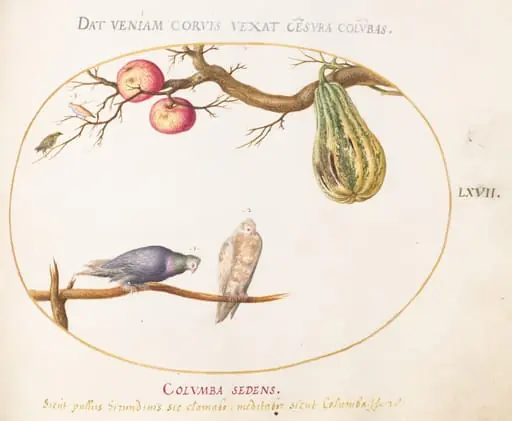 Plate 67: Two Doves beneath a Gourd and Apples
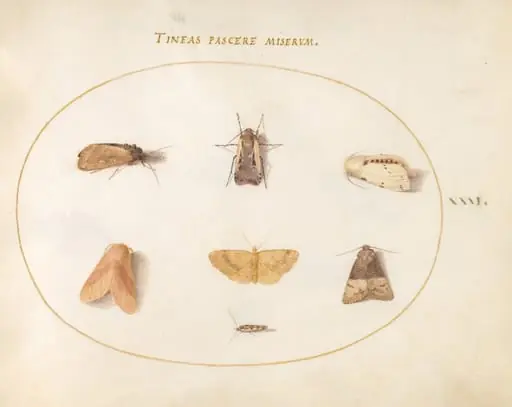 Plate 31: Seven Moths
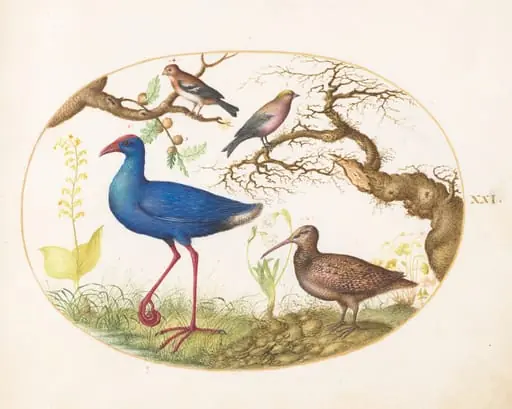 Plate 21: Swamp Hen and Woodcock with a Streaked Rosefinch, a Finch, and Oak Galls
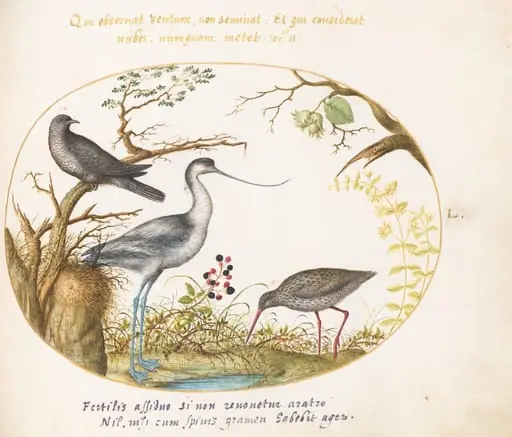 Plate 50: An Avocet with Two Other Birds