Artwork
Plate 55: A Tawny Owl, an Eagle Owl, and Two other Owls
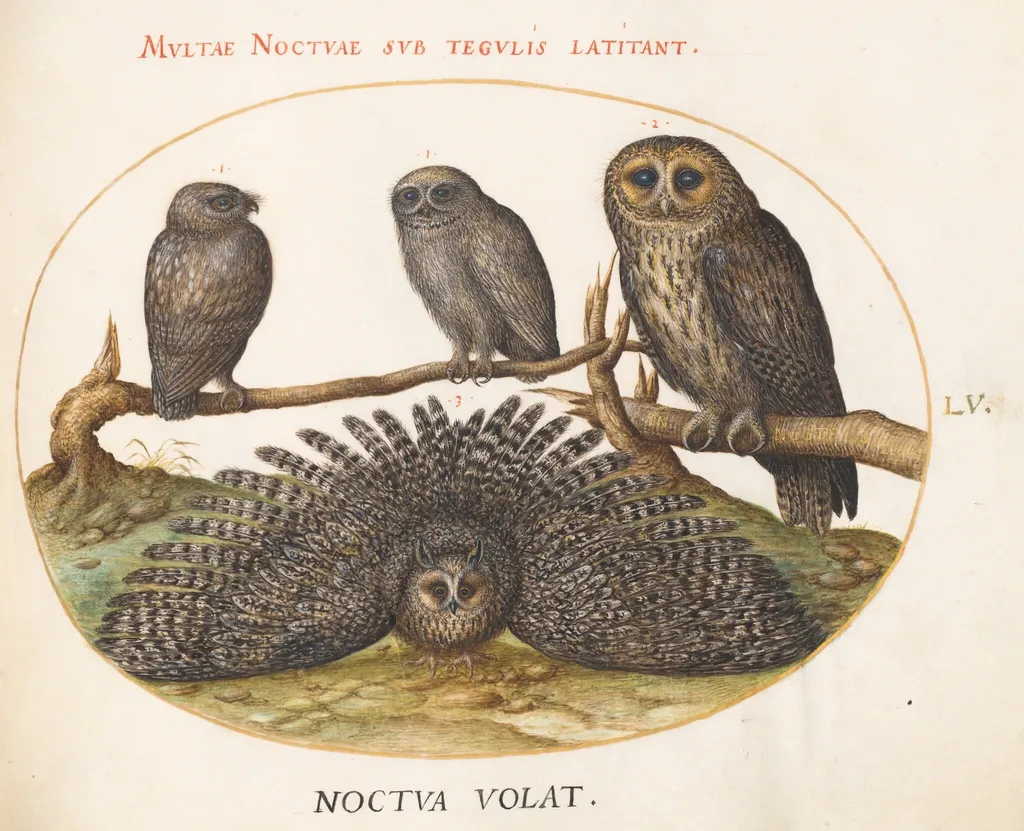
Plate 55: A Tawny Owl, an Eagle Owl, and Two other Owls is a gouache drawing by the Renaissance artist Joris Hoefnagel. It dates from 1594 and is held in the collection of the National Gallery of Art.
- Inscription
- Inscribed:Upper center in red ink: MVLTAE NOCTVAE SVB TEGVLIS LATITANT. (“Many night owls lie hidden under the rooftops.” Gesner, _Historia animalium_ 3:600, 602) (trans. Bass 2019, 198); center right in (gold?): LV.; images of owls in image numbered .1., .2., and .3.; on branch under owl numbered .2. in image, in (gold?): IN NOCTE CO[N]SILIUM (“Counsel in the nighttime.” Erasmus, _Adages_, 2.2.43) (trans. Bass 2019, 199); lower center in black ink: NOCTVA VOLAT. (“The night owl flies.” Erasmus, _Adages_, 1.1.76) (trans. Bass 2019, 198) Facing page: Upper center in black/blue ink: Noctua ut in tumulis, super utq[ue] cadavera bubo. / Talis apud Sophoclem, nostra puella sedet.(“As the night owl perches on tombs and the eagle owl on corpses, so my girl sits with Sophocles.” Alciato, _Emblemata_, 127 and Gesner, _Historia animalium_ 3:233) (trans. Bass 2019, 198); lower center in black ink: Ignavus bubo, dirum mortalibus omen. (“Eagle owl, a fearful omen to mankind.” Ovid, _Metamorphoses_ 5.551 (trans. Bass 2019, 198)
About this work
Overview
Created circa 1594 by the Flemish artist Joris Hoefnagel, this small-scale work combines watercolor and gold paint on a sheet of parchment. It presents a quartet of owls, identified as a tawny owl, an eagle owl, and two additional species, arranged within a circular frame. The composition balances meticulous natural observation with the decorative conventions of manuscript illumination.
Subject & Meaning
The four birds are shown perched and nestled, two atop a slender branch and two crouched within a feathered nest. Their alert eyes and detailed plumage emphasize nocturnal vigilance. Encircling the image, a Latin inscription translates to “Many nocturnal creatures hide under the roof,” reinforcing the theme of hidden night‑life.
Technique & Style
Hoefnagel employed transparent watercolor washes to build subtle tonal layers, then applied fine gold pigment to accentuate feather edges and convey a luminous quality. The delicate glazing technique allows the parchment’s surface to glow, while the restrained background, a faint greenish plane, keeps attention on the birds.
History & Provenance
The drawing belongs to Hoefnagel’s broader output of natural‑history illustration and illuminated manuscripts, produced for a learned audience in late‑sixteenth‑century Northern Europe. It reflects his role in advancing the emerging genre of floral and fauna still‑lifes, though its exact ownership trail before entering modern collections remains undocumented.
Own this work as a print
Artist & collection

Artist
Joris Hoefnagel or Georg Hoefnagel (1542 – 24 July 1601) was a Flemish painter, printmaker, miniaturist, draftsman and merchant.

 Forum Vulcani: The Hot Springs at Pozzuoli
 Plate 76: Insects with a Pink and Cream Columbine
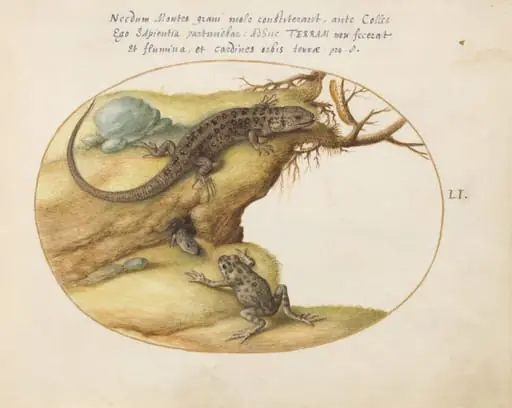 Plate 51: Two Sand Lizards, a Common Parsley Frog(?), and a Caterpillar
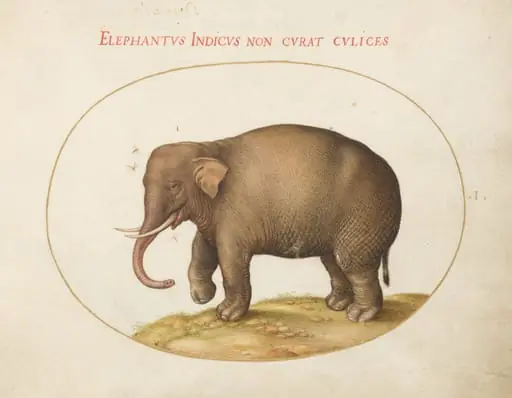 Plate 1: Elephant with Insects
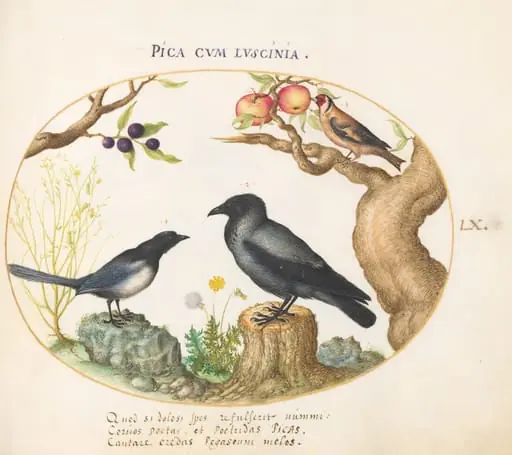 Plate 60: Magpie, Crow, and Goldfinch
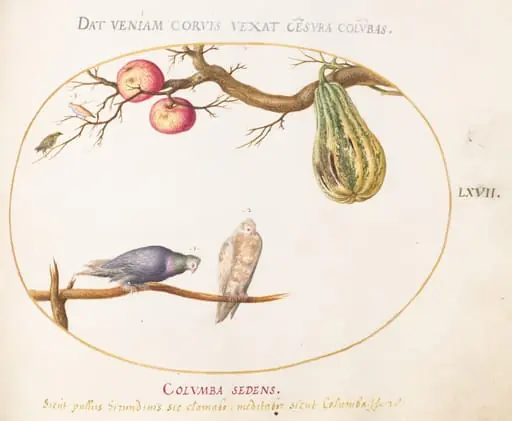 Plate 67: Two Doves beneath a Gourd and Apples
 Plate 31: Seven Moths
 Plate 21: Swamp Hen and Woodcock with a Streaked Rosefinch, a Finch, and Oak Galls
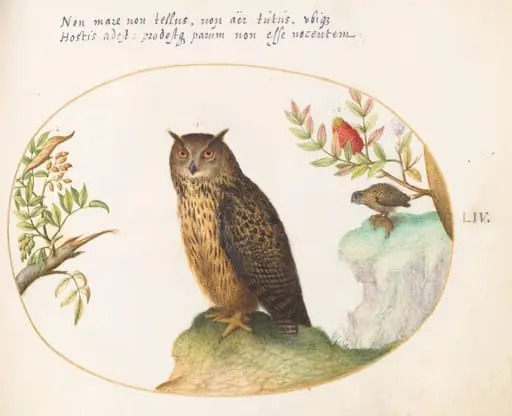
- Plate 54: An Owl, with a Second in the Distance Eating a Rabbit
 Plate 56: Barn Owls with a Mouse, Eagle Owl(?) and Another Owl
 Plate 68: A Ptarmigan, Swallows, and Other Birds
 Plate 16: Gray Heron and Purple Heron(?) with a Sunflower
 Plate 7: Four Birds of Prey on a Wooden Frame
 Plate 6: Four Birds of Prey, Including a Sparrowhawk(?)
 Plate 28: Barnacle Goose with Shrikes and Other Birds
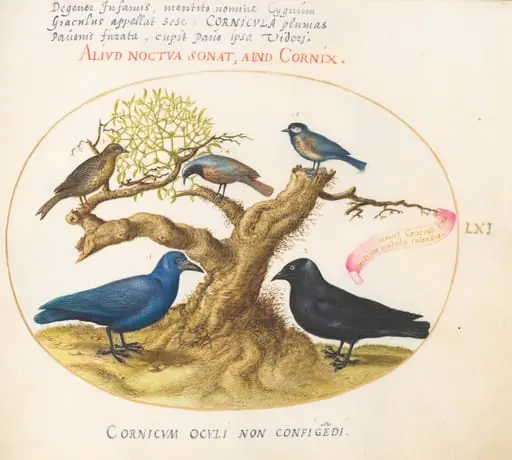 Plate 61: Blue Crow(?), Jackdaw, Chickadee or Tit, and Other Birds
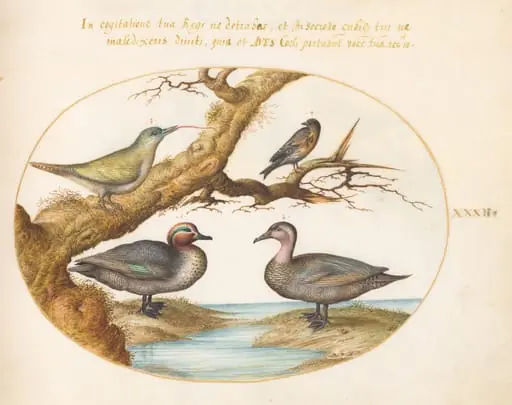 Plate 32: A Green-Winged Teal, a Juvenile Green Woodpecker, and Two Other Birds